Christie Is Busted?

This sure doesn’t look good to me: Christie is photographed yukking it up with David Wildstein and Bill Baroni of the Port Authority three days into the GWB traffic scheme to punish a Democratic mayor for not endorsing him. That follows the governor’s insistence that he could barely remember any serious interaction with Wildstein “for a long time”. That could still be true, depending on your definition of a long time, but it sure looks fishy to me. And it will, I presume, to potential primary voters.

One other bell that rang for me about this the other day. Why, I wondered, was it so important for Christie to get endorsements from Democrats in a campaign he was winning anyway in a landslide? Because it was really part of a presidential primary argument that only he, among the possible contenders, can deal with Democrats! So this was all part of scheming for the presidential nomination and nothing to do with New Jersey at all. Which makes it even more, well, calculated and icky.

Obamacare By The Numbers

Ages Buying Obamacare

Yesterday, the government released detailed data on Obamacare enrollments. Cohn provides the chart seen above:

The figure bound to get most attention is the age breakdown. Insurers rely on premiums from healthier people to offset the costs of people with significant medical bills. And young people are a reasonably good proxy for healthy people—or, at least, as good a proxy as we have right now. According to a recent study by the Kaiser Family Foundation, about 40 percent of the population that could enroll in Obamacare exchange plans are between the ages of 18 and 34. But, according to the government’s new data, only 24 percent of the people signing up for coverage are in that age range. In short, the people who have gotten insurance through the Obamacare marketplaces so far are significantly older than the people who could, in theory, be buying insurance from them.

But is that really a big deal? In Massachusetts, according to analysis from MIT economist (and Obamacare architect) Jonathan Gruber, younger people tended to sign up later.

Philip Klein pushes back:

Though there’s a plausible case to be made that younger Americans will wait until later to sign up, the administration is still in a deep hole. Because the current number of young adult signups is significantly less than 40 percent, to make up ground, signups in the coming months will have to be significantly higher than 40 percent.

As an example, let’s just say all of the roughly 2.2 million Americans whom HHS says have signed up for insurance pay their premiums and complete enrollment, and the total paid enrollment number through March ends up being 5 million people. To meet the original demographic goal, about 1.4 million of the remaining 2.8 million enrollees — or roughly half — would have to be between the ages of 18 and 34.

Sarah Kliff digs deeper into the numbers:

Even more important than these top-line numbers is what’s happening in each state. Insurance rates are set on a state-by-state basis, so even if thousands of young people are signing up in California, it doesn’t effect the premiums in neighboring Nevada.

The new Health and Human Services report does show some variation by state, although most exchanges tend to hover somewhere in the 20-percent range. In the District of Columbia, 44 percent of enrollees are young adults, the highest for any exchange (and remember: This is just the individual marketplace, not the small business exchange where Congressional staff shop). Arizona and West Virginia have the lowest rates of young adult sign-ups, who make up 17 percent of their marketplace.

Avik Roy considers what happens if the exchanges skew older:

As Philip Klein notes, a recent article by Larry Levitt, Gary Claxton, and Anthony Damico of the Kaiser Family Foundation described an enrollment of 25 percent among 18-34 year olds as a “worst-case scenario,” estimating that insurers would lose money on these plans, because “overall costs…would be about 2.4% higher than premium revenues.” 2.4 percent may seem like a small number, but given that the average insurer has profit margins of 4 to 6 percent, a 2.4 loss on premiums—before we even count overhead costs—is a serious problem. It’s why Humana reported to the Securities and Exchange Commission that it expected meaningful losses in its exchange-based plans.

McArdle looks at the percentage of enrollees receiving subsidies:

Five million people were deemed eligible to buy a policy on the exchanges; 2.7 million, or 54 percent of them, were eligible for subsidies. But of people who actually selected a plan, 1.68 million, or 80 percent, were subsidized. To put it another way, 62 percent of the people eligible for subsidies selected a plan, but only 8.5 percent of those who weren’t eligible for subsidies actually purchased one. That is very different from the information we were getting in December, when most of the people who selected plans were not eligible for subsidies. … This is much closer to what the Congressional Budget Office was projecting, in terms of subsidized enrollment; it had predicted that about 85 percent of the people on the exchanges would get subsidies. So in one sense, it’s not novel. But it does show enrollment looking a lot more like the wonks had been projecting, and that’s important. The next step for the administration is to get the mix of young and healthy people more in line with initial forecasts.

Sprung looks on the bright side:

Signup rates are impressive in many large states in which Republican governors and legislatures have worked actively to undercut the law. On 12/28, the open enrollment period (Oct. 1 – Mar. 31) was just shy of half over — and signups were miniscule through the first week of December. Any state that had reached more than say one third of the CBO projection for first-year exchange signups might be deemed more or less on course. Major non-cooperating states that passed that threshold (as tracked by Charles Gaba’s invaluable spreadsheet)include Florida (33% of CBO projection, 158.0k signups), Michigan (47%, 75.5k), New Jersey (36%, 34.7k), North Carolina ((56%, 107.7k), Pennsylvania (39%, 81.3k), Virginia (35%, 44.6k) and Wisconsin (52%, 40.7k).

More good news: only about 20% of those choosing plans on the exchanges have opted for the cheapest bronze plans, where deductibles average $5,000 per person. Benefits are benchmarked to the second cheapest silver plan in each state, and subsidies that reduce deductibles. and maximum out-of-pocket costs, offered to buyers with incomes below 200% of the federal poverty level, are only available to silver plan buyers. Further, 79% of those who have enrolled in plans thus far have qualified for subsidies. Put those numbers together and it appears that most exchange buyers thus far may indeed find their coverage and care affordable.

Democrats For War With Iran

The Senate is full of them. The list of Democratic Senators who favor a march to war with Iran rather than allowing the current negotiations to proceed unhindered is here. I note a few remarkable members of the war chorus: Michael Bennet of Colorado – a key Obama supporter; Cory Booker of New Jersey (ditto); Mark Warner of Virginia; Richard Blumenthal of Connecticut; Ben Cardin of Maryland; and, of course, Chuck Schumer of New York. All of these Democrats are in favor of humiliating the president of the United States and refusing to allow him to pursue negotiations without being trumped by deliberate, pre-meditated sabotage.

I wonder how many of their Democratic constituents really want them to sabotage their own president’s negotiations to avoid what would otherwise be a relentless march toward another war in the Middle East? Do these Democrats seriously want war as the only option with Iran’s newly emergent moderate government? Do they want to do to Obama what no Republicans did with Reagan over his rapprochement with the Soviet Union? Do they really want to sabotage a negotiation years in the making, created by crippling sanctions, and now possibly about to bear fruit? Why on earth can they not wait until the final deal is done, if it is?

The View From Your Window Contest: Winner #187

vfyw_1-11

A reader writes:

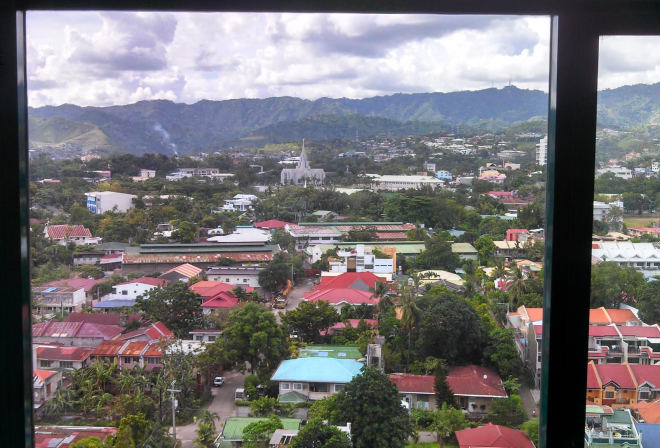
Okay, if that ain’t the angel Moroni on top of that spire in the distance, sitting on top of a structure looking very much like a Mormon temple, then I don’t know what that could possibly be.  The surrounding area looks a lot like San Jose, Costa Rica, but given that the temple in that city doesn’t look anything like the one in this picture (according to the LDS website), I’m going with Tegucigalpa, Honduras, looking south towards the temple from the Colonia Ciudad Neuva, off Calle de Los Alcaldes.

Another:

The LDS temple is first big hint. The church is growing/recruiting heavily in the South Pacific. Quick search of LDS temples in this region returns Apia, Samoa as a pretty close match. Not that many tall buildings in Apia, so perhaps the photo was taken from one of the hotels on the water.

Another Samoa entry:

This LDS temple looks closest.  So I’ll guess that the photo was taken from the Tanoa Tusitala Hotel at Beach Road, Sogi, Apia, Samoa, 7th floor.

Another reader:

I’m a low achiever with these contests. I basically just ask myself, “Does that look like Brazil? No? Well then, who knows.” But this was one of the ones that did look like Brazil, in particular, southern Brazil, and I even noticed that, hey, that’s a Mormon temple! So I googled for a minute or two and decided Curitiba, Brazil. Good enough for this week.

Another:

Mountains in the background and a Mormon temple a few blocks away?  Provo, Utah, OBVIOUSLY (they must be having a mild winter).  Try to make it difficult next time!

Another continent:

This is Kiev, Ukraine, looking toward the newly constructed Mormon temple.  Angel Moroni clad in gold on the spire is a dead giveaway.

Another:

Though I’ve never seen any photos of the city before, it took me two minutes to determine it is a view of Accra, Ghana. A Mormon Temple in a non-US tropic setting is a huge clue, needing only a cross reference to an LDS temple photo site. Pinpointing the window’s location is a little harder. I’ve decided that it is a view east looking toward the rear of the Temple from the area of the Accra High School, probably the Alisa Hotel North Ridge 3rd or 4th floor which I see is between the school and the temple on Google Maps. I can’t get more exact than that.

Another gets a tad frustrated:

It’s official. I hate you.

I spotted this one and thought, “This’ll be a snap. I won’t win, of course, because I won’t create a map with animated arrows and GPS coordinates and a story of how I recovered from dengue fever in a room on the floor below.  But at least I will have the satisfaction of getting the location right.”

Why did I think it would be an easy one?  The Mormon temple.  Having been married in one (the first time), it popped right out at me.  Mormon temple, tropical setting in developing country … how many can there be?  Too many as it turns out.  I went to www.ldschurchtemples.com and looked at photos of every temple they have that was even a remote possibility.  Wasn’t as easy as I thought.  Looked at every damn tropical spire where Moroni would be sweating in the tropical sun and NONE appeared to be a match.

Hence my hate – enticing me to waste two hours looking at pictures and Google Earth and getting basically nowhere.  You’re an awful man.

Guayaqui, Ecuador seemed the closest.  But I don’t think it’s right. Fuck.

Another:

I used the helpful LDS world map to figure out where this might be. The closest match to me looked like Cochabamba, Bolivia, possibly taken from the Instituto Americano. The map is an interesting look at where the Mormons have been more (or less) successful. Africa only features three active temples, for example, while Oceania has 10 and South America 15 (with 7 under construction). Asia only has 9 temples, with none in China (unless you count Taiwan) or India. Anyway, if I’m not right, I know more now about the Mormon global presence that I normally would have, and those kind of random learnings are what I enjoy the most about the VFYW contest.

Another nails the right city:

OK, I have enjoyed this contest for years and continue to be amazed at how your readers meet the weekly challenge. First clue in the Jan 11, 2014, image is the greenery. No Polar Vortex. Second, the white spire in the center of the image. It looked similar to the LDS temple I have seen here in Albuquerque. The Google search “white Mormon temple” brings up the church’s locator map, which kindly furnishes an image for each existing temple. From there, it is deduction. Not South America, not Central America, not Mexico, and not the Caribbean.  A journey to Asia puts us in the Philippines, and … Oh, hello, Cebu City.

Next, it’s a matter of locating the rooftops and streets on the Google Map satellite image. The image is taken from a high vantage point, and the websites for the area budget hotels didn’t appear to have the same window frame as the one in the contest image. So, guessing on the exact location, I wager it is the Waterfront Cebu City Hotel & Casino, from the, um, lucky 7th floor.

Mormons and gambling. Nice one.

Another:

After a couple weeks of near-impossible ones, this was a nice reprieve. The Mormon temple in the middle was the dead giveaway. I did my undergrad at UCLA and there’s a Mormon temple in West LA that looks strikingly similar in style. The scenery screamed Asia to me, so on a hunch I googled “Mormon temple Philippines” and voila, our beautiful temple showed up:
unnamed

I’ll bet I’m not the only one who made the Mormon connection, so something tells me you’re gonna have a host of correct answers this week!

About 200 in fact. Another Cebu City entry:

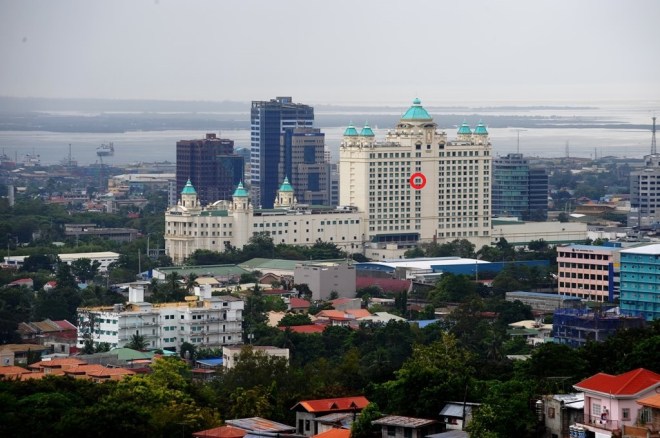
That view of the lovely church just screamed out to me, “Mormon Temple!” perhaps because just a few days ago I saw the raucous (and highly offensive – in a good way) “The Book of Mormon” in San Francisco. And the tropical feel of the surroundings led me in just a few clicks to the Mormon Temple in Cebu City, Philippines, which can be seen clearly from the Waterfront Cebu City Hotel and Casino. A similar photo was posted on Trip Advisor by someone staying in room 803 last August:

Waterfront_Cebu_City_Hotel___Casino_-_Hotel_Reviews_-_TripAdvisor

Based on the perspective from that room, I’m guessing the VFYW hotel room was on a higher floor and to the north, so I’m guessing Room 1127 of the Waterfront Cebu City Hotel.

Another:

I’ve never been any good at solving these VFYW locations, but the scenery looked vaguely like some of the towns I used to travel to when I lived in the Philippines as a child. We’re talking 35 years ago, so my memory is very fuzzy, where to begin? The church in the background didn’t look familiar to me, but with so many beautiful churches across the country, I thought a Google image search might yield something. Nada. Upon closer inspection of the photo, I thought the building looked more like something the LDS church would build, so I googled “LDS temple Philippines”, and found several photos of an LDS temple in Cebu City that looked like it could be a match:

mormon-temple-Cebu-Philippines1

I actually visited Cebu City in 1979, but as you might have guessed this temple hadn’t been built. Apparently the temple was completed in 2010. With the address in hand (Gorordo Avenue Barangay Lahug 6000, Cebu City, Central Visayas, Philippines) it was on to Google Earth, where I see a hotel just a mile or so southeast of the temple. I believe the photo was taken at this location, The Waterfront Hotel, 1 Salinas Drive Lahug,, Cebu City, Cebu, Cebu, 6000, Philippines. My best guess is the photo was taken from a guest room on the eighth floor or above.

Win or lose, it was fun to take this little trip down memory lane. Thanks!

A visual entry:

Cebu map

Only one reader guessed the exact room number, and his entry was short and sweet:

Window is in the Waterfront Cebu City Hotel in 1 Salinas Drive Lahug Cebu City, Philippines. Nice view of the LDS Temple. Just guessing the room #1417.

Great guess! From the submitter:

I’m in Cebu City, Philippines for my brother’s wedding tomorrow. This view is from the 14th floor (room 1417) of the Waterfront Hotel and Casino City Center, looking west towards the mountainous interior of the island. It’s my first time in this country and seeing the widespread poverty surrounding the pockets of wealth is shocking.  Cebu City is the “headquarters” of typhoon relief, with an international airport able to handle cargo planes and relief workers (and John Kerry – insert joke about his ego). My flight on Monday had a group of workers from Hungary. Oh, and the city was affected by the earthquake a few months ago, too.

By the way, here’s the entry from Chini, who basically has a permanent place in the contest at this point:

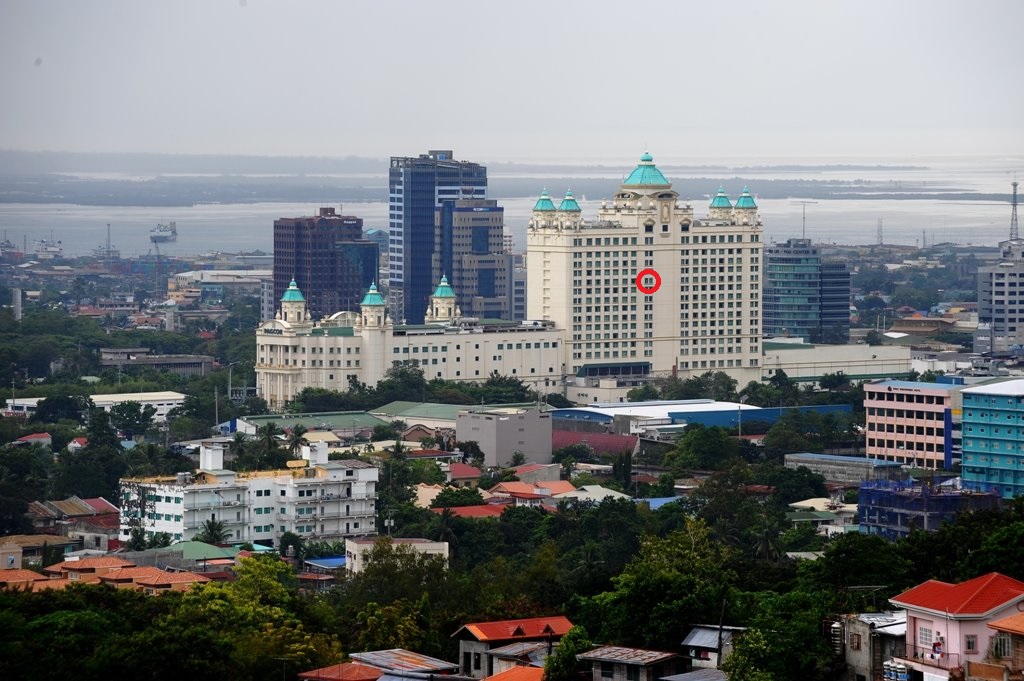
The last time the VFYW contest was in the Philippines (VFYW #153), it was an absolutely brutal challenge to find the right spot. But this one was far easier, thanks mostly to the Mormon temple sitting smack dab in the middle of the frame. This week’s view comes from Cebu City. The picture was taken from the Waterfront Cebu City Hotel and Casino from, let’s say, the 12th floor. The view looks west north west along a heading of 296.5 degrees. A marked overhead view and a pic of the possible window are attached:
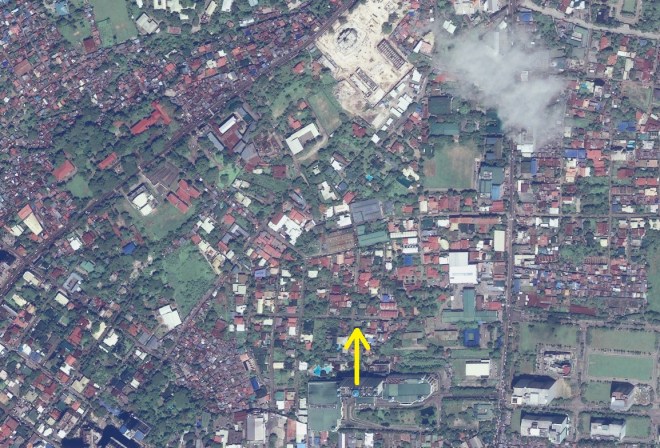
VFYW Cebu City Overhead Marked - Copy

(Archive)

Torturing The Mentally Ill

Reporting on the shocking treatment of mentally ill inmates in South Carolina’s prisons, Andrew Cohen asks why the state has refused to do anything about it:

On Wednesday, in one of the most wrenching opinions you will ever read, a state judge in Columbia ruled that South Carolina prison officials were culpable of pervasive, systemic, unremitting violations of the state’s constitution by abusing and neglecting mentally ill inmates. The judge, Michael Baxley, a decorated former legislator, called it the “most troubling” case he ever had seen and I cannot disagree. Read the ruling. It’s heartbreaking. The evidence is now sadly familiar to anyone who follows these cases: South Carolina today mistreats these ill people without any evident traces of remorse.  Even though there are few disputed material issues of law or fact in the case, even though the judge implored the state to take responsibility for its conduct, South Carolina declared before the sun had set Wednesday that it would appeal the ruling—and thus likely doom the inmates to years more abuse and neglect. That’s not just “deliberate indifference,” the applicable legal standard in these prison abuse cases. That is immoral.

But what makes this ruling different from all the rest—and why it deserves to become a topic of national conversation—is the emphasis Judge Baxley placed upon the failure of the good people of South Carolina to remedy what they have known was terribly wrong since at least 2000.

Nicole Flatow examines the horrors the inmates suffered:

Jerome Laudman, a schizophrenic, intellectually disabled inmate in South Carolina, was placed in solitary confinement, although he was neither aggressive nor threatening. During his transfer to the “Lee Supermax” facility, he was sprayed with chemical munitions and physically abused by a correctional officer. Although the transfer should have been recorded, the videotape turned up blank. While Laudman was confined naked in his cell, officers observed that Laudman had stopped eating and taking his medication, and appeared sick and weak. They did not report it. A week later, he was found laying in his own feces with 15-20 trays of molding food in his cell, vomiting. Nurses and an officer refused to retrieve his body. When two inmates were eventually sent to remove him, he was transferred unconscious to a hospital, where he died of a heart-attack. …

Other plaintiffs in the case were held naked in restraint chairs for hours at a time without treatment of their injuries, left to urinate in place and forced to stay in a painful “crucifix” position for hours. In one instance, blood pooled beneath an inmate held in a restraint; in another, an inmate’s intestine was protruding from his abdomen as officers tightened restraints surrounding the wound. One inmate was restrained with his arms in a twisted position, soaked in water, and then left outside on a December night.

A Franciscan Era?

The Dish is thrilled that a new online site has been formed to explore and examine the lives, minds and bodies of animals, and our relationship with them. It’s called “The Dodo” and it’s edited by the extremely talented Kerry Lauerman, formerly of Salon.

dish_fotdsun12Dish-readers know that this is an area we’ve been covering more and more – particularly as neuroscience and research in general is slowly breaking down the absolute boundaries between the human animal and our cohabitants on this planet, and as our manic compulsion toward greater material comfort leads to the transformation of our climate and seals the fate of so many species. I have to say I don’t regard this as some kind of side-issue in politics and culture. I think it’s in the vanguard of our moral evolution as a species.

Some introductory stories from the Dodo: Do Dogs Tilt Their Heads When Confused? And As Blackfish Soars, Will SeaWorld Sink?

It’s easy in the age of Upworthy to think the web cannot provide new, smart, engaging content which isn’t just linkbait or page-view whoring or social media p.r. The Dodo proves them wrong. Good luck, guys. We’ll be reading and linking.

(Photo: Tri Joko, photo-shopped)

Malkin Award Nominee

“That was [governor Cuomo’s] anti-gun legislation, which he had promised not to do, but then he had a little convenient massacre that went on in Newtown, Conn., and all of a sudden there was an opportunity for him,” – New York Post columnist Fredric Dicker, on his WGDJ talk-show in Albany, yesterday.

Quotes For The Day

“I am optimistic over the future. This is a first step to overcome extremism in both our countries,” – Heshmatollah Falahatpisheh, a former conservative member of Parliament who teaches political science at Tehran University.

“It just stands to reason if you close the diplomatic option, you’re left with a difficult choice of waiting to see if sanctions cause Iran to capitulate, which we don’t think will happen, or considering military action,” – Benjamin J. Rhodes, a deputy national security adviser to president Obama.

Despite a real breakthrough in negotiations with six world powers, despite a future option to reimpose sanctions if Iran fails to live up to its obligations in a final deal, there are now 59 votes in the Senate and a large majority in the House attempting to poison-pill the negotiations with threats of new sanctions while negotiations continue. 59! That includes a big tranche of Democrats. Where, one wonders, are the Democratic voices loudly supporting the best chance to avoid another war in the Middle East? Or the sane Republican ones?

We’re about to see who actually controls American foreign policy – a duly elected president or a lobby group.

Lena Dunham’s Skin In The Game

Girls Nudity

Last week, ahead of the Season 3 premiere of Girls, TV critic Tim Molloy asked Dunham why she does so many nude scenes. Molloy:

I don’t get the purpose of all the nudity on the show. By you particularly. I feel like I’m walking into a trap where you say no one complains about the nudity on ‘Game of Thrones,’ but I get why they’re doing it. They’re doing it to be salacious. To titillate people. And your character is often naked at random times for no reason.

Amanda Hess fires back:

Asking why Dunham regularly appears naked in the show was a legitimate question—in 2012. Dunham’s many answers on the topic—that pantlessness is inherently comedic, that showing average-sized women’s bodies in the media is so rare that it constitutes a radical act, and that the outsized attention and criticism she’s received for it wouldn’t be placed on a naked actress with “tiny thighs”—have demonstrated that there are copious and pointed reasons justifying the choice. For Molloy to approach the question from a place of total obliviousness to that discussion makes his statement not only lazy and dated, but ignorant.

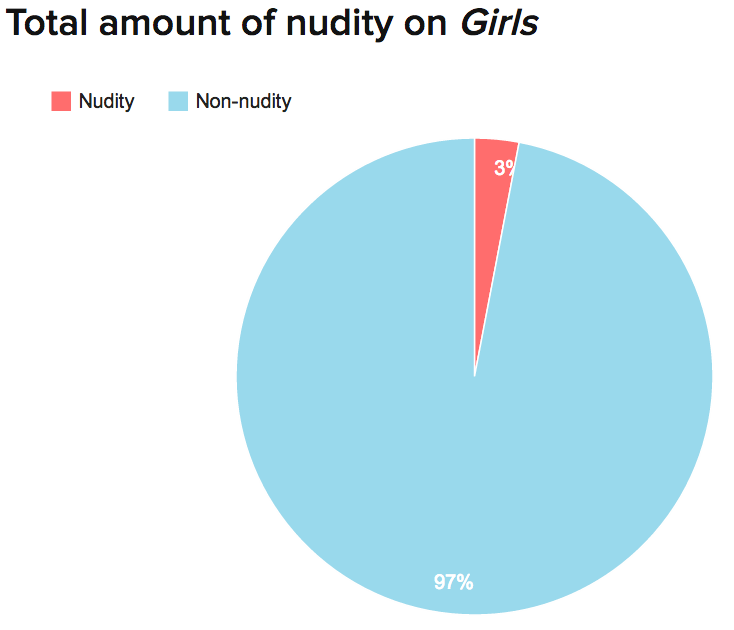
Louis Peitzman, who created the above chart, argues that “show is, by and large, less explicit than True Blood or Game of Thrones“:

Hannah is a full-figured woman, and while she looks a lot like the majority of people in this country, she is not the stick-thin, big-chested woman who often populate our TV screens. Because she deviates from the norm in that way, Hannah stands out. She seems, to some, gratuitously naked, even if she’s only naked for a very small percentage of Girls.

That’s why questions like Tim Molloy’s are met with such indignation. Whether or not his intention was misogynistic or a means of body policing — and I’ll give him the benefit of the doubt that it wasn’t — that is the connotation the question carries. It’s not about the nudity itself, which is nowhere near constant, but rather how it makes the viewer feel. And in this case, that feeling of “wrongness” is inextricably tied to Dunham’s body, making her defensiveness all the more valid.

So while Girls may indeed be too sexually explicit for some, the nudity question doesn’t merit the kind of serious response Molloy may have been looking for. The characters simply aren’t naked all the time, and when they are, it’s because Girls, as Dunham put it, is “a realistic expression of what it’s like to be alive.”

Emily Shire also defends Dunham:

Although I do find nudity gratuitous sometimes, Girls‘ use of it, especially Dunham’s, feels natural. Guess what? We sometimes walk around our apartments naked. When we pee or have sex, at the very least the important parts have to be naked for it to work, and if we’re hanging out with people who have already seen us naked, we may stay nakedish, as Dunham’s Hanna Horvath did during a much maligned ping pong scene in season two’s “One Man’s Trash.”

So, one answer to Molloy’s question about why Dunham is naked if not for the purpose of being sexually arousing is because the show is committed to a certain realism. And as Apatow later stated, “I have people naked when they’re willing to do it.” Not all the actresses on Girls are willing to be naked, but when they are, the show uses nudity to bring that extra touch of reality to their interactions.

Megan Gibson adds:

Girls is peppered with moments that are funny and poignant and Dunham often uses nudity, her own and her casts’, to emphasize these moments. Sure, not every viewer enjoys it, but then again not everyone likes the provocative nudity on Game of Thrones. But what’s really troubling is not the amount of skin that appears on either  show, but the reaction to it. For anyone who thinks that female nudity should solely be about titillation — and are subsequently confused or even angry when that’s not the case — has a disturbing view of women’s place onscreen. And if Dunham and Girls helps shift that view, I say bring on the nude scenes.

The Caudillo Of Cairo

As General Abdel Fattah Al-Sisi signals that he plans to seek the Egyptian presidency, Shadi Hamid compares his dictatorial style with that of Mubarak:

Mubarak was your run-of-the-mill autocrat, intent on restricting dissent, but also willing to tolerate a degree of opposition. He had no particular ideology except the preservation of power and, in his latter years, the accumulation of wealth. Sissi evinces no such modesty, hearkening back to the caudillos of Latin America with his populist paternalism. He is a compelling orator, comfortable speaking extemporaneously and with seeming conviction. Just weeks after his rise to power, Sissi, on state television, called for mass rallies to “authorize” him to do what was necessary in the fight against “terrorists.” A personality cult has grown accordingly, with Sissi-themed cupcakes and chocolates and even women’s nightwear featuring the general himself in dark sunglasses. …

Previously coy about his intentions, General Sissi appears to have made a decision. He has been driven by both personal ambition (a voice reportedly told him in a dream: “We will grant you what no one has had before”) and mounting public pressure. One pro-Sissi group filed a lawsuit in an attempt to “force” Sissi to run. Another pro-Sissi group, claiming 12 million signatures in support, would prefer to skip the formality of elections altogether.

Totten expects no good news from Egypt anytime soon:

The idea that Sisi would ever “restore” the democracy that went “off track” with Morsi, as so many activists claimed when he seized power, was always delusional. Egypt had no democracy to begin with. (A single election does not a democracy make.) Nor does the Egyptian military have a democratic cell in its corpus. Egypt’s choice is the same now as it has been for decades: Islamic theocracy or military dictatorship. It can’t be sustainably settled at the ballot box, so it will be fought over instead in the streets.

Peter Oborne looks glumly at this week’s constitutional referendum:

In no way can the referendum be called democratic. There are thousands of posters urging Egyptians to vote yes, but on my visit to Cairo last week I did not witness a single one urging them to vote no. The reason for this emerges from a very worrying report from Human Rights Watch out today. Campaigners against the constitution are being arrested and charged with “attempting to overthrow the regime”. The main opposition party, the Muslim Brotherhood, has been declared (on no evidence) a terrorist organisation. There are reports today that the political party Strong Egypt, which claims to be liberal, has been forced to suspend its no campaign because of the recent arrests. Meanwhile, General Sisi says that a successful vote this week will license him to run for the presidency in a poll later this year. This is very sinister. As Bruce Riedel powerfully points out here, the coup d’état which restored military rule in Egypt is being seen by al Qaeda as validation of their murderous ideology.