Monogamy: Gay Men, Lesbians, And Straights, Ctd

Shauna Miller sounds off on Hanna Rosin’s post on gay monogamy, focusing on the lesbian phenomenon of “‘U-Hauling’ – packing up and moving in together after knowing each other for just three months”:

I can only speak for my own observations about gay women, but I do agree with Rosin’s assertion that the current crop of young gays–women included–are freer with casual relationships and even the idea of responsible, respectful polyamory. Janet Hardy’s The Ethical Slut came out in 1997, and by the time we were in college we were fluent in Dan Savage, being GGG, and the idea of monogamishness. The generation now in their twenties is even more attuned to this. There are certainly inspiring, committed poly relationships in my circles.

With everything changing over the past decade (and few weeks), maybe the future model for lesbian families will look different. Maybe it will be a mom, mama and kids. Or two moms and a donor dad. Or an intentional family of several partners. At the same time, more lesbian couples than ever are raising kids together. I’ve been to approximately 607 lesbian weddings over the past three years. I know a LOT now about where to find quality sperm. There is something to be said–and Mundy said it well–about the wisdom gay women have to offer straight couples in terms of what works in a marriage. Now that we have a few more rights in terms of marriage ourselves, perhaps we will slow down on trying to get there so fast.

More Dish on gays and monogamy here, here, here, and here.

Short And Sweet

Sam Lipsyte lauds short stories:

Many of my greatest moments as a reader have come with short stories. Raymond Carver, Robert Coover, Chekhov, Kafka, Katherine Mansfield, Roberto Bolano, Borges, Barry Hannah, Gordon Lish, Christine Schutt, Joy Williams, Ann Beattie, Lydia Davis, George Saunders, Leonard Michaels, Donald Barthelme were all major revelations for me. I still recall reading many of their stories as distinct episodes of a nearly manic euphoria. I’ve had the same experiences with novels, of course, but perhaps fewer. Your heart breaks when even the best novel sags a tiny bit, as they all must, sort of like the give in bridge suspension. A great short story is more like a stiff plank across a narrow but bottomless crevasse. The plank will hold. But that doesn’t mean you are not in danger of freaking out and falling off.

I love writing novels and short stories, and though I started with short stories, I never thought of them as stepping stones to novels. I consider them a rich and vital artform. They are harder, really. They demand the rigor of poems. They are also a good way to start writing, because you can work on one and recognise its failure and throw it away, start another one. And years haven’t gone by. I teach writing and many students don’t even want to bother with stories. They are all at work on the novel that will deliver them riches and fame within a year or two of graduation. It will happen for one or two of them. But the rest will wish they’d played more, experimented more, hit a dozen different walls, found fresh ways to tell stories and learned about the beauty of language under pressure in the bargain.

(Hat tip: Tandeta)

Now We Should Add FA To LGBT? Ctd

A reader writes:

This is ridiculous. I am a mildly overweight person. I am 5’10 and about 190 lbs. My BMI is about 27. I could stand to lose about 15-20 pounds. I am the only person in my extended family who is not obese. I have obesity on both sides for generations. Morbid obesity.

Why am I the only member of my family who is not obese? Because I am the only member of my family who walks 15 miles a week. And runs 20 miles a week. And works out several times a week with weights. And eats carefully.

I do all that and I’m still about 20 pounds overweight. So I get that genetics has a lot to do with it. I would have to starve to be truly normal weight. But barring injuries that prevent people from being physically active, no one has to be morbidly obese. You just have to do what you have to do.

In my case, I have to run like hell to maintain my body weight at simply “overweight”. I have family history of hypertension, obesity, diabetes – you name it. But I don’t have any of those things. Because I work incredibly hard at not having them.

I don’t hate, or discriminate, against people for being overweight. I love my family and I know how hard it is to stay even reasonably trim, because I have to do it. But the fact is, if you don’t want to be fat, and your legs work, you don’t have to be.

Another is even more blunt:

I am fat.

I have lost 25 pounds since April 1 and I still, according to all the charts, have about 50 to lose before my BMI becomes the high end of normal. I have lost this weight by working out six days a week, watching every calorie and all but eliminating soda and alcohol. The next 25 pounds will be harder and the final 25 pounds will be the hardest yet.

This is genetics. My mother was 5 feet tall and 215 pounds and died two years ago of heart and diabetes issues. My maternal grandmother died at 55 of diabetes. Two maternal uncles, massively obese men, died before their 50th birthdays of heart attacks. I will turn 42 later this month.

This is difficult. I’ve yo-yoed in the past. I could yo-yo again. But here’s the difference: It is physically possible for me to make a massive lifestyle change and lose weight. Unless you are willing to argue that a gay person, through Herculean effort and willpower, can NOT be gay.

I am working too hard to be put into a group where someone else – my ancestors – takes the blame. Fuck you. I am fat and I’m going to not be fat.

To all the fat people out there: Work harder. There are too many people out there who are like what I used to do – donuts for breakfast; pizza buffet for lunch and McDonald’s for dinner. Figure it out. And stop expecting Fat Acceptance. Support? Yes. Encouragement? Yes. Education? Yes.

But never acceptance.

Update from a reader:

I don’t think “FA” is an ideal fit with LGBT, but geez … I’m rolling my eyes pretty hard at the “suck it up, fat people” direction this thread has gone. Yeah, I’m fat too. About 40 lbs more than I should but 60 lbs less than I weighed two years ago. An uncomfortable balancing point between being pretty proud of myself for the work I’ve done but also beating myself up every day that I don’t have the time or will to push for that last 40 yet. And you know what? I don’t need other people, fat or thin, thinking it’s OK to excoriate me for my failure to achieve this!

The poor: suck it up and get a better job!

Addicts: suck it up and kick the habit!

Blacks: suck it up, the Civil War was 150 years ago!

Gays: suck it up – my fancy book says you are an abomination!

So fucking lazy, this argument. Even lazier than my 40 lb overweight fat ass.

Life is a struggle for everyone. We are all in a mind-numbingly difficult spiral of self-improvement and defeat. It’s about treating people with dignity. Is having formal recognition of this a step too far? I don’t know. Have I felt harassed and lessened my entire life for being “fat” even when I was in no danger of poor health but was merely “fat” by beauty standard norms? A bit.

Deep breaths.

I wonder if people offended by the concept of a formalized “fat acceptance” movement would otherwise agree with the assertion that all people should be treated with dignity across race, class, gender, religion, sexuality, AND appearance. I certainly don’t want people’s tastes to be policed. I may be less than perfect for my inability to fully “suck it up” but I’m certainly not less a person.

A Review Of Your Windows

Screen Shot 2013-07-07 at 11.17.33 PM

Jay Pinho – who tracked the Dish’s use of read-ons following independence – turns his analytical eye to the VFYW feature:

The Dish’s View From Your Window posts have been going on for years (since May 22, 2006, in fact), long before the start of the weekly contest. (As of April this year, The Dish had published over 2,700 VFYW photos.) But quite frankly, I had neither the time nor the stamina to log every single View From Your Window throughout The Dish‘s history. (I’m certain there’s some non-manual way to do this via page-scraping or something, but I haven’t figured that out yet.) And anyway, the 1,228 posts I recorded between June 9, 2010 [when the VFYW contest launched] and May 25, 2013 — a period during which The Dish itself was hosted on three separate sites: The Atlantic, The Daily Beast, and now independently via WordPress – seemed like a large enough sample size to provide a solid idea of VFYW trends.

As far as I know, this is the first-ever long-term study of the View From Your Window feature. The closest (and much cooler) cousin to this concept that I’ve seen is Llewellyn Hinkes-Jones’ View From Your Window game, in which — with a limited number of guesses available — the contestant must click on the correct sector of a map, as the view zooms in ever closer before finally zeroing in on the location of the photo. But as far as I know, no statistical study of VFYW has ever been conducted. (Cue the drum roll…”until now.”)

Going back through the archives was more fun than it sounds.

(That said, the old military axiom — “It’s 99% boredom punctuated by 1% of sheer terror” — roughly applies here too, although terror should be replaced by something more pedestrian. “Pleasant surprise,” maybe?) Although most daily posts simply contained a photo and a caption listing the city and country, occasionally I’d run across some tearjerking post about a reader’s brother succumbing to his injuries in a hospital from which a VFYW photo was taken, or an admonition from another watchful reader not to include photo EXIF data in the weekly contest. (My personal favorite? My girlfriend’s submission from Alaska while clerking there last year, of course.)

The coincidences, too, were startling — none more so than the case of the reader who responded to the weekly contest by noting that he was sitting, by happenstance, in the very same room where the contest photo had been taken by someone else. And I couldn’t help but laugh at the August 3, 2010 post in which one reader marveled at his fellow contestants: “Gosh, you would think Dish readers could find Bin Laden if you made it into a contest!” Turns out, one did.

Jay goes on to break down a variety of statistics, including the most overrepresented and underrepresented states in the VFYW feature.

(Image: “a map of all View From Your Window locations in the “modern era” — from June 9, 2010, when the VFYW contest was launched, through May 25, 2013.)

Why Did A Small Town in Quebec Explode This Weekend?

At least five people were killed in Lac-Mégantic, Quebec on Saturday when an unmanned tanker train derailed and destroyed much of the city center. Monique Muise considers the catastrophe in the context of the North American shale boom:

Even if the disaster in Lac-Mégantic prompts more stringent oversight, the sheer volume of crude oil traveling along Canadian railways means that future accidents–both large and small–may be inevitable. According to the Railway Association of Canada, approximately 230,000 barrels of oil are transported by rail in North America every day. In Canada, the amount of crude oil being moved in this manner has skyrocketed since 2010, feeding an increasing demand for fuel across the country and abroad. As industry executives, governments and environmental groups have waged war over pipelines, the railways have picked up the slack. In the past two years, the volume of crude chugging along Canadian tracks has reportedly quadrupled. The traffic is only expected to increase in the coming decade with the development and expansion of oilfields in both North Dakota and Alberta.

Marianne Lavelle details why crude producers have turned to rail transport as an alternative to pipelines:

North America’s new hot oil production centers, the Bakken shale in North Dakota and the oil sands of western Canada, aren’t well tied into [the existing] pipeline network. The price of crude oil is now high enough that the additional cost of paying to transport it by train has not been a hindrance for the oil industry in North Dakota, the U.S. State Department said an extensive market analysis related to the decision whether to approve the controversial Keystone XL pipeline from Canada to Texas.

Rail transport of oil has been slower to develop out of Canada’s oil sands. But State Department analysts foresee it growing–one of the key reasons they concluded that the Keystone XL, if built, would have minimal impact on greenhouse gas emissions. The carbon-intensive oil of Canada’s tar sands will get to market, with or without the pipeline, they argued; it will move by rail.

But Alec MacGillis argues the Lac-Mégantic disaster might turn public opinion against rail and new pipelines:

The environmentalist opponents of Keystone argue that the pipeline should be blocked so that high-emissions tar sands oil stays in the ground in Alberta rather than being burned and thereby exacerbating climate change. The pipeline’s boosters have countered that the tar sands will be developed and exported regardless of whether the pipeline is built or not—whether by pipelines crossing British Columbia for export to oil-hungry China, or by rail to the Atlantic or Gulf Coast. That was the gist of the State Department assessment that found that Keystone would not significantly increase emissions compared with other routes of export.

That basic claim—that the tar sands will make it out no matter what—has taken some hits of late, though. An in-depth Reuters analysis in April challenged the State Department assessment, raising serious questions about the economic feasibility of transporting large quantities of tar sands oil by rail. Then came word last month that the provincial government of British Columbia had, on environmental grounds, rejected a proposed pipeline to carry tar sands oil to ports for export to China.

And now comes the dreadful spectacle in Quebec, which puts another damper in the notion that it’s going to be a breeze to export vast quantities of tar sands by rail. It’s increasingly becoming clear that the reasons that the Canadians are pushing so hard for Keystone is because they, well, really need Keystone.

The Female Cartel

Andrea Castillo analyzes sexual restrictions such as prostitution laws, porn censorship, and slut-shaming from an economic perspective:

Sex is a female resource. While both genders certainly enjoy and depend on the act, natural constraints on female sexuality create scarcity—and value. The high costs of female fertility—in terms of time, mental and physical health, and opportunities forgone—impel women to act as suppliers in the sexual market. Male sexuality, on the other hand, is ubiquitous and cheap. What’s more, men tend to place a higher value on sexual gratification than do women. Men, therefore, comprise the demand for sex.

To consume their desired quantity of sex, men must offer women something of equal subjective value in return. The aggregate supply of willing women and aggregate demand for a roll in the hay in a given market will converge to an equilibrium “price” for sexual access. The price need not be literal, as is the case with prostitution. Historically, this bundle of goods offered to women included resources for child-rearing, material comfort, and protection for their families. When the supply exceeds the demand, the price drops, and women’s producer surplus declines. When men seek more sex than women are willing to supply, producer surplus increases, and women rule the roost. …

Slut-shaming, prohibitions against paid sex work, censorship of pornographic images, and gender segregation are all tools that restrict supply in the sexual market. Anxieties and incentives cause women facing sexual competition to psychologically exhibit similar, although uncoordinated, cartelistic behaviors. Thrill-seekers and erotic entrepreneurs that buck the sexual syndicate find themselves at the mercy of moral indignation and exclusion. A review of the literature on sexual suppression [pdf] suggests that the evidence is more consistent with the female cartel theory than the patriarchy theory: Periods of sexual restraint coincide with sellers’ markets. Although men historically enforced sexual norms, female self-interest shapes them.

Map Of The Day

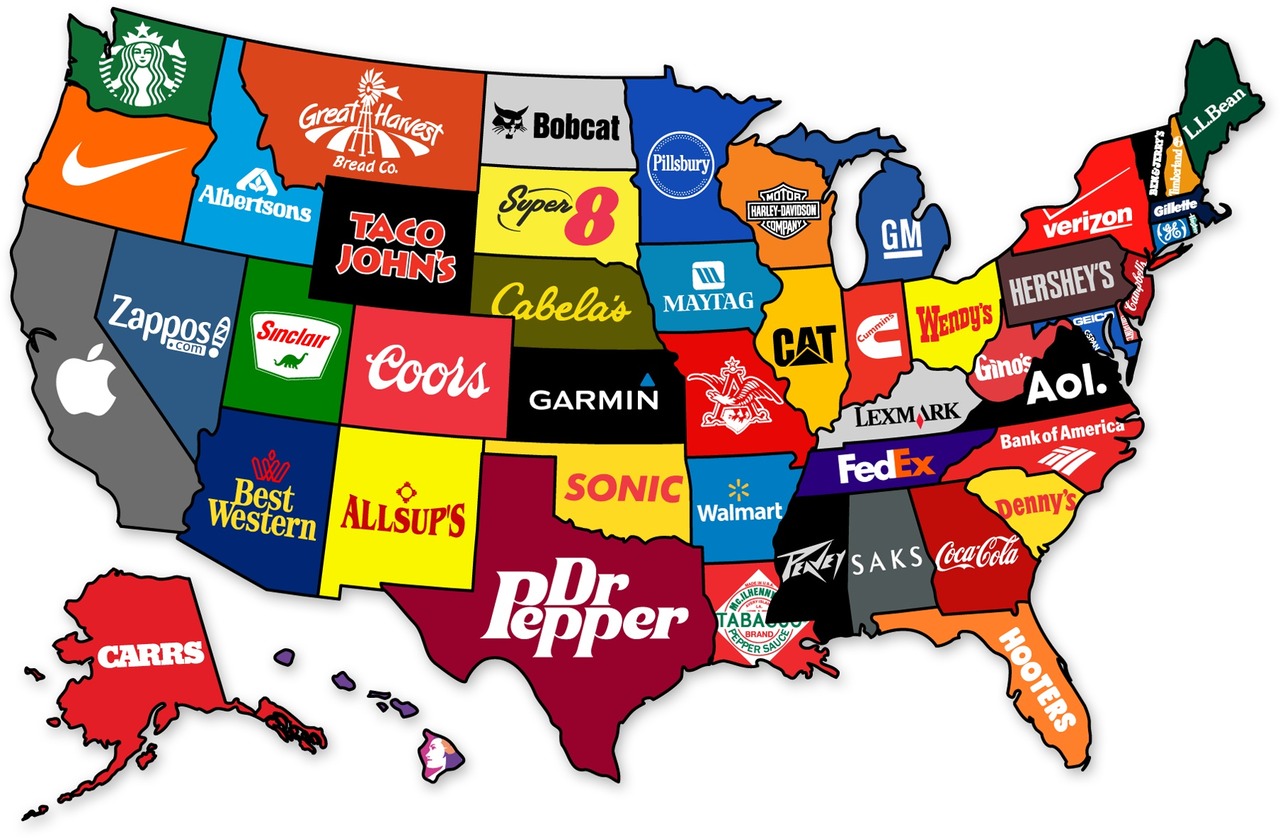
dish_usmapbrands

Kevin Hartnett highlights it:

At a glance it’s just eye candy: Steve Lovelace of Dallas has created a map of the United States, where each state is filled with the logo of a corporation that originated there. Gillette for Massachusetts, Anheuser-Busch for Missouri, Apple for California, L.L. Bean for Maine. On his website Lovelace acknowledges that his choices are subjective, based on his judgment about which well-known corporations best represent the states they originated in, rather than objective criteria like choosing state’s biggest employer or most valuable company. Some of his choices were a given (Starbucks for [Washington], General Motors for Michigan), others were inspired (Pillsbury for Minnesota, Garmin for Kansas), while a few have a whiff of irony about them (Saks for Alabama, for instance).

Lovelace lists the featured companies by state here. It’s not as great as this video though.