Eating Like Which Caveman?

Laura Miller summarizes arguments from Marlene Zuk’s new book, Paleofantasy, which calls the “paleo diet” fad pseudoscientific:

[G]eneralizations about the typical hunter-gatherer lifestyle are spurious; it doesn’t exist. With respect to what people ate (especially how much meat), the only safe assumption was “whatever they could get,” something that to this day varies greatly depending on where they live. Recently, researchers discovered evidence that people in Europe were grinding and cooking grain (a paleo-diet bugaboo) as far back as 30,000 years ago, even if they weren’t actually cultivating it. “A strong body of evidence,” Zuk writes, “points to many changes in our genome since humans spread across the planet and developed agriculture, making it difficult at best to point to a single way of eating to which we were, and remain, best suited.”

Yglesias agrees with Zuk:

None of which is to say that adopting a paleo diet won’t “work.” Any sufficiently stringent, somewhat arbitrary set of dietary restrictions is likely to lead you to snack less and be more mindful of what you’re eating. But the paleo concept is a marketing gimmick that doesn’t have much basis.

#1 In Distracted Driving

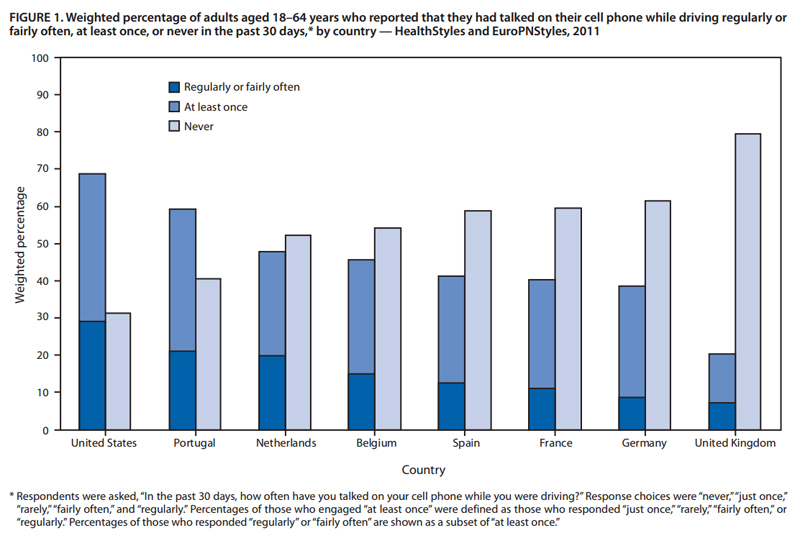
A new report finds that Americans are more likely than other Western countries to talk and text while driving:

Distracted Driving

Sarah Johnson summarizes:

The United States had the highest rate of both texting and talking while driving of any country in the survey. For adults 18-64 in the U.S., 69 percent reported talking on the phone while driving in the past 30 days at least once, and 31 percent reported texting or emailing while driving — tying with Portugal for the highest rate.

Plumer adds:

Why the disparity? One theory: All those European countries have laws against driving while talking on a hand-held phone. In the U.S., by contrast, fewer than half the states forbid adult drivers from driving while talking. See here for a legal overview.

Driving On Sunshine, Ctd

A reader writes:

With regard to solar highways, a more inclusive solar policy would be to modify building codes to require re-roofing to be done with solar-collecting roofing tiles. If the homeowner was willing to fund the full cost of the solar roofing, they would own the electricity generated by their roof. Their electric bill would be reduced by using the energy from their roof and they could sell any excess power to the utility company (as is often done today). The twist would be that if the homeowner didn’t want to pay the additional amount for solar tiles and hook up to the grid, a government subsidy could bridge the difference between a traditional roof and a solar one. In that scenario the energy created by the homeowners roof would belong to “the commons” and the homeowner would receive the usual electric bill for all the power consumed by that household.

This method would allow utilities to expand solar service in a very predictable way that allows the business to ramp up production with a real knowledge of future demand. Also, within 30 years, the entire county would be a giant solar collector.

A wonky reader responds to another recent post on solar energy:

Loving the recent focus on energy issues, attacked with the usual vigor.

The Bloomberg analyst has it exactly right: Suntech is the most recognizable, reputable Chinese brand, and the government won’t let it go down. There are certainly a number of other high-quality Chinese manufacturers, but there is a lot of substandard product coming from that country, as in other industries. Given that they’ve just effectively vanquished the U.S.-based manufacturers, it seems crazy that they’d fold now. As long as the U.S. incentive structure holds up (barely, for now) there will still be demand here, and most consumers unfortunately don’t know enough about solar brands to distinguish between the junk and the premium manufacturers. The loss of Suntech’s production share would be significant for the U.S. market.

I also doubt the warranty issues is as big a concern for companies like SolarCity and SunRun. Most of these systems are closely monitored, and they don’t fail terribly often. When they do, it’s more likely to be wiring or the inverter, rather than the panel itself. Since the large installers buy high-quality product, there’s every likelihood that most panels will perform at or above spec for their full warranty life. Many “solar guys” proudly display still-working arrays from the first solar boom in the 70’s. The industry touts a 1%/year efficiency degradation rate but it’s probably often better than that.

One thing that’s commonly misunderstood about solar panels is that once you’re beyond the level of the solar cell itself, a typical PV panel is just about the least complex form of energy generation in existence. They have no moving parts. The panel itself is encased, usually rated to withstand hail or whatever type of weather is appropriate for the region. You could crack one if you kicked it really hard (I never tried), but they’re not what I would call fragile. The only “mechanism” is a wire attached to the back which transmits the current. Some systems have microinverters attached on each panel, but those are warrantied separately, and are more likely to be U.S. manufactured.

I’m talking off the cuff here though, and while having to eat the warranty on Suntech panels might not kill a company like SolarCity right away, it’s just as easy to imagine their already-thin margins getting nibbled to death over time under those circumstances.

The long game here – and this ties into your post from the other day about fracking – is that solar is pretty close to an economic tipping point in the U.S., and it drives solar industry guys nuts when academic renewable energy guys talk about “costs need{ing] to come down”. We don’t need more research; we need more demand. The only way solar gets any cheaper anymore is for guys in harnesses and helmets learn how to do their jobs better. We don’t need another scientist at MIT setting a cell efficiency record, or another “expert” telling the politicians that they should cut demand incentives to fund research. Doubly so for the whole “the sun doesn’t shine at night” bit – how much electricity demand is there in the middle of the night? Solar produces power when it’s needed – the middle of the hottest day in the summer when everyone turns on their air conditioners at once. If energy were priced in real-time, solar would get top dollar. Instead, we have a regulatory regime that effectively guarantees that all electricity is the same price no matter how much is purchased or when.

Even with our distorted electricity market, solar has almost reached grid parity, or the point where solar electricity competes with natural gas-generated grid electricity without subsidies. As long as solar prices declining and the boom-bust incentive cycle doesn’t cause the industry to lose the manufacturing knowledge and economies of scale – again – solar could go pretty big in the next few years. Moreso if we fixed the electricity markets, not just to price pollution but price electricity supply and demand in real-time. The utilities that see this future as inevitable or desirable are the ones pushing smart meters, by the way. Trust me, these things are good for you.

Sorry for the lengthy note; these issues are so often misunderstood, so rarely discussed well. Between school and work I spent the better part of a decade trying to unpack them, before burning out late last year. I have a friend who just spent a night in jail protesting Keystone XL. After working with Congress on energy for four years, I sometimes wonder if guys like him are the only ones making a difference.
Crowdsourcing On Steroids, Ctd

A reader pushes back:

Your readers are wrong on a few key points about the Veronica Mars movie.  First, depending on the deal, Warner Bros will not be getting all the profits.  Producers and others will get a cut, actors will be paid royalties, etc.  Furthermore, WB is distributing the movie and promoting it.  This costs quite a bit of money.  So there is not “no risk”, as one reader claimed.  And having that corporate muscle at your back can make a big difference.  But WB believed that there wasn’t a fanbase for this movie that was willing to pay for it, and they have good reason to be skeptical (I’m looking at you, Snakes on a Plane).  Also, if you really gave $100, you would get to see the movie for free because they’ll be sending you a digital copy of it (as stated in the rewards). As for transparency, the Kickstarter video clearly states that they need $2 million to get off the ground, but that all additional funds will be used to expand the film (able to do more action/effects/locations, etc).

Now, this shouldn’t be the model for all productions, but for a cult show with a loving fanbase that has been wanting it for years, this sounds just about right. Kickstarter is about making projects that people want but wouldn’t be funded otherwise, how does Veronica Mars not fit that mold?

Another:

Can we please stop with the crowd sourcing snobbery. I’ve never seen Veronica Mars, but this movie kickstarter is an unmitigated good. A dormant intellectual property with a passionate fan base is being used to create something new. The creators get to work on a project they love, the fans get a movie they’ve been hoping for, and yes, a studio makes money. No one loses here.

Plus, if your reader had looked at the Kickstarter page, he or she would have realized that the backers are getting much more than a T-shirt for $100. Here is how much each piece of swag they are offering would cost if they were unbundled:

Digital Script: $10
T-Shirt: $15
Digital Movie: $10
DVD: $15
Poster: $25
Blue ray: $25
Complete TV Series: $75

Just by selling these products at reasonable prices they raised ~$1.7 million. What is much more interesting is that by selling things like a 15 second voicemail greeting by one of the cast members ($500 for Kristen Bell, $350 for others), tickets to the premier and after party ($1,000), being a background actor ($2,500), and even a line in the movie as a waiter ($10,000), they were able to raise ~$1.2 million.

Some may worry that letting fans pay to get this close and even become a part of the process jeopardizes artistic integrity, but for years Hollywood and the Indie movie scene have been luring in big money by offering access to the glitz and mystique of movie making. Now Kickstarter is allowing producers to offer a piece of that to their fans too. Plus it’s a hell of a lot more transparent because everyone knows the waiter paid to be in the movie. I expect we’ll see more movies and creative endeavors take this fan involvement approach. (Maybe if the Dish can’t make it’s budget in future years I’ll hear Andrew greeting me on my friends voicemail.)

Another:

It sits poorly with me when anyone thinks they get to determine how a crowd “should” behave.  Perhaps Veronica Mars rests uncomfortably inside the current tent of crowd-sourced projects, the Dish included, that are truly independent and transparent. But maybe the tent is going to get bigger and more various, with crowd-sourcing doing something simpler: giving the people what they want. If the people want a corporate-owned franchise that doesn’t release revenue figures, so be it. I think their priority, in this instance, is spending time with characters in a universe they love. Who are we to judge?

Amazing Amazon

Readers push back against the most recent Dissent of the Day:

Amazon and the ebook don’t displace independent book sellers as much as they displace the supermarket mass-market paperback.  I see the ebook as a great technology that is inevitable and Amazon may wipe out the independents.  Just like horse, carriage and stables were all part of our economy and provided jobs, the book publishing industry is a dinosaur in the world of human advancement.  We all have nostalgia for the things we loose to technology and progress, but it does not mean we are worse off in society.  Like it or not the guy who works for a independent bookstore will become the stable boy of past.

Another quotes the dissenter:

“We need traditional book publishers to sift through endless submissions, just as we need highly-literate booksellers to promote exceptional new works to the public.” Do we? The stunning success of author Hugh Howey says we don’t and his Wool is the best new sci-fi I’ve read in ages. It’s not clear to me that publishing gatekeepers will do any better than crowd-sourcing and word-of-mouth in identifying worthy authors. But really, we’re all supposed to go talk to a “highly-literate bookseller” to tell us what to read, when we can go to Goodreads or Amazon and get the opinions of dozens, hundreds, or thousands? Please.

Another:

I agree with your dissenter that print books and bookstores offer something necessary and important in the world, and I hope they survive forever. But I have to add that, from the writers side, Amazon is offering a steady income stream to hundreds (maybe thousands) of writers who never had an income stream before.

Some breakout self-publishers are even making huge amounts of money and gathering zillions of readers. Not many of them, but beyond the stories of these big successes there is an unrecognized story of writers who are finding readers and paying their bills when they were blocked before by the gatekeepers of the large publishing houses.

I wish Apple and Google and B&N and Kobo would step up and give Amazon some real competition on this front. But don’t condemn Amazon. They have created new markets as they’ve broken old ones.

Another:

I also like to support independent bookstores when I can. So I immediately looked at the three mentioned in the dissent and searched for my new mystery novel, The Killer Wore Leather. Because like many authors these days, I do most of my own marketing, and I link to Amazon and Barnes and Noble all the time. I have also started to include Powells, the well-loved Portland, Oregon store. I would love to link to more places where people could walk in and find it!

What did I find? One bookstore didn’t have it and had no way to special order it. The other two didn’t have it, but I could order it from a warehouse, adding 1-5 business days to the shipping time.

Now, consider Amazon, which had my book listed on EVERY Amazon website all over the world, even though the book is only (right now) in English. They allowed people to pre-order it, both as a paperback and as an e-book. When the e-book went live, people who pre-ordered it got it downloaded to their Kindles automatically. People who ordered the paperback got boxes in the mail within days of the release. And Amazon offers it at a discount.

I’m sorry to see brick-and-mortar stores go. I love a good bookstore, staffed by people who read, with handwritten shelf tags, personal recommendations and a quirky selection of things not found in every airport bookstore across the country. But you know what else I like, as an author whose income depends on sales? I like it when people can find my book easily, and get it quickly, and be able to go back and recommend that book on a website millions of people use every day. If I was depending on The Strand, McNally Jackson, the Community Bookstore, or, for that matter, Rizolli to help MY job? I’d have nothing. Because Rizolli also doesn’t stock my book, or even offer it as a special order.

The Daily Wrap

ITALY-VATICAN-POPE-CRIB FIGURINE

Today on the Dish, Andrew hoped for strong leadership from a concise Pope of the Assisi tradition, but grew uneasy at his disputed role in 1970’s Argentina and his pending court appearance. To relax, he meditated by playing Angry Birds (but won’t watch the show).

In politics, Obama’s approval returned to pre-election levels, Noam Scheiber tired of Paul Ryan’s games, and Boehner risked Hannity’s wrath over Obamacare. Blackwater extended the CIA’s reach beyond the rule of law, IEDs migrated into Syria, Tik Root mourned teens executed in Yemen, and Ambers found drones to be the best of our bad options. On Pope Francis’ first full day, we corrected the record and struggled for clarity regarding his ties to the Junta, and hoped that his background would make a good recession Pope. While Garry Wills revealed that he might bring the clergy down to earth, readers threw in their views and the Daily Mail quarreled with his stance on the Falklands.

Elsewhere around the web, World’s Best Dad reprogrammed a Princess to be the Heroine, Google relegated Reader to the dustbin, new technologies paved the way for more solar power, and Bas Van Abel designed a conflict-free phone. The Onion spoiled the next episode of Girls and Kickstart got a producer credit in the Veronica Mars movie, but that may not have been a good thing. The Atlantic spouted management-speak, Christian Caryl shone a light on the worst parts of the Malaysian sponsored content scandal, and the library went underground.

Lydia DePillis worried about the future of NOLA’s 9th district, Dana Becker encouraged readers to release their stress, and Rhys Southan chose suffering over eternal sleep. Yglesias advised low-income students to aim high in their college applications, readers added another layer to the debate on racism and made the case against civil polygamy. The Pet Shop Boys gave us more than we deserve while Dr. Andy Hildebrand defended auto-tune. A Guatemalan peak filled the VFYW, Pogo remixed Kenya in the MHB, and a mustache froze in the FOTD.

– D.A.

(Photo: Crib figurines’ artist Genny Di Virgilio works on a figurine depicting Pope Francis, the day after he was elected on March 14, 2013 in Naples. By STR/AFP/Getty Images)