Scientists in Vancouver have engineered a computer that can “reconstruct lost languages using the sounds uttered by those who speak their modern successors”:
Reconstructing ancient languages can reveal details of our ancient history. Looking at when the word for “wheel” diverges in the family tree of European languages helps us date the human settlement of different parts of the continent, for instance.
Evan Fleischer considers the porous lines of the world’s languages. From his extensive list of words:
[I]f we want to … use a word that means the same in both Polish and Czech, we get “Wyrok,” as in, “sentence, verdict”; and if we’re looking for a word that exists simultaneously in Czech and Hawaiian—Czech being the mother tongue of Kundera and the stunning Josef Koudelka—we get “pukowi,” as in, “birch tree”; and if we want a word that simultaneously exists in Hawaiian and Spanish, we use “paniolo,” as in, “cowboy.”
Armin Rosen visits Rawabi, the “West Bank’s first Palestinian-designed planned city”, which has the potential to spawn jobs and development in the West Bank:
Rawabi represents something totally new — a visionary Palestinian-directed private sector project, with support from both Israeli businesses and a major Arab government. It has the potential to shift the conversation on the region’s future on both sides of the Green Line. It could convince Palestinians — and the rest of the world — that the future of the West Bank shouldn’t be shackled to Ramallah or Jerusalem’s vacillating willingness to hash out fundamental issues. It could prove that there’s an appetite, both among Palestinian consumers and foreign donors, for the creation of a social and economic existence in the West Bank that’s de-coupled, insomuch as currently possible, from the Middle East’s tense and labyrinthine politics.
Here’s hoping. I don’t think the Good Friday Accords that finally ended the worst of the conflict in Ireland would have happened without the astonishing economic growth of the Republic back in the days of post-Euro euphoria. Prosperity always helps compromise along.
Bernstein thinks “it’s ridiculous to claim that there’s never been a filibuster against a cabinet nomination before; every single nominee that Barack Obama has sent up has been subject to 60 votes”:
Everyone covering the Senate needs to understand that Republican are requiring 60 votes for everything; that they’ve been doing so since January 2009; that prior to 2009, filibusters were frequent (since January 1993) but not universal; that very few Republicans have voted yes on cloture but no on the underlying substance on anything since January 2009; and that the name for requiring 60 votes is “filibuster.”
Felix Gillette covers Snapchat, the app that deletes a photo seconds after the receiver views it:
[Viktor] Mayer-Schönberger [author of Delete: The Virtue of Forgetting in the Digital Age] argues that all information created online should come with customizable expiration dates. Not every piece of data would have to expire after a few seconds as photos on Snapchat do. The key, says Mayer-Schönberger, is to include some form of a self-destruct button in everything created online and to give consumers the power to tinker with the settings from the outset.
Michael Scherer expects to see more tools like this emerge:
Technology has created an enormous burden on all of us. Over time, more companies will move into this space, selling not just a way for us to connect to each other–a technology that long ago left novelty and became a commodity–but a way for us better protect our connections by eliminating their trail. (Facebook already has a Snapchat mimic, called Poke.) There is no good reason that emails you wrote three years ago should be so hard to delete, or still be living on the servers of your friends’ email clients.
Previous Dish on Snapchat here. It sure would have saved me some acute embarrassment a decade and a bit ago.
People who care about good language tend to assume that casual spoken language is full of chaos and error. I shared this belief till I did some substantial research into the linguistics of speech. There’s a surprising reason why we — academics and well-educated folk — should hold this belief: we are the greatest culprits. It turns out that our speech is the most incoherent. …
[W]e drift into sentence interruptus: a phrase is left dangling while we silently muse — and we never return to finish it. When we academics were in graduate school, we were trained to write badly (no one put it this way of course) because every time we wrote X, our teacher always commented, “But have you considered Y? Don’t you see that Y completely contradicts what you write here.” “Have you considered” is the favorite knee-jerk response of academics to any idea. As a result, we learn as students to clog up our writing with added clauses and phrases to keep them from being attacked.
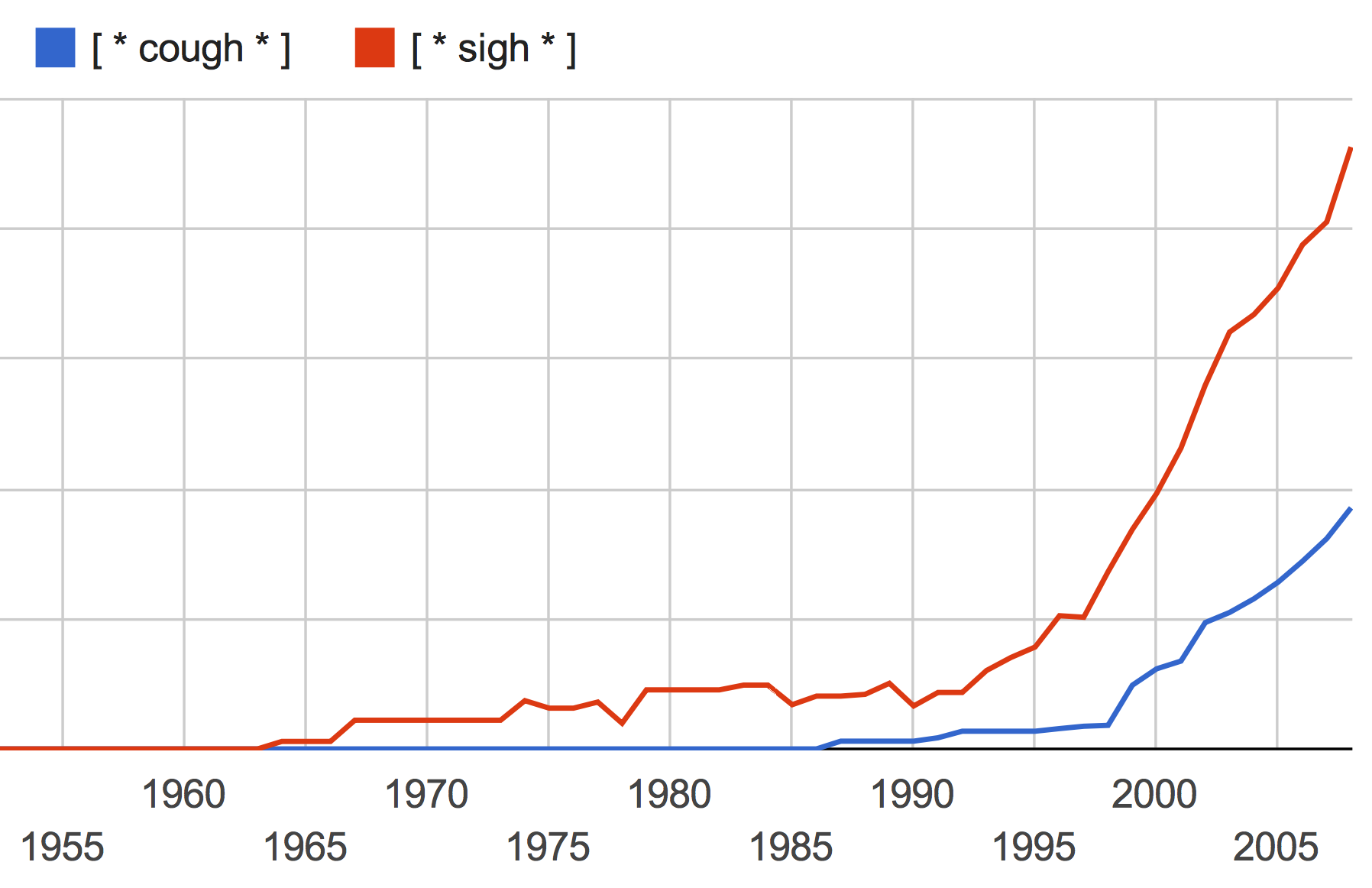
John Gruber noticed an asterisk-framed interjection (*cough*) in the New York Times and wondered about its roots:
Using asterisks this way strikes me as an Internet-ism. I would think those coughs should be italicized; using bounding asterisks is a substitute in plain text contexts, something we collectively started doing in email, newsgroups, web comments and forums, Twitter, and various other input fields where computer software doesn’t allow proper italics (or bold, or any other formatting).
With the help of Twitter, Gruber concludes *sigh* probably started in the 1960s thanks to the comic strip “Peanuts” and Charlie Brown’s constant invocation. Ben Zimmer traces longer usages (*hangs upside down like a bat*) to games like D&D:
As one “Role Play Manual of Style” explains, “Actions are enclosed in asterisks and written in third person perspective.” But this type of asterisking has thoroughly infected Usenet posts, blog comments, tweets, and anywhere else online that people feel the need to describe real-world actions in a virtual space.
Nassim Taleb urges skepticism when assessing the claims of Big Data miners. He warns that big data “may mean more information, but it also means more false information”:
[B]ig data means anyone can find fake statistical relationships, since the spurious rises to the surface. This is because in large data sets, large deviations are vastly more attributable to variance (or noise) than to information (or signal). It’s a property of sampling: In real life there is no cherry-picking, but on the researcher’s computer, there is. Large deviations are likely to be bogus.
Today on the Dish, Andrew spent the night live-blogging the State of the Union. Blog reax here, tweet reax here and meme of the night here. Earlier, he sighed at what might have been of Benedict XVI’s reign, and pressed further on the implications of a Pope stepping down. He also compared the outgoing pontiff with St. Gregory the Great, and took on readers’ criticism of his take on what lies next for Ratzinger. Later, Andrew unmasked the Dish’s cartoonist, Terry Colon, and our special teams, Chas Danner, and updated everyone on the first few days of the new indie Dish experiment.
In political news, James Inhofe wonderfully articulated the stance of the American Christianists looking to divinize our foreign policy, Sam Tanenhaus linked the far right with the doctrines of John C. Calhoun, and the Consumer Protection Bureau went to bat for college students. Enten raised his eyebrow at Rubio’s 2016 chances, while Larison claimed it’s still too early to call. Meanwhile, we charted the theft of human life caused by gun violence, Kate Sheppard revealed the climate-benefits of fewer work hours and The Economist took social mobility down a peg.
Then we took a tour of the high seas with actual pirates as William Prochnau, Osnos reported the cost of anti-corruption to China’s economy, and Laura Parker found little evidence for the mythical “secure border.” Finally, we bummed out that the correction of the day wasn’t genuine news for the Alaskan Esther as Megan McCloskey corrected Phil Bronstein’s veteran-insurance blunder in Esquire.
In assorted news and views, we sampled deep-friend deep-space scallops, Alex Knapp unearthed more evidence at the scene of dinosaurs’ demise and Nicola Twilley made the case for cheap, fence-free animal herding. Paula Marantz Cohen praised literature-as-textbooks and Kelley Vlahos shook her head at thee persistence of must-cringe TV. Oriana Aragón and Rebecca Dyer explained the urge to squeeze that kitten to death, and posted more views from your blizzard here.
For another tricky VFYW contest, we breathed the open air of Castillo San Cristobal in San Juan, Puerto Rico and reconsidered the benefits of joining the Super Adventure Club for the MHB before we looked over Ojai, California in the VFYW.
Ezra Klein was struck by the ambition of Obama’s agenda:
It’s often the case that candidates are more ambitious than presidents. But Obama’s second term is showing precisely the reverse progression. The speech went much further than Obama’s 2012 Democratic convention speech. There, his address was notable mainly for how modest the policy proposals were. Here, his speech was notable for the sweeping nature of the proposed changes. Obama’s agenda hasn’t been this bold since 2009.
The president’s speech felt like something out of the Roosevelt administration (Franklin), full as it was with progressive policy proposals–not exactly suited to our current paralytic times. So I’m going to propose that he has an eye on 2014. “Here are a bunch of proposals that you’ll probably like–universal pre-school, higher minimum wage, etc–and that Republicans will never pass,” he seemed to be saying. “Do you want to reward such obstructionism?”
A very strong speech, better that most, an A-. The writing was prose, except for the “they deserve a vote flourish at the end,” which was powerful, but the structure was very effective. I really liked the way he opened by diving right into the sequester (as I suggested!). The words weren’t exactly the ones I’d have chosen, but it was good that he said–early, when everyone was still watching–that the Republicans are going to be the ones to blame if these cuts kick in.
Mr Obama will have gratified progressives by calling for action on climate change, and pleading emotionally for a vote on gun control measures, but there’s little reason to think he gained any ground on these divisive issues. It will be interesting to see how Republicans respond to Mr Obama’s proposal for universal preschool, as well as to see whether this new expence will actually survive as a priority for the president during negotiations over fiscal belt-tightening.
Obama’s repeated plea to the nation tonight was to face reality: his tone was relentless reasonability. He spoke with a distilled fluency of a man who has been articulating the same values and proposing essentially the same policies (excepting gun control) for six years on the national stage and now speaks with the knowledge that through several permutations and waves of oppositional hysteria he has still has (or has regained) a majority with him on the big stuff. And so he argued, not only as if he were himself convinced but convinced that we are convinced …
I thought speech clever in how he handled challenge to GOP; very Clintonian in policy offerings (and better than past SOTUs); and pretty good at taking advantage of areas where public opinion pretty much already on his side. Minimum wage increase good example: Republican pols and business leaders hate it, public loves it.
Dylan Matthews analyzes Obama’s proposal to bump the minimum wage to $9.00:
According to a 2007 study by the CBO, an increase in the minimum wage to $7.25, like that eventually passed that year, would increase wages by $11 billion, of which $1.6 billion went to poor families. By contrast, increasing the Earned Income Tax Credit for large families (as happened in the stimulus bill) and for single people would cost $2.4 billion, of which $1.4 billion would go to poor families. The EITC option costs one fifth as much to society but does about as much good for poor families. That suggests that if you want to help families escape poverty, wage subsidies are a more cost-effective option than the minimum wage.
Keith Hennessey thinks the minimum wage hike is unwise:
A minimum wage increase precludes employers from hiring, or from continuing to employ, those workers whose productive value to the firm is worth less than the new minimum wage. Like any price ceiling or price floor a minimum wage restricts supply, and an increase in the minimum wage restricts supply more. Raise the minimum wage and you will eliminate jobs for the lowest-skilled workers in America.
Adam Ozimek suggests an alternative to Obama’s minimum wage proposal:
I think on balance the evidence suggests [raising the minimum wage] does cause unemployment, and I don’t support it. But I recognize the evidence is mixed, and this is why I think what Obama should propose is a randomized minimum wage. Let the policy be designed by the Alan Krueger, the head of his Council of Economic Advisors, and one of the pioneering researchers on the impact of the minimum wage. The higher minimum wage can be set to sunset in 8 years conditional on what the experiment has shown about the impact of the policy.
Yglesias wants more details on the universal pre-K proposal:
People who consider themselves skeptics of K-12 education “reform” sometimes fall into a trap of thinking that preschool is like some kind of magic wand. But in fact the research on preschools is very similar to the research on K-12 schools. On both levels, some schools are excellent and make an enormous difference in kids’ lives but there are also a lot of middling-to-poor institutions that are adding little educational value. We have some intriguing examples of amazing preschools, but little experience with bringing them up to mass scale—the exact same problem we have with K-12.
And Howard Gleckman wanted more fiscal seriousness:
The fiscal goal he described is the same one he’s had for months: By his count $1.5 trillion in new deficit reduction over 10 years that would stabilize the debt at slightly below current levels—a far cry from balance.