The Hidden Threat Of Hobby Lobby?

As the dust settles a little, a few scholars are fine-tuning their critiques and analysis. Marty Lederman echoes the alarm sounded in Slate about the radical view of Justice Alito (but not Anthony Kennedy and thereby the majority) that the RFRA undid decades of previous jurisprudence on religious liberty:

Perhaps we should not be too surprised by this dramatic doctrinal development in Hobby Lobby.  In retrospect, it was a serious mistake for Congress to use the language of strict scrutiny (especially “least restrictive means”) in a statute that was intended only Supreme Court Issues Rulings, Including Hobby Lobby ACA Contraception Mandate Caseto restore a generation of Court precedents that applied a form of scrutiny that was far less searching. Chip Lupu sounded the alarm about this, not only in his testimony to Congress during RFRA’s consideration, but also in his excellent 1995 article on RFRA.

Chip was prescient:  He foresaw (see pp. 193-198) that the statutory language was a loaded gun that might one day be employed by judges inclined to press religious exemption claims far beyond what the Court had sanctioned in the pre-Smith generation:  “[T]he government will be very hard-pressed to prevail if the provision is construed straightforwardly,” he wrote two decades ago.  “RFRA, literally construed, would . . . insulate religious exercise far beyond its most stringent protection in the prior law.  If government is truly required to employ the means least restrictive of religion, without regard to the loss to the state in attaining its objectives, the Act would significantly ‘over-restore’ religious liberty in two distinct ways.  It would exceed all prior law protection, and it would frequently be insensible.”
And if one more seat goes to an Alito-style Justice, it will. In another post, Marty wonders if the Supreme Court’s temporary injunction allowing Wheaton College to refuse to fill out the form opting out of the ACA’s contraceptive mandate misunderstands the law:

The principal problem with the Wheaton College order is the Court’s assumption that changing the form of Wheaton’s objection will have no legal effect on the ability of the government to ensure that Wheaton’s employees and students obtain cost-free contraception coverage.  That assumption appears to be based upon a misunderstanding of what the parties have represented to the Court. It is true, as the Court writes, that Wheaton College “has already notified the Government— without using EBSA Form 700—that it meets the requirements for exemption from the contraceptive coverage requirement on religious grounds.” …

Yet the matter is not quite as simple as that.  To be sure, the legal obligation for Blue Cross to reimburse Wheaton students and employees for contraceptive services, without any payment from or involvement by Wheaton, arises from the underlying law and regulations promulgated by the federal government, rather than from the filing of Form 700, or from any choice made by Wheaton College.  That is the government’s principal argument, and it is at the heart of Justice Sotomayor’s dissent.

Dahlia Lithwick and Sonja West argue that the Wheaton injunction blows up the claim that Hobby Lobby was a narrow ruling, and accuse the court of contradicting itself:

Although the [Hobby Lobby] opinion nowhere guaranteed that this compromise was not also going to prove to be a religious burden, Alito said it “achieves all of the government’s aims while providing greater respect for religious liberty.” Again, you would be forgiven for reading that to mean, as we briefly did, that the form implicitly did not burden religious liberty, even though the court did not directly decide the question. Or for expecting that the array of challenges pending in the lower courts (122 at last count) by nonprofits claiming that signing the opt-out form violates their religious liberty, might now be resolved in favor of the government. Days later, the respect it afforded religious liberty is not enough. The new unsigned opinion in Wheaton suggests that the fix to Monday’s problem—signing a form—is now a religious burden. At this rate, by next Tuesday the court will have decided that religious objectors can more readily opt out by way of a Bat Signal to HHS. Which said workaround, in turn, will soon be found to offend religious freedom.

But Jonathan Adler pushes back on that argument, which is also the crux of Sotomayor’s dissent:

In Hobby Lobby the Court concluded that the existence of an accommodation for religious non-profits demonstrated that the contraception mandate did not represent the least restrictive means of advancing the government’s interest in expanding contraception coverage.  This does not mean that the accommodation is, itself, the least restrictive alternative available.  Finding that option B is “less restrictive” than option A suffices to demonstrate that option A is not the least restrictive option, but  tells us nothing about whether there exists yet another option — option C, D or E — that might be even less restrictive still.

So, while the Court did “expressly rely” on the accommodation’s existence to conclude that the mandate was not the least-restrictive alternative, this in no way precludes the Court from upholding RFRA claims against the accommodation if and when such a claim is before the Court in a future case.

Steve Chapman doubts Wheaton’s objection will hold up in the end, anyway:

Their argument was always a reach. Filling out a form claiming an exemption is not much trouble. Nor does it make these institutions complicit in sin: The insurers have to provide the coverage even if they don’t fill out the forms. In this instance, Judge Richard Posner of the 7th Circuit Court of Appeals said in ruling against Notre Dame, the odd thing is that “the beneficiaries of the religious exemption are claiming that the exemption process itself imposes a substantial burden on their faith.” He compared it to a conscientious objector asking out of the draft while insisting that the government not draft anyone else instead.

But the way the court framed the Hobby Lobby opinion makes it even less likely to succeed. The justices in the majority, who stressed that the government can use an alternative means of providing contraception, are not likely to turn around and say the alternative is illegal.

Legalization Takes The Initiative

In order to “understand how important and effective the initiative process has been for advancing marijuana reform,” Jon Walker recommends looking “at two states recently in the news for the issue, New York and Oregon”:

New York is actually more liberal than Oregon, according to Gallup, and voted heavily for Barack Obama in 2012. Obama carried New York with 63.4 percent of the votes but won only 54.4 percent in Oregon. The people of New York are also arguably as supportive, or even more supportive, of marijuana reform as the people of Oregon. A Quinnipiac poll from February found 57 percent of New York voters support legally possessing small amounts of marijuana for personal use. The highest support any independent poll found for legalization in Oregon was 54 percent.

Yet this year New York is finally only getting a watered down medical marijuana law while Oregon has had medical marijuana since 1998 — and will likely fully legalize marijuana for adults this November.

The less liberal Oregon is effectively 16 years ahead of New York for the simple reason that it provides an initiative process for getting around reluctant politicians. It was a citizen initiative, ballot measure 67, that got medical marijuana legalized in Oregon back in 1998, and it is another initiative that will likely lead to the state legalizing adult use this year.

Update from a reader:

Walker conflates support for marijuana and political orientation. As you’ve noted often, this is not purely a left-right issue. One of Oregon’s most famous initiatives was the landmark Death with Dignity law that legalized doctor-assisted suicide. Like marijuana, that issue, often cast as liberal, had more complex support and opposition from both sides (but a substantial and durable majority).

There are conservatives who support marijuana legalization, and this gets to the second point: West Coast liberals are not the same as those in New York and Massachusetts. You could over-interpret this, but left-coast liberalism is more libertarian. The pioneer spirit lives out here, and so-called nanny-state liberalism is less prevalent. Oregon’s flavor of liberalism exhibits itself in our extremely broad free-speech constitutional provision – the one that makes strip clubs dens of free speech, not sin and depravity (legally-speaking). It’s why we’ve had medical marijuana so long and why we will almost certainly join libertarian-liberal western states Washington and Colorado soon.

Like conservatism, liberalism isn’t a monolith.

Meanwhile, Washington state will be begin selling legal marijuana tomorrow. But there likely won’t be enough to go around:

Pot regulators, business owners and analysts say pot could sell out in Washington within hours or days at the few shops slated to open on Tuesday. That is largely because of limited harvests by licensed growers and processors, or because they failed to clear regulatory hurdles to get their product to market. Washington is also grappling with a backlog of hundreds of would-be growers who still need to be screened by overwhelmed investigators with the state Liquor Control Board, agency spokesman Brian Smith said.

Recent Dish on Washington’s woes here.

Hobby Lobby Through Liberal Eyes

Responding to Damon Linker’s “Why liberals should cheer the Hobby Lobby decision,” Scott Lemieux writes, “This mode of argument — ‘this case presents a clash between potentially legitimate interests, so in conclusion, I win’ — is, to put it mildly, unsatisfying.” His take on what liberalism has to say about a case like Hobby Lobby:

Would this alleviate or reinforce domination? Democratic values should seek to increase individual liberty by attenuating power relations, private as well as public. In this case (since state power is implicated either way) this would compel siding with the Iudworkers, not the employers who wish to deny them something they have a right to based on religious values they don’t share. Linker, conversely, seems to side with Alito’s illiberal “kiss up, kick down” assumption.

Who would bear the greatest burden of the accommodation? This is both possibly the most important question and where the case for Hobby Lobby really collapses. I agree that liberals should in some cases accommodate religious belief where doing so doesn’t burden third parties. If there are two people working in pharmacy and one opposes Plan B on religious grounds, having the employee who doesn’t object fill the prescription makes sense. If this creates a de minimis burden on a third party — say, waiting an extra five minutes — that’s fine. If this means a substantial burden for the customer — say, waiting until tomorrow — then the employee should fulfill the prescription irrespective of her religious conscience.

In the case of the contraceptive requirement, the burden on third parties is clear, direct, and material. Employees will be denied a something they worked for and are entitled to under federal law without being compensated for the denial. The burden on employers, conversely, is so abstract and attenuated it’s hard to even explain what it is.

PM Carpenter hears intonations of the Civil Rights Movement both in the Court ruling and in my sanguine view of it. He doesn’t like that:

Many of these Goldwater conservatives were genuine in their beliefs. They weren’t bigoted. They did extol freedom and limited government above all other principles. What they ignored was that others had to pay for their “free society.” And when social “justness” has evaded the afflicted long enough, a friendly, powerful central government begins to look pretty damn good. In short, Goldwater conservatism’s overzealous pursuit of limited government only hastened its ill health.

Still, what more easily counters Sullivan’s argument, it seems, is that the Hobby Lobby decision was grounded in statutory law–not First Amendment principles–for a rather good reason gone bad. The Affordable Care Act was not, is not, and never will be an act designed to interfere with the sanctity of religious freedom. Period.

On the other hand we are governed–by constitutional design–by principles of a secular, not theocratic, society. Accordingly, the evangelical Green family’s corporate empire should be no more exempt from the statutory law of the land than Sears or Starbucks is.

Meanwhile, Kilgore fears that Linker and I (and some Dish readers) underestimate how much power the Christian right still wields:

Damon’s obviously right that on the marriage equality issue the Christian Right is losing the battle (unless the Supreme Court provides it with a temporary comeback with a decision reversing all the lower-court rulings invalidating state same-sex marriage bans) and quite possibly the war. I suspect they will soon retreat to a posture of separating religious from civil marriages and treating only the latter as “real,” and it’s not entirely clear they’re going to lose the fight for protecting their “right” to discriminate against LGBT folk.

But if you want a real test of whether Damon’s right and I’m wrong, look at the Republican Party. Until such time as it separates its policy views from slavish obedience to Christian Right doctrine—which has in no way happened yet other than some vague and occasional talk about “downplaying social issues”—then the idea the Christian Right is losing real political power, much less “dying,” strikes me as completely unsubstantiated. We’re still one Republican-controlled presidential election cycle from the Christian Right being in a strong position to dictate to the rest of us on a significant range of subjects.

Responding to the hyperventilation on the left, Ezra argues that Hobby Lobby was “a blow to Obamacare’s effort to expand women’s access to reproductive care — but, in truth, a minor one.” He reassures pro-choice liberals that “the Supreme Court’s decision doesn’t touch most of Obamacare’s reproductive health gains”:

Almost all insurance plans now have to cover a broad range of reproductive health services. This is the backdrop to the Hobby Lobby fight. Obamacare didn’t simply mandate that Medicaid and exchange-based insurance would cover reproductive health services. It decreed that virtually all insurance had to cover reproductive health services. … That’s why there was a Hobby Lobby case in the first place: because Obamacare forced millions of employers to expand their coverage to include reproductive health services with no copays. (There are temporary exceptions for some plans that predate Obamacare, but in the long-run, these changes will apply to virtually all insurance plans.)

Critics of Obamacare argue, accurately, that these rules raise premiums and reduce the flexibility employers have to manager their insurance options. At the same time, they inarguably increase access to, and reduce patients’ costs for, reproductive health services. According to data from the IMS Institute for Health Informatics, the number of women who filled prescriptions for oral contraceptives with no copay shot from 1.2 million in 2012 to 5.1 million in 2013. “The numbers we saw for the first year the benefit was in effect showed that women in America saved more than $400 million,” says Richards. Those numbers will be much higher in 2014.

My takes on the Hobby Lobby ruling here and here. Reader reax here, here, and here.

Bibi’s Vengeance

A reader writes:

That quote from Netanyahu about god avenging etc. – that isn’t something he came up with; it is a standard religious thing to say whenever someone is murdered by an enemy (השם יקום דמו if you can read Hebrew; הי״ד , the acronym, is often simply added to the notice of such a death). Normally and through most of Jewish history, this was interpreted to mean simply that god will settle the score with the killer. The more sinister interpretation is obvious, but it is also quite a new idea, historically speaking, and it is only taken up on the very far right by supporters of the late racist hate-monger Meir Kahane. (To give you some idea of how far out they are from the mainstream, parties that advocate his teachings are outlawed.)

Another Jewish reader:

There’s a worse quote from Netanyahu. He quoted national poet Cham Bialik, as saying “such vengeance, the vengeance of the blood of a little child, is yet to be invented by the Devil.”

But he quoted out of context. Bialik, writing after the Kishinev pogrom, actually wrote (in his “On the Slaughter, Al Ha’Schita): “And damned be he who calls for vengeance!/Such Vengeance, the vengeance of a little child/is yet to be invented by the Devil.” In the Hebrew, it goes like this:

וְאָרוּר הָאוֹמֵר: נְקֹם!

נְקָמָה כָזֹאת, נִקְמַת דַּם יֶלֶד קָטָן

עוֹד לֹא-בָרָא הַשָּׂטָן –

This is one of most famous bits of poetry in Hebrew; it is taught to schoolchildren all over the country. By inverting the quote, by laying the emphasis on vengeance instead of its denouncement, Netanyahu was dog-whistling to his extreme right-wing crowd. He does so often; the Israel left has been calling him “inciter in chief” since the 1990s. Not something mentioned often in Republican circles, I’d bet.

The Tears Of An Elephant

Thailand's Elephant Hospital and Mahout School

Yesterday, there was a strikingly good reported piece in the NYT magazine on the growing evidence that consciousness does not have some kind of radical break between humans and every other species on the planet. And by consciousness, at varying levels, I mean, for example, the ability to feel fear, or joy, or anxiety, or even grief. This is emphatically not about anthropomorphism. It’s about the reality of creation:

A profusion of recent studies has shown animals to be far closer to us than we previously believed — it turns out that common shore crabs feel and remember pain, zebra finches experience REM sleep, fruit-fly brothers cooperate, dolphins and elephants recognize themselves in mirrors, chimpanzees assist one another without expecting favors in return and dogs really do feel elation in their owners’ presence. In the summer of 2012, an unprecedented document, masterminded by Low — “The Cambridge Declaration on Consciousness in Human and Nonhuman Animals”[PDF]  — was signed by a group of leading animal researchers in the presence of Stephen Hawking. It asserted that mammals, birds and other creatures like octopuses possess consciousness and, in all likelihood, emotions and self-awareness.

And then I come across this rather beautiful story about an elephant around my own age, captured in his infancy, chained and shackled his entire life, until he is released by an animal welfare group:

Fitted with painful shackles for nearly his entire life, Raju had been forced to walk the dusty roads of India, interacting with tourists in exchange for coins and food. His body bears the signs of malnutrition and the scars of physical abuse — but the emotional toll was no less profound. Late last week, a team led by the UK-based animal charity, Wildlife SOS, intervened to liberate Raju from his cruel keeper. As it started to become clear that they were there to help him, the elephant wept.

Wept? I was doubtful until I read other tales of exactly this phenomenon: in a book from Jeffrey Masson, When Elephants Weep, and a recent story about a newborn elephant calf, rejected by its mother, who then cried uncontrollably for five hours.

Does weeping mean in elephants what it does in humans? We cannot know, of course. But when it is occasioned by the kind of event that prompts human tears, it does not seem to me to be indulging in anthropomorphism to posit that something like grief or relief (or some elephantine version of either) is behind it. And that, to my mind, tells us a huge amount empirically about the way we treat animals in our society: we treat countless living creatures as if they had no feelings and as if we shared nothing in our experiences. That’s not just based on untruth; it is the kind of thing that future generations may well look back on in horror and disbelief.

To see what is in front of one’s nose …

(Photo: Tears run down the face of Motala the elephant. She is crying from the pain as vets clean up the damaged tissue that is all that is left of her front left foot. She is a patient at the Elephant Hospital where vets and doctors hope she will recover from extensive damage when she stepped on a landmine on the Thai/Burma border. The hospital was founded by Khun Soraida Salwala, and the NGO Friends of the Asian Elephant (FAE). By Peter Charlesworth/LightRocket via Getty Images)

Arming Both Sides In The Surveillance Debate

Over the weekend, Barton Gellman reported, based on documents from Snowden, that 90 percent of people whose online communications the NSA intercepts are not the agency’s intended targets. But Gellman also claims that the program has provided more valuable intelligence than Snowden’s fan base would like to acknowledge:

The surveillance files highlight a policy dilemma that has been aired only abstractly in public. There are discoveries of considerable intelligence value in the intercepted messages — and collateral harm to privacy on a scale that the Obama administration has not been willing to address. Among the most valuable contents — which The Post will not describe in detail, to avoid interfering with ongoing operations — are fresh revelations about a secret overseas nuclear project, double-dealing by an ostensible ally, a military calamity that befell an unfriendly power, and the identities of aggressive intruders into U.S. computer networks.

Stewart Baker calls the 90 percent statistic in the article’s lede “a phony,” noting that any investigation into a target’s communications will cover the correspondence of many people who are not the target:

Maybe the Post is performing some far more sophisticated calculation, and they didn’t bother to explain it, despite its prominence in the story.  If not, though, the inherent bias in the measure is such that it demands an acknowledgement . (After all, it allows you to say “half of all account holders in the database weren’t the target” if the agency stores a single message sent to the target.) This is something that any halfway sentient editor should have recognized. Which raises this question:  I’ve heard of newspapers chasing stories that are “too good to check.”  Does the Post think that Gellman’s are too good to edit?

Though he also finds the premise dubious, Wittes admits that “the story raises a valid question”:

Is the agency minimizing U.S. identities and communications in all situations in which it should?

The details it provides are inadequate to venture an opinion on that subject. And once again, the story raises a tension that is to some degree inherent in the agency’s project: A valid overseas target who is in communication with people in the United States is, for obvious reasons, of particular interest. He will also, however, by the nature of the activity that gives rise to that interest, be in contact with more U.S. persons than many other people will. And that means that incidental collection affecting U.S. persons will be greater. Minimization is a key protection for U.S. persons, but you don’t want minimization of information that may be of foreign intelligence value. Wherever you draw the line here—or, rather, the many lines—you’re going to pay costs both in privacy and in effectiveness. You’ll retain information that is utterly innocuous and corrosive of people’s privacy and you’ll minimize information that will prove to have value. The question is how much of each harm you are willing to tolerate and when you want to err on which side of the line.

Furthermore, Digby is troubled by the story’s revelation that the NSA “treats all content intercepted incidentally from third parties as permissible to retain, store, search and distribute to its government customers”:

You just don’t know what personal information about innocent citizens you’re going to need until they do something you need it for. (Or maybe, you never know, you need their cooperation on something and having this sort of info make the “persuading” just a little bit easier…) Best to keep as much information stored about everyone as possible. After all, the government may need to target you for something someday and it would be a shame if they didn’t have all of your communications stored in a nice digital file somewhere. Just in case.

Friedersdorf uses the piece to slam the NSA’s defenders:

They have no choice but to admit that the NSA was so bad at judging who could be trusted with this sensitive data that a possible traitor could take it all to China and Russia. Yet these same people continue to insist that the NSA is deserving of our trust, that Americans should keep permitting it to collect and store massive amounts of sensitive data on innocents, and that adequate safeguards are in place to protect that data. To examine the entirety of their position is to see that it is farcical.

Here’s the reality. The NSA collects and stores the full content of extremely sensitive photographs, emails, chat transcripts, and other documents belong to Americans, itself a violation of the Constitution—but even if you disagree that it’s illegal, there’s no disputing the fact that the NSA has been proven incapable of safeguarding that data. There is not the chance the data could leak at sometime in the future. It has already been taken and given to reporters. The necessary reform is clear. Unable to safeguard this sensitive data, the NSA shouldn’t be allowed to collect and store it.

Recent Dish on the NSA’s online surveillance program here.

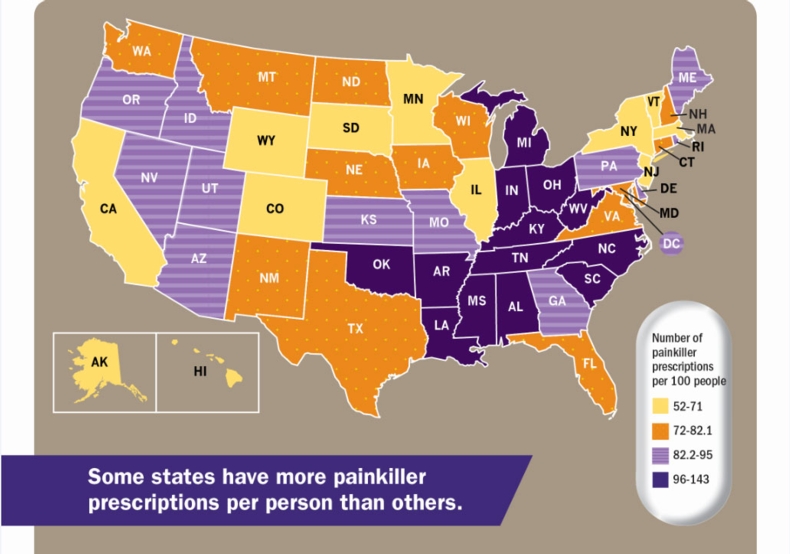
Map Of The Day

dish_painkillersusa

A new report from the CDC measured prescription painkiller use across the country:

Southern states — particularly Alabama, Tennessee and West Virginia — had the most painkiller prescriptions per person, the report said. For example, in Alabama, there were 143 prescriptions for opioid prescriptions written for every 100 people. That’s about three times the rate seen in Hawaii, which had the lowest rate among U.S. states, with 52 prescriptions per 100 people.

The rate of prescriptions for oxymorphone, one type of opioid painkiller, was about 22 times higher in Tennessee than in Minnesota, which had the lowest rate of prescriptions for that drug, the report said. Prescription rates for long-acting/extended-release painkillers, and for high-dose painkillers, were the highest in the Northeast, particularly in Maine and New Hampshire, the report said.

Such wide variations in prescriptions for painkillers cannot be explained by differences in the health of people in different states — that is, pain-related health issues don’t vary much by region, the CDC said. Rather, the differences may indicate a lack of consensus about when it is appropriate to prescribe painkillers, the report said.

Quote For The Day

“Abu Khdeir’s murderers are not ‘Jewish extremists.’ They are the descendants and builders of a culture of hate and vengeance that is nurtured and fertilized by the guides of ‘the Jewish state’: Those for whom every Arab is a bitter enemy, simply because they are Arab; those who were silent at the Beitar Jerusalem games when the team’s fans shouted ‘death to Arabs’ at Arab players; those who call for cleansing the state of its Arab minority, or at least to drive them out of the homes and cities of the Jews.

No less responsible for the murder are those who did not halt, with an iron hand, violence by Israeli soldiers against Palestinian civilians, and who failed to investigate complaints ‘due to lack of public interest.’ The term ‘Jewish extremists’ actually seems more appropriate for the small Jewish minority that is still horrified by these acts of violence and murder. But they too recognize, unfortunately, that they belong to a vengeful, vindictive Jewish tribe whose license to perpetrate horrors is based on the horrors that were done to it.

Prosecuting the murderers is no longer sufficient. There must be a cultural revolution in Israel. Its political leaders and military officers must recognize this injustice and right it. They must begin raising the next generation, at least, on humanist values, and foster a tolerant public discourse. Without these, the Jewish tribe will not be worthy of its own state,” – the editors at Ha’aretz.