Would You Report Your Rape? Ctd

Another reader recounts a horrifying experience:

I’ve been following this thread closely.  Thank you, as always, for providing a forum for these kinds of conversations.  I’m grateful.

I’m an over-educated, professional, heterosexual male, single, no kids.  I’m also a recovering sex addict.  Several years ago I was to meet a woman whom I had met online at a party at a sex club, a club where she said she was a member.  I had never been to one of these kinds of parties before.  I was still very active in my addiction at the time, and I had not yet found my way to meetings or rehab or therapy or honesty.

She did not show up.  I stayed at the party anyway.  It was a pretty amazing environment at the time, given my current state of mind.  At some point during the evening (the details are still a bit sketchy), I was drugged.

It was a drink someone gave me, or mine was spiked – I don’t know. I woke up several hours later, alone in a room, bleeding, naked, battered, very high.  I had no active memory of what had happened to me, but I wasn’t stupid either.  I quickly gathered my things, put myself together as best I could and stumbled out.  My driver’s license, debit cards, credit cards and cash were gone.  I was barely coherent, barely conscious, barely able to move or walk. I did not know how I got out of there; I did not know how I got home. And I was in an incredible amount of pain.

On some level I knew what had happened to me, but my mind very quickly and very effectively buried and burned any memory away.  Three or four days later, I went on vacation with my girlfriend overseas for two weeks.  She did not know about my “other life.”  I told no one, and two days later I did not remember why I had bruises on my body and face – seriously.  I still didn’t know where my wallet had gone.  I had no conscious explanation, so I chalked it up to maybe I had been in a bar fight.

It took several years, two months of inpatient rehab, 30 months of Sex Addicts Anonymous meetings and 12-step work, and two years of incredibly intense therapy for the memories to begin to return.  I had been gang raped by at least three people that I can remember that night.  The memories came in bits and pieces for a day or two, and then everything, all at once, while I was driving across a bridge.  I almost wrecked my car, and then I almost parked it and jumped.

When “it” all came back, I cannot begin to express the level of shame I felt, the level to which I blamed myself.  I believed that because of how I had been living my life at the time I deserved what had happened to me – I believed that to my core.

And the next day I went to work.  I was in my office, socializing with my co-workers, again hiding my real daily experience from those around me, although this version was much different than what I had believed to be the exciting double-life I had been living before – as a sex addict, screwing everything in sight.

I have since told four people what happened to me, about my gang rape – my sponsor, my therapist, a sibling, and one close friend.  It is still almost impossible for me to even type those words and own them.  I have never spoken of it again until writing this email.  I did not “report” it … what would that have even meant for me?  Call the cops?  What would that phone call have sounded like?  HOW would I have even reported anything?  I could not even begin to wrap my head around that concept.

It was an experience that, on a very deep subconscious level, drove me deeper and deeper into my sex addition.  I was left suicidal for a very long time and kept heading full speed for rock bottom until I lost everything of any value in my life.  Only then did I somehow find my way to a residential, inpatient treatment center out of state.  I still don’t entirely understand exactly how that came to pass, but it is the only reason I am alive today.

Obviously the name on the email account is fake – the account is a burner account – but I would still like to remain as anonymous as possible.  Part of me fears that I have already given away too much detail in this email, that someone will find out its me.  No one (apart from those mentioned) in my life has any idea of what I’ve been through, what I experienced.  I still struggle with reconciling this experience in my life with being a heterosexual male, dealing with all of the fallout and aftermath, in the context of our society and culture, in the context of my “identity”.  It’s challenging everyday, but the ones I have shared this with have been (to me) surprisingly supportive and understanding, never failing in telling me that it was not something I deserved to have happen to me.

Beard Of The Week

beard-tug

The back-story:

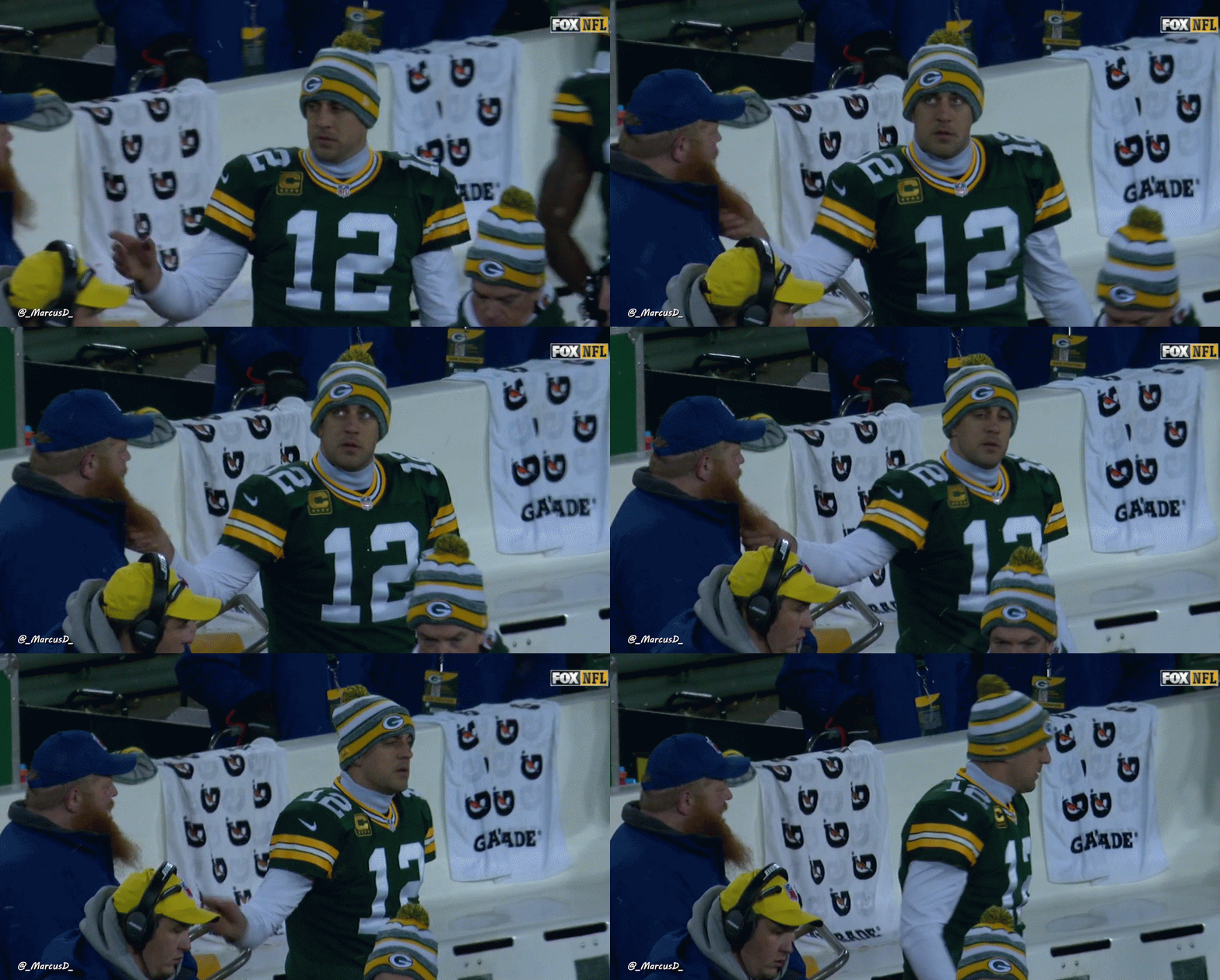
That bearded guy who’s apparently [Green Bay QB] Aaron Rodgers’ good-luck charm? He’s Wausau’s Jeremy Wilcox.

Wilcox, whose company is a Lambeau Field contractor for the Green Bay Packers, caused a social media stir when FOX Sports TV cameras caught Rodgers tugging the man’s beard right before he re-entered Sunday’s game against the Detroit Lions. Rodgers injured his left calf right before the half and sat out two series before returning in the third quarter to lead the Packers to a 30-20 victory that secured a first-round playoff bye and a home game. … [F]ans are joking that Wilcox’s beard was pivotal in the Packers big win.

No joke. James Dator counts the ways:

There are three good reasons pulling this beard is important to Aaron Rodgers.

– It’s a beard that brings him luck.

– He’s wistfully remembering his own beard.

– The beard’s essential oils soften his throwing hand in preparation for the Packers next drive.

Previous BOTWs here. Update from a reader:

You missed the best part of the beard story: “It’s red and 9 inches long, and #Packers quarterback Aaron Rodgers tugs it for good luck”.

Heh.

Scalise Should Learn To Google, Ctd

And Cantor, of course, was the only Jewish Republican left in Congress. The latest in the Scalise scandal: the guy who organized the white nationalist conference is defending the embattled whip:

“The truth is that we used that room early on in the day to sponsor a town hall meeting between Steve Scalise and his constituents,” [Kenny] Knight said. “It was totally separate from the EURO conference […] Poor Steve Scalise is getting a bad rap,” Knight, a long-time aide to former KKK leader David Duke, told The Daily Beast.  “I don’t think Steve Scalise would come anywhere near a white hate group.” It’s a bit of an odd statement, since Knight and his cohorts don’t consider their outfits to be hate groups, despite their stridently racist rhetoric.

About that rhetoric:

“My [EURO] speech was about the Iraq war,” Duke said, adding that thought at the time “that it was a war for Israel, the Richard Perles and the Paul Wolfowitzes of the world”—a reference to two Jewish advisers to President George W. Bush, who supported the Iraq war. Duke, a former Republican state legislator who has run unsuccessfully several times for higher office, said he did not hear Scalise’s address to the group. “He came and actually just spoke to his local constituents about one of his tax bills, and they are trying to make it out like this is a big deal,” he said. “I really believe that the Zio-globalists that control the American media, finance and government are leading us all to disaster, both African Americans, white Americans, all Americans,” he continued, returning to his central theme.

Oy. Philip Bump backs up Scalise – sort of:

[T]he idea that Scalise was pandering to a key voting constituency simply doesn’t hold up.

Scalise first won election to the state House in 1995 with more than two-thirds of the vote. In 1999, he won by a slightly tighter margin — but still by more than 30 points. In the vernacular, these races were “blow-outs.” Admittedly, the 2003 election — the one closest to Scalise’s 2002 appearance before Duke’s “European-American Unity and Rights Organization” — was different. In that, Scalise was unopposed. …

The 28,000 people who’d voted for [Duke for Congress] in 1999 probably weren’t still an organized constituency in 2002. Other members of Duke’s base from earlier, statewide races might have still been loyal to the former Klan member, but it seems hard to believe that Scalise would have considered this an essential part of his electoral considerations. Far more likely, as the Post reported Tuesday, is the idea that Scalise was asked by an apparent friend [Knight] to make an appearance.

Betsy Woodruff digs deeper:

“[Scalise] was just up there for a few minutes, maybe 10, 15 at the most, and it was in the morning,” [Barbara Noble, Knight’s then-girlfriend], said. Noble said that there was no signage, banners, or mention of the EURO conference at the civic association event and that Scalise left immediately after giving his talk.

There’s total consensus on the right and left that Scalise displayed miserable judgment by associating himself with Knight, an ally of the former KKK leader. But Knight’s and Noble’s accounts cast doubt on an emerging narrative: that, as Democratic Congressional Campaign Committee spokesman Josh Schwerin told Politico, the Louisiana Republican “chose to cheerlead for a group of KKK members and neo-Nazis at a white supremacist rally.” If Knight and Noble are right, then the truth is much less theatrical than some make it sound.

But Beutler isn’t buying the whip’s defense:

Let’s assume that Scalise is telling the truththat poor staffing explains his participation, and that he rushed in and out of the event too quickly to realize what was up, or that he was led in to the hotel conference center blindfolded, ears plugged, and fled the scene the moment his remarks concluded. There’s a problem with southern Republican politics if an up-and-coming star stumbles heedless into a white supremacist convention in the course of his constituent outreach, and then doesn’t notice the mistake for more than a decade.

Conservatives have compared the Scalise revelation unfavorably to Chris McDaniel’s neo-confederate sympathies, which establishment Republicans happily deployed against him when he was poised to topple an incumbent senator in Mississippi; and to the Klan-curious comments that got Trent Lott, another Mississippian, ousted from Senate leadership in 2001. But whether Scalise’s transgressions are worse than McDaniel’s and Lott’s is a subjective and unnecessary question. The appropriate question, whether Scalise stays or goes, is, Why does this kind of thing happen at all?

Vinik thinks it’s a “tough call” whether to strip Scalise of his #3 position:

Given that Scalise doesn’t have a record of racist comments or a history of attending gatherings with white nationalists, I, like [Ezra] Klein, am willing to give him the benefit of the doubt that this was just an honest mistake. … But Klein makes a strong argument that Scalise’s speech, even if it was an honest mistake, is representative of compromises he had to make to win elections in Louisiana. He also twice voted against making MLK day a state holiday, first in 1999 and second in 2004. The latter passed by a 90-6 vote. (Scalise’s office did not return a request for comment on whether he would still vote the same way today.)

Michael Brendan Doughtery, in contrast, considers dropping Scalise a “no-brainer”:

For the good of the party and the country, Republicans need to reach out to America’s oldest minority, the group whose emancipation was a motivation for many of the GOP’s founders. Black voters, just as much as white exurban voters, deserve competition for their vote, in the cities just as much as in the South. If a Republican majority whip was discovered to have once spoken to a group created by Anton LaVey, founder of the Church of Satan, he’d be dropped from leadership before Richard Land could hit up a friend on speed dial. Keeping Scalise in leadership confirms that the GOP doesn’t care about its perception among black voters.

Indeed, Boehner and his #2 are standing by their #3.

The Best Threads Of 2014: “The View From Your Obamacare”

President Obama Visits Boston To Talk About Health Care

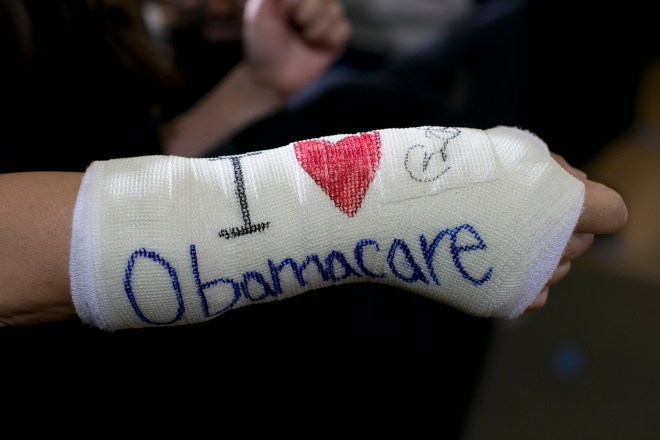
The latest reader thread we want to highlight centers on your personal experiences with the ACA – mostly good, some just okay, a few terrible. Read the whole collection here. Several more of your stories are below, aired for the first time:

I’m 43 and was laid off last year from one of the major banks.  I fell off a ladder about five years ago and ended up having four surgeries to get it all straight.  Besides that, I’ve got ADD and generic meds, but no other major health issues.  I was pretty surprised to be denied coverage by a few companies when trying to get it myself last year.  When Obamacare activated, I was surprised that I got subsidies as a member of the upper-middle class and able to get affordable coverage while looking for a job.  When I did get a contract job, I looked into health coverage.  What the contract company was offering was over twice what I was paying on my own!  The benefits weren’t even that different.  I kept my plan through healthcare.gov and am very happy for it.  For an income around $100k, I figured I’d make sacrifices for the greater good, but I’m actually seeing benefits.

Another reader:

My extended family’s Obamacare success stories come with a huge helping of Republican epistemic closure.

First, the successes.  My 52-year-old brother retired early from working in a manufacturing plant for 30 years and started his own small business.  His house is paid for and he is extremely frugal, so his business provides a comfortable yet modest living.  However, he could not afford to purchase insurance just for himself before Obamacare, so he went uninsured.  Now he pays $53 a month for a plan that is very similar to what his girlfriend has through her employer.  Success!

My niece was able to stay on her parents insurance while she went to grad school for nursing.  Success!

My cousin has a 24-year-old son with spina bifida.  With that preexisting condition, it would have been almost impossible (and unaffordable) to find insurance to cover him once he was off his parents’ policy.  Now with the law restricting insurance companies from denying coverage for preexisting conditions, he will be able to enter the workforce with no worries about his coverage.  Success!

Now the epistemic closure part.  Even with all of these personal examples, my extremely Republican parents have been brainwashed by Fox and still think Obamacare is the worst thing ever to happen to this country.  They are convinced that their Medicare will be taken away and they won’t be able to find any doctors.  They are convinced that President Obama just wants to take all of their money and give it to poor people.  I have stopped trying to educate them with facts and real examples because it is no fun beating my head against a brick wall!

Another:

I am a surgical specialist.  My politics would be RINO, but in this day and age, I vote “not Republican”, as I do not believe the party can be trusted with power nor to govern.

ACA is basically a Rorschach test for partisans.  I’m personally for it as a first step towards a better system, so maybe I’m biased.  I see someone every week who now has healthcare who didn’t before.  Unfortunately, these are often neglected issues that would have been better managed in the past, but at least they have a way now to get care.  I also may be unique because I am uninsurable outside of a group plan due to a personal history of blood clots.  I was turned down by every single insurer despite being fit, no other health issues, and a lifetime risk of clotting again of 8% with no medications or 3% with Coumadin, 10.00/3 month supply.

I practice in a blue-collar area with plenty of uninsured and I’ve watched my income plummet with the economic downturn.  I found that about 1/2 of my head-and-neck cancer patients were uninsured and I had to eat the cost of their treatment – no more; this year so far everyone has had insurance.  Medicaid doesn’t pay much, but it is better than nothing.  The homeless guy I operated on last week came in with his tongue cancer small enough that it hasn’t spread to the neck and his surgery should be all he needs.  That saves the cost and morbidity of radiation therapy.  Sure, he is being paid for by the state, but the cost was much less than what it would have been had he hit the ER in a few months with metastatic disease.

I also had a guy follow up today who is no longer insured since losing his job recently. My right-wing office manager of course blames Obamacare.  I had a gentleman last year who was in the union but for some reason hadn’t been working. He had refused working a certain job since it would have been on a concrete floor, which is hard on his back.  I don’t know the other details, but he had opted to not get his Cobra, and being a 62-year-old smoker and drinker, he has some risks.  He tried to buy Cobra, but he was 20 months out – and of course, he blamed Obamacare for his inability to get Cobra. I don’t bring politics into the mix, but the only reasons he’ll ever get insurance again is because of government programs.  Good luck finding a private insurer who would touch him.

Those who love purely private medicine should ask how would a 78-year-old diabetic with heart disease gets insurance, and what would be the cost?  How does someone with MS get health insurance on the private market if they are single and unable to work?   Look at dental care. (This is healthcare, but that’s another argument.)  A sizable percentage of the population has untreated dental disease.   One-half of my on-call weekends are spent dealing with neck abscesses related to dental infections.  Many of these people are uninsured. And the classic story is they had dental work done, had to pay a bunch of money in cash, developed an abscess, were treated with oral penicillin, got worse and were sent to the ER, where the rest of us treat for free.

I see at least one case a week where the ACA has helped someone get insurance and I have yet to see a case where it hurt.  I am sure there are 25-year-olds who didn’t have insurance and who didn’t have a healthcare issue who are financially hurt, but the fact is, statistically, some of them do get sick, injured, etc … and not having coverage is not acceptable to society who has to eat the cost.  Believe me, I’ve fixed dozens of facial fractures on young men with motorcycles, fast cars, or big mouths who didn’t have insurance.

I also do not understand the greed of many.  I have colleagues who makes 3X what I make yet they feel they are being screwed.  I make a very good living and it bothers me that I see people who are poor and have to do without basic care.  I do not think that everyone should make the same amount of money, and I feel my work is worth more than most, but I also grew up lower middle-class and I can’t fathom not caring that hard working people or children unfortunate to be born to bad parents suffer needlessly.

But another dissents from the others, quoting me:

I’m not sure that “Obamacare is as big a liability for Obama this fall as the Iraq War was for Bush in 2006″, but I do think it will potentially be used as a HUGE negative, even for many who voted for him and other Dems in the past few elections. And I believe that if the Democrats do not quickly grab hold of the reins and prepare well and cleverly and early on to counter what will be the number one issue to beat about the head and shoulders of our candidates, we will most definitely lose the Senate and eventually the presidency. Why? Because many of those hardest hit by the worst unintended effects of Obamacare are middle-class independent and Democratic voters.  And they are feeling betrayed and pissed and afraid for their financial safety.

Most of us who supported health care reform did so out of a sense of empathy and fairness; we were tired of seeing so many people going without decent health care, were angry hearing the nightmare insurance stories in which children were denied cancer treatment, in which the mentally disabled and chronically ill and employed but uninsured got all their care through emergency room visits. We wanted our kids covered longer because college is costlier and taking more time to complete, much less find employment after graduation.  We were tired of having our local communities and hospitals and ERs having to foot the bill for the low-income uninsured, for being forced to absorb the costs of long-neglected conditions that ended up being hundreds, thousand and even hundreds of thousands of dollars when decent primary care could have prevented the illness. We thought it was not only stupid financially; it was morally wrong and wanted to find a way to fix it, smartly.

What we all really wanted, whether we knew it or not, was a single-payer/public option that was affordable and spread out the risk nationwide to make all of our out of pocket costs go down. Instead we got the worst possible “free market” solution they could dream up in DC. 

Far too many of us in the middle class – those of us with one or two job incomes and employer provided health insurance – have been financially REAMED by Obamacare – by the tax changes; by the way this law has been manipulated by our employers and insurance companies to pass on their costs to the individual; by the increase in costs and reduction in benefits in an economy that is stagnant and in which most of us haven’t had a raise in years.  Too many people who supported reform, who voted D, who out here are making moderate incomes and dealing with the competing financial demands of raising families, paying for college costs, helping their elderly parents and now desperately trying to save for their retirements (there are no pensions anymore, don’t forget) are being hurt financially by this law, and unfairly so. And – whether I agree with this or not – it’s all being blamed on Obama and the ACA.

Example: I work as an RN at a medium-sized corporate hospital that offers our employees a really shitty BCBS plan. We staff nurses averaging about $50-60K/yr in earnings and many of them are single parents. I am blessed to be able to opt out due to my spouse having coverage (excellent coverage) as a federal employee, but my friends do not.  Over the past two years, they have seen their deductibles jump to $6000K/yr or more, with co-insurance of 20-30% or more pharmaceutical “co-pays” have jumped to ridiculous levels.

This winter several of my co-workers had to pay almost $60 for a generic albuterol inhaler during their recovery from the various flu-bugs we all got. My coworker’s 12 year-old daughter has juvenile diabetes and she pays hundreds out of pocket monthly for her insulin and supplies. Remember that $5000/family tax-free flexible health savings account we all could sign up for in the past? You know, the one where you set an annual amount to divide up like a loan and put into an account that will advance you the money up to your elective limit for health costs?  Well, “Thanks to Obamacare” it’s been cut to $2500, and believe me that goes fast. One of my coworkers had to take both her small children in for abscessed tonsillectomies and it cost her $3500 dollars, out of pocket,  on our hospital’s wonderful BCBS plan. 

I’ve seen more formerly uninsured people get covered, which is fantastic, but now my hardworking peers approaching middle adulthood with diabetes, hypertension, chronic autoimmune disorders like lupus, funny moles on their skin, obstructive sleep apnea, depression and a whole host of health issue are JUST NOT GOING TO THE DOCTOR ANYMORE.  If it’s not free or catastrophic, they’re crossing their fingers and hoping a trip to the health food store or some meditation will fix their problem.

Yes, they get the low-cost, required “essentials and annual freebies”, but in general, too many of us had better out-of-pocket costs before Obamacare (and even then we were sometimes stretched to pay those).  Since we’re insured by our employers, we don’t meet the stringent numbers to qualify for subsidies on the exchanges, so even if we wanted to opt out and buy there, we’d pay even more in premiums than we do now. I am exuberant that my kids can stay on our health insurance until they’re 26, and that my 29-year-old son would have insurance right now after not having any for four years if he had not finally found a job with it as a benefit.

And I won’t even tell you ALL the ways business is blaming Obamacare so that they can ruthlessly make cutes, refuse raises, and generally squeeze out profit and then dump the hurt on their employees.  At our hospital, ACA is blamed SPECIFICALLY for the layoffs and cost cuts that are hurting the quality of care and safety we offer our patients. They have forced on us increased nurse-to-patient ratios and cuts to CNA caregivers, which has resulted in poor outcomes and even a few serious harms to patients.

Physicians at our hospital are miserable, and spend less time on patients and more time trying to learn and use our electronic medical system . It’s clunky, out-of-date and creates serious errors, but because corporate is cashing in on CMS bonuses in reimbursements by implementing electronic medical records now, they are more concerned about their bottom line than doing it well. So they refuse to purchase better software and the doctors yell and insult and dodge putting in orders (which means WE have to step away from the bedside to do it for them.  Worse, they take their business elsewhere down the road, which in turn results in days off for us due to fewer patients in our unit.

Patients are unhappy and give us poor “Patient Satisfaction Scores” because no one answers their call lights fast enough, so they wet their pants, their food sucks and their rooms are dirty longer than they used to be and the equipment looks like something donated to a Third World hospital in Africa, so they don’t trust it.  My CCU is an oasis of relative safety, mostly due to Medicare reimbursement rules about ratio’s and standards of care, but we are struggling every day and stretched way too thin, and we all worry about the looming “sentinel incident” around the corner that hurts or kills a patient and costs us our license.  Would YOU like your nurse to be distracted from your open-heart surgery recovery because she has to leave your bedside to answer the phone, buzz in visitors, deliver food trays, enter medical orders for cranky doctors, answer call lights for water for other patients, and cant get your emergency cardiac iv’s because her computer system has crashed once again? I don’t think so.  

Anyway, this is just a long, frustrated, but hopefully insightful, rant about the day-to-day NEGATIVE impact of ACA has been, and why it will be a big challenge to overcome in the next two election cycles. I really wish we had more focus on THESE kinds of issues and how they will be remedied, and fast because it scares the SHIT out of me that we’ll end up getting an entirely radical Republican national government if we don’t. And there’s no Meep Meep if that happens.

Update from a reader:

Your allegedly sympathetic but frustrated RN asserted that “because of Obamacare,” Health Savings Account minimums have been “cut” to $2,500, and folks can’t sign up for robust HSA accounts anymore. Well, I knew that was bull as soon as I read it because I have an HSA for my kids and me, to which I contribute $4,000 annually. So I Googled the issue. The IRS issues the annual HSA minimums and maximums, which I don’t see has anything to do with “Obamacare” – have a look.

So this RN is using the HSA minimum and representing that as the maximum that “Obamacare” appears to allow. The truth is, anyone with dependents could sign up for as much as $6,550 in HSA contributions in 2014! (That figure is verified here.) And it’s going up another $100 for 2015.

Another:

The respondent discussing HSA limits as quoted by the IRS is discussing a health savings account, which has different limits and is continuable through successive years, as opposed to the Flexible Spending Account as discussed by the RN. The FSA is a tax-differed method to pay for out-of-pocket expenses for health plans without high deductibles. FSAs expire at the end of each year, with any unspent money evaporating. So, in a sense, they are both right, but talking about different beasts.

(Photo by Yoon S. Byun/The Boston Globe via Getty Images)
Quote For The Day

“In a better world, sexual education would be concerned with the development of taste. All the great lovers in literature were also lovers of tales and had their heads full of sublime rivals in their divine quest. The progress of civilization is intimately connected with the elaboration of erotic sensibility and a real examination of the delicate interplay of human attractions. But everything today conspires to suffocate imagination. There have been hardly any great novelists of love for almost a century. Scientific sex claims to tell us about the real thing. Reading classic books has become less and less of a taste among the educated, although cheap romantic novels, the kind that are sometimes stuck into boxes of household detergent, apparently flourish among housewives who haven’t heard that Eros is dead. And now the most respectable authorities in the study of books tell us that their messages were always pernicious and sexist. There is practically nothing within our horizon that can come to the aid of ideal longing. Sure, you can be a romantic today if you so choose, but it is a little like being a virgin in a whorehouse. It just doesn’t fit with the temper of the times and gets no support in the current atmosphere.

Talking about love has suffered the most.

Eros requires speech, and beautiful speech, to communicate to its partner what it feels and wants. Now there is plenty of talk about relationships and how people are intruding in on one another, and there is talk akin to discussions on the management of water resources. But the awestruck vision of the thing-in-itself has disappeared. It is almost impossible to get students to talk about the meaning of their erotic choices, except for a few artificial cliches that square them with contemporary right thing. Out of self-protectiveness, no one wants to risk making arguments, as Plato’s characters did, for the dignity of his or her choice and its elevated place within the whole of things. What one cannot talk about, what one does not have words for, hardly exists. Richness of vocabulary is part of richness of experience. Just as there is a disastrous decline in political rhetoric, rhetoric necessary to explain the cause of justice and form a community around it, so there is an even more disastrous decline in the rhetoric of love. Yet to make love humanly, the partners have to talk to each other,” – Allan Bloom, Love and Friendship.

Hacking Your Fingerprints

fingerprint

It can be done from photographs:

In his talk at the Chaos Computer Club — Europe’s largest hacker organization — Jan Krissler said he used a high-profile target for his attempt: German defense minister Ursula von der Leyen. Krissler, also known by the pseudonym “Starbug,” used several close-range photos from a “standard photo camera” of von der Leyen’s hand from a few angles before creating an image of her thumbprint via VeriFinger, a software program used to read fingerprints.

In a 2013 interview, the same hacker panned Apple’s fingerprint reader: 

Biometry just also has its weaknesses. Unlike passwords that are either right or wrong, there is always a certain probability of match. Therefore the TouchID scanner isn’t really a security method, but a comfortable method. Had Apple made the mechanism more secure, too many people would have struggled turning on their iPhone and too many people would have been rejected too often.

Many don’t use any passcode on their smartphone at all, whereas using a fingerprint is still better than nothing – as Apple said at the launch. But it’s obviously about convenience and ease of use, not about security. Therefore I would not even want to rate TouchID associated with security practices.

However, Emil Protalinski thinks it’s “important to keep the findings in perspective”:

Even if reproducing a fingerprint was a viable method for breaking into a system, be it a smartphone or a high-security vault, this news doesn’t mean that fingerprints are suddenly useless. Perfect security measures do not exist, and fingerprints definitely still have their place. They can still be more secure than PIN codes in many cases, and can always be used in conjunction with them or other types of passwords for multiple layers of security.

Megan Geuss considers alternatives to fingerprints:

Fingerprints have been favored in the past as biometric identifiers, but because fingerprints can be reproduced, some security experts have recommended biometric keys that are less dependent on a single aspect of a person’s body. For example, earlier this month researchers were able to identify people using only video shot from a camera on a fixed point on their body by recreating defining characteristics of the target person’s gait. Vein pattern analysis is also considered a potential way to identify a person without leaning on an outwardly identifiable physical trait.

Talking Through Touch

Clive Thompson explains why we may soon be able to feel who’s texting us:

Haptic technologies have begun to flourish recently—tools that buzz, vibrate, or otherwise “communicate information through people’s skin,” as haptics pioneer Karon MacLean, of the University of British Columbia, puts it. Automakers like General Motors are producing drivers’ seats that vibrate in the direction of an impending collision. Apple’s new smartwatch can deliver taps of different intensity to your wrist to communicate everything from a new message to GPS directions. Haptics, it appears, is the next way we’ll interact with information—and each other. …

[T]o me, the most interesting use of haptics won’t be “hey, go check this out” alerts. It’ll be the potential to spawn a new mode of communication. People are extremely good at distinguishing among many different signals written on their skin. Google wearables designer Seungyon Claire Lee tested what she called BuzzWear, a wristband that vibrated three small buzzers in 24 different patterns. With 40 minutes of training, her subjects were able to distinguish among them with 99 percent accuracy. In another study, MacLean played patterns onto people’s fingertips via a smartphone game—and found they could remember them weeks later. “It was like learning new words, like learning verbal language,” MacLean says.

Thompson imagines that the “alphabet of haptics could become the next emoji, a way of supplementing our traditional language—email, text—with expressive flourishes.”

Was The Ebola Epidemic Preventable?

A NYT investigative report finds that “there was a moment in the spring when the longest and deadliest Ebola outbreak in history might have been stopped”, but failures of communication among health officials in West Africa enabled it to spiral out of control:

A two-month investigation by The New York Times into this largely unexamined period discovered that the W.H.O. and the Guinean health ministry documented in March that a handful of people had recently died or been sick with Ebola-like symptoms across the border in Sierra Leone. But information about two of those possible infections never reached senior health officials and the team investigating suspected cases in Sierra Leone. As a result, it was not until late May, after more than two months of unchecked contagion, that Sierra Leone recorded its first confirmed cases. The chain of illnesses and deaths links those cases directly to the two cases that were never followed up in March.

Since then, West African authorities and international organizations have followed a steep learning curve, Alexandra Ossola writes, but containing the outbreak (which the WHO reports has now infected over 20,000 people) remains a daunting task:

The WHO and others have disseminated info​rmation about proper burials to dissuade families from conducting funeral practices that may cause further infection, and they have been pretty effective. But there are still too many risky burials; Sierra Leone, which still has the highest number of cases, did no​t meet its December 1 goal of safe burials for 70 percent of victims.

… There are signs that these countries are fighting Ebola more effectively, [CDC spokesperson Kristen] Nordlund said, but challenges remain. Health care workers are still struggling to contain Ebola’s spread in cities like Freetown, Sierra Leone. When people move across borders between countries with high infection rates, tracking down the people who may have come into contact with a patient becomes extremely challenging. Some hospitals still don’t have enough beds to safely treat infected patients, Nordlund said, and not all regions have sufficient number of medical personnel to do the necessary follow-up with those who may have been exposed.

Meanwhile, a group of scientists has put forth a theory as to how the outbreak made the jump from animals to its first human victim, a two-year-old boy from the remote Guinean village of Meliandou:

Reporting in the journal EMBO Molecular Medicine, scientists led by Fabian Leendertz at Berlin’s Robert Koch Institute delved into the circumstances surrounding this first fatality. The finger of suspicion points at insectivorous free-tailed bats — Mops condylurus in Latin — that lived in a hollow tree 50 metres (yards) from the boy’s home, they said. “The close proximity of a large colony of free-tailed bats… provided opportunity for infection. Children regularly caught and played with bats in this tree,” the team said after an exhaustive four-week probe carried out in April.

In other Ebola news, another returning health worker has carried the disease home with her, this time in the UK. Scottish nurse Pauline Cafferkey was diagnosed yesterday after returning from Sierra Leone, where she had been volunteering along with other NHS health workers:

Ms Cafferkey, who had been working with Save the Children in Sierra Leone, arrived in Glasgow on a British Airways flight on Sunday but was placed in an isolation unit at Gartnavel Hospital on Monday morning after becoming feverish. [Scotland’s First Minister Nicola] Sturgeon told journalists that as a precaution, Health Protection Scotland has traced and contacted, or left messages with, 63 of the 70 other passengers who were on the same flight from London to Glasgow as the patient.

The New Greek Drama

-1x-1

Yesterday, Greece’s Prime Minister Antonis Samaras called snap elections after the parliament rejected his candidate for president a third time:

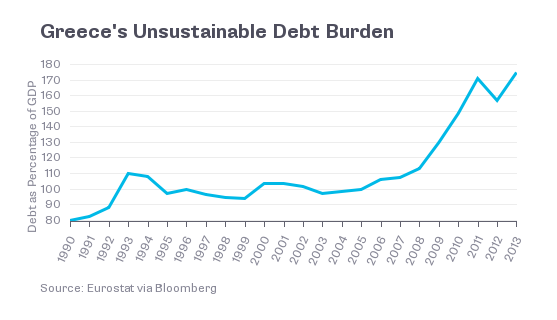
The trigger for the elections was the failure at the third and final attempt of Samaras’s bid to push through his nominee for president, Stavros Dimas. Dimas attracted the support of 168 lawmakers in the 300-seat chamber, short of the 180 votes required. Under the constitution, the legislature must now be dissolved and a date for elections set. Samaras said he’ll meet tomorrow with the incumbent president, Karolos Papoulias, and ask for the election to be held on Jan. 25. That’s just weeks before Greece’s 240 billion-euro ($293 billion) bailout expires.

Mark Gilbert explains why Greece’s political crisis could have ramifications for the entire Eurozone:

Polls suggest that the opposition Syriza party may win power in Greece; its leader, Alexis Tsipras, wants to unwind government spending cuts to halt what he calls a “humanitarian crisis” in his country. If he does win the prime minister’s job on Jan. 25, the EU will need to take his concerns seriously, recognize that fiscal backtracking is preferable to seeing Greece exit the euro, and concede that the unfortunate solution to the nation’s unsustainable debt is to forgive some of it. …

The EU’s apparatchiks will need to take seriously Syriza’s demands for an easing of Greece’s economic strictures — or risk turning the political drama into an economic crisis. If Greece were to abandon the common currency project, it would call into question the membership credentials of other euro nations. (Note that Portuguese bonds are also taking fright today.)

Danny Vinik also warns of a Eurozone crisis if Syriza wins:

[M]arkets are nervous. Germany has an outsized influence at both the ECB and European Commission, and is determined to use its financial leverage to force Greece to make structural changes to its economy. If Germany becomes determined to hold a hard-line negotiations with the Syriza-run Greek government, the odds of a “Grexit” could rise substantially. Already on Monday, yields on 10-year Greek bonds rose nearly 1 percentage point, to 9.7 percent. That could provoke similar fears in other periphery nations in the Eurozone.

That is all months off. Greek attitudes toward Syriza may shift if the party’s chance of gaining control of the government increases. There may be another political stalemate with parties unable to form a governing coalition. But the risks are realnot just for Europe’s economy, but the world’s.

Yglesias runs down some other possible outcomes:

One can also imagine a scenario in which parties of the far-left and far-right (including the fascist Golden Dawn) gain enough votes that no politically viable coalition is mathematically workable. In that case, well, it’s not really clear what would happen. Something along these lines occurred briefly in 2012 leading to a short-term “caretaker” government of Brussels- and Frankfurt-approved technocrats. That could happen again, or you could have the kind of more severe political crisis that sometimes occurs when a country endures a years-long spell of unemployment over 20 percent.

But Douglas Elliott downplays the potential for a Greek tragedy:

It is quite unlikely that Greece will end up falling out of the Euro system and no other outcome would have much of a contagion effect within Europe. Even if Greece did exit the Euro, there is now a strong possibility that the damage could be confined largely to Greece, since no other nation now appears likely to exit, even in a crisis.

Neither Syriza nor the Greek public (according to every poll) wants to pull out of the Euro system and they have massive economic incentives to avoid such an outcome, since the transition would almost certainly plunge Greece back into severe recession, if not outright depression. So, a withdrawal would have to be the result of a series of major miscalculations by Syriza and its European partners. This is not out of the question, but the probability is very low, since there would be multiple decision points at which the two sides could walk back from an impending exit.

Likewise, Neil Irwin sees no signs of a periphery-wide panic:

[W]hat we’re not seeing is the kind of contagion that was widespread from 2010 to 2012. At that time, any sign that the crisis was worsening in Greece immediately translated, through the financial markets, into greater panic about the much larger European economies of Spain and Italy. … But Greece’s latest troubles don’t seem to be adding much to economic and financial uncertainty beyond Greece. Spanish and Italian bond prices fell a bit Monday and their yields rose a bit, but Spain’s 10-year borrowing costs are now at 1.67 percent and Italy’s at 1.98 percent, much closer to Germany than to Greece.

“A Virtual Work Stoppage”

The New York Post reports that “NYPD traffic tickets and summonses for minor offenses have dropped off by a staggering 94 percent following the execution of two cops — as officers feel betrayed by the mayor and fear for their safety”:

[O]verall arrests [are] down 66 percent for the week starting Dec. 22 compared with the same period in 2013, stats show. Citations for traffic violations fell by 94 percent, from 10,069 to 587, during that time frame. Summonses for low-level offenses like public drinking and urination also plunged 94 percent — from 4,831 to 300. Even parking violations are way down, dropping by 92 percent, from 14,699 to 1,241.

The Post obtained the numbers hours after revealing that cops were turning a blind eye to some minor crimes and making arrests only “when they have to” since the execution-style shootings of Officers Rafael Ramos and Wenjian Liu.

Scott Shackford snarks:

Well, we can only hope the NYPD unions and de Blasio settle their differences soon so that the police can go back to arresting people for reasons other than “when they have to.”

The NYPD’s failure to arrest and cite people will also end up costing the city huge amounts of money that it won’t be able to seize from its citizens, which is likely the real point. That’s the “punishment” for the de Blasio administration for not supporting them. One has to wonder if they even understand, or care, that their “work stoppage” is giving police state critics exactly what they want—less harsh enforcement of the city’s laws.

No doubt police are hoping that citizens will be furious when police don’t do anything about the hobo pissing on the wall in the alley or won’t make the guy in apartment 3b turn down the racket at four in the morning. And they’re probably right to a certain degree. But if they think the city is going to turn into sheer anarchy over the failure to enforce petty regulations, they’re probably going to be disappointed.

Update from a reader:

Nice to see the NYPD are not responding like petty, petulant, spoiled children and have instead taken up a constructive debate over their grievances with the mayor. It would be sad to think that they were so thin skinned as to compromise the integrity of their positions because their soft, touchy-feely side was bruised when the mayor expressed how he cautioned his child in dealing with the police.

Another piles one:

It’s anecdotal, but we went away for Christmas and left the car on the street. At $45, one street-cleaning ticket is cheaper by far than putting it in a garage. Then I changed my return, putting us in line for two tickets. I got back yesterday anticipating a $90 bill—and found nothing on the windshield. Suspecting the wind might have blown the tickets away, I checked online. Zip.

I’m selfishly pleased by that. But if this horseshit “wartime footing” stance by the NYPD union extends even to traffic cops, then the life-and-limb ramifications of minimal law enforcement are appalling. The NYPD is using New York citizens – its bosses, its responsibility, and the folks who pays its salaries – as the ante in its poker match with the mayor. In the past, I’d have expected the citizenry to pretty quickly side with the cops, be it simply out of self-interest. But I think this time the NYPD may have made a bad bet. One of their men killed a man and walked. Then, when even gently criticized, they took the city hostage rather than eat a bite of crow, or even swallow a bite of pride. This time may be different, and I very much hope it will be.