Hey, Wait A Minute, Mr Kramer, Ctd

A reader is incredulous:

This quote from Kramer surprises you? This is the Larry Kramer of the novel Faggots piping up. This is Fred Lemish, not Ned Weeks, the Kramer alter-ego who disdains everyone who enjoys his sexuality unshackled by the particular strain of Puritanical self-restraint (or self-denial) that Kramer/Lemish prefers. In this construct, condoms require foregoing a certain amount of pleasure; therefore they are courageous and virtuous. A pill doesn’t reduce the pleasure in sex; therefore it is a morally cheap and cowardly alternative. That Mr. Kramer is consistent in this since the 1970s doesn’t make it any less deluded and irresponsible.

No, it didn’t surprise me. Larry has been consistent in all this for ever – and wrong about it for ever. What still shocks me is that his moral agenda actually trumps preventing the spread of HIV. Another reader speculates:

I have nothing more to add to what you wrote, other than to say that the combination of safe sex, education, anti-virals and now Truvada may have finally put the disease on a path to oblivion, and as one result, Kramer may be losing the issue that defined who he was and is these past 30 or so years. Not to make a false equivalence, but it’s kind of like the neocons who can’t accept that the world has changed and there is no need for the US to be the world’s policeman anymore. Letting go of something one has fought for or against for a long time can be a loss.

I’d put it a little differently – and I explored this a little in my essay “When Plagues End” in Love Undetectable. Plague creates an entirely new persona – embattled, on guard, constantly afraid and always mobilized. And demobilization is never psychologically easy. Camus brilliantly saw this in La Peste. When I first read it, I didn’t really believe that the inhabitants of Oran would resist the good news when the nightmare lifted. But they did. And then I saw it in my own life – in the truly shocking wave of abuse I got when the essay first appeared in the New York Times Magazine and then, when my own viral load went to zero, in the deep depression that knocked me flat on my back. Humans are conservative. They get attached to what they know – even if it is brutalizing – and fearful of change.I think we’re seeing exactly the same psychological reaction to the amazing Truvada and anti-retroviral breakthrough. The reasons people are giving for opposing Truvada are so irrational and knee jerk they only make sense in the context of a deep aversion to change, even for the better.

Another reader asks:

Did you watch The Normal Heart, and if so, what did you think?

Yes, I did. So how to put this diplomatically?

I thought it was really helpful in showing people what it was like when the plague first hit, and in revealing the appalling, early indifference of the majority of Americans toward it. I thought Matt Bomer did about as good a job as possible in portraying the gruesome decline HIV visited upon so many. If that’s all the movie did, it was worth making.

But in general, I thought the production revealed the weakness of the original script – which works best in a theater as a kind of agit-prop set-piece designed for the 1985 moment. The best speech in the play, for example, is Bruce’s telling of the tale of the AIDS patient being treated literally like garbage in his final hours on earth – quarantined, untouched, brutalized and then sealed in a black plastic bag, ready for a garbage truck. The speech has real rhetorical power and forces you to imagine such cruelty and callousness – for the AIDS epidemic was not merely about pain and suffering, it was about adding stigma and discrimination to pain and suffering. But in the HBO movie, the literal depiction of the scene robbed it of almost all its force, although I wonder whether Taylor Kitsch’s mediocre talent could have pulled it off anyway. Or take one of the really powerful moments at the end of the play, when the names of the dead cascade over the stage in the hundreds of thousands. In the movie, it was about rolodex cards.

The play itself, of course, is a massive vanity project. Larry Kramer was Chad Griffin avant la lettre. Its politics are as crude as its cartoon characters. The added scenes were just excruciating. Ned Weeks in the White House screaming in the hallways? A Reagan official literally asking if the plague could affect someone who hired hookers? Embarrassing. Then there’s the underlying message – that nothing ever happened to beat back HIV, that the plague is as powerful as ever, that Reagan is still murdering people, and there’s no hope unless you follow Larry Kramer. The fact that AIDS deaths plummeted after 1996, and that we have a solid prevention tool and a powerful treatment regimen could not be mentioned, because it would detract from the pure drama of it all. And when you are engaged in pure drama, it’s hard to beat Larry Kramer’s talent for it.

Larry was dead right to write this play and a hugely important figure in helping gay men fight back at the hour of our deaths. None of that should ever be gainsaid. I honor him and feel great affection for him. But this movie? Meh.

The EU Encourages Corruption?

Reihan entertains the idea:

There is a longstanding view, rooted in the rise of the centralized fiscal state in early modern Europe and, more recently, in the rise to affluence and power of states like South Korea, that states often adopt growth-enhancing policies when they’ve run out of other options, e.g., when they face a formidable military threat and find themselves unable to extract aid, or enough aid, from allied states, thus forcing them to rely on internal resources. (Nicholas Eubank’s work on Somaliland offers a distillation of some of this literature.) Yet when states have an easily-accessible resource at their disposal, like point-source natural resources (oil and gas) or government-to-government transfers, they don’t necessarily have to adopt growth-enhancing policies, as political elites can take the easy root of just turning on the spigot and skimming off their cut.

Dalibor Rohac, a policy analyst at the Cato Institute, has thought deeply about this question, and when I asked him to write something for The Agenda on the subject, he kindly agreed to do so. If Dalibor is right, the European Union hasn’t just failed to prevent the deterioration of liberal-democratic norms in central and eastern Europe. It has exacerbated the problem. Dalibor calls this “the curse of European structural funds,” and I think he makes a rock-solid case.

The heart of Rohac’s argument:

The inflow of EU funds into countries with weak institutions does not mean just wasteful spending but also breeds corruption. The impact may be hard to quantify but is very visible. Before joining the EU, Eastern European countries had made significant progress in reducing cronyism and corruption – mainly because of the numerous reforms they had to adopt in order to qualify for EU membership in the first place. After the accession, not only did the progress come to a halt but some measures of corruption actually deteriorated.

Why Take Vacations? Ctd

A reader responds to the question:

Vacations are the best way to build a family. When out in a tent for a week with the kids, the whole family is doing nothing but family activities and building family memories. Same applies now that the kids are out of the house.  A vacation with my wife is “us time”.  Vacations together bind families together.

Another adds, “Because when I’m dead, my daughters aren’t going to say to each other, ‘I really wish that when Daddy was alive, he’d spent more time at work.'” Another:

I’m not sure “happiness” is the proper measure for why or why not, vacations should be taken. I don’t travel to increase my happiness.

I think you could make the argument that if one never took a vacation and never saw something new, one might be happier never having known the vast diversity of all things on this earth. It’s like that expression, the grass is always greener; if one never knew about the grass on the other side, then perhaps one would be content with their own grass on their own side. I travel because I want to visit that grass, to smell it and see it, and to compare it with my own. Had I never travelled to Europe as a teenage, backpacking for a couple months on my own, I would never know how disgusting soda is warm with no ice, or how fantastic fresh pasta tastes when its authentically prepared, as they do in Rome.

I take vacations in order to explore the world. To see the diversity of lifestyle, of cuisine, geography and language. Exploring the world doesn’t make me happier; it just makes me, me. And with each passing trip, be it a trip to Peru or a plop vacation to an island, I learn a little bit more about myself, a little bit more about what I like and what I don’t, and in doing this I feel more at peace with myself. Vacations are good in that way. They help define who we are when we return home.

Another puts it this way:

One of the best parts of vacation is making home seem new again.

Update from a reader:

In a truly wonderful letter, Kurt Vonnegut advised a group of students to “Practice any art, music, singing, dancing, acting, drawing, painting, sculpting, poetry, fiction, essays, reportage, no matter how well or badly, not to get money and fame, but to experience becoming, to find out what’s inside you, to make your soul grow.”

I write to make my soul grow. It’s also why I travel.

When I move through the world with open eyes, I gain a few inches. I earn a little valuable perspective. The dullness of everyday life is swapped out with an intense curiosity that wipes clean my mind’s carefully constructed sensory adaptation. That to which I was once blind is temporarily laid bare in plain sight. Like a good night’s sleep restoring the well of willpower, travel rejuvenates my dwindling childlike wonder. Music, food, nature and people are furiously alive with rich detail and flavor.

When I travel, I am reminded of our fundamental goodness as I my see comfort zones, slide past them ungracefully and get by with the help of strangers and newfound friends. Because everything seems so different, the bonds between people get a fresh take and deep look as I see mothers caring for children, brothers jostling each other out of childhood, or friends soaking up the familiar rhythm of their rapport.

When it’s all over, travel remains with me. My self-imposed demands to be less blind and see more of what I call home. The new imperatives to be less passive and act more. The stories I relate to friends and family among the soft early mornings and the hazy late nights. The hopeful wanderlust and sense that adventure is just over the horizon.

Most of all, what remains from travel is the becoming and the growth of my soul. If nothing else, that’s why you’ll find me hunting the world for the unknown. To become. To grow my soul.

Essential Reading For Rightwingers

Nicole Hemmer looks back at three political paperbacks released in the spring of 1964 that sold an astonishing 16 million copies between them in just six months – a publishing phenomenon she calls the “leading edge of conservative media’s first presidential campaign”:

Appearing in rapid succession, the books startled observers with their dark and conspiratorial interpretation of American history. In None Dare Call It Treason, John Stormer spun a tale of internal subversion and weak-willed foreign policy that marked “America’s retreat from victory” in the Cold War. “Every communist country in the world literally has a ‘Made in the USA’ stamp on it,” he wrote. Phyllis Schlafly, author of A Choice Not an Echo, accused “a few secret kingmakers” in the Republican Party of conspiring to keep conservatives out of power. J. Evetts Haley’s A Texan Looks at Lyndon served up 200 pages of greased palms, stolen elections, and suspicious deaths to argue that President Johnson was better suited to the penitentiary than the presidency.

Haley’s claims rivaled the darkest and most bizarre Clinton conspiracies.

The author, a Texas cowman, called Johnson an “inordinately vain, egotistical, ambitious extrovert” and claimed Lady Bird Johnson mirrored “Lady Macbeth’s consuming ambition for the growth of her husband’s power.” Of the Kennedy assassination he wrote, “What a strange coincidence.”

These “hatchets with soft cover sheaths,” as the Chicago Tribune characterized them, owed their success to the conservative movement’s innate populism and its institutional architecture. Conservatives, like most populists, harbored deep suspicions of institutions not under their control, particularly the media and the Republican Party. If the newsmen of the Washington Post and the grandees of the GOP were left to shape the campaign narrative, the right believed, Goldwater’s campaign would be over before it began. So conservatives used their own media to craft an alternative campaign unmediated by outside institutions.

China’s Panda Diplomacy

GERMANY-ZOO-PANDA

Dara Lind examines it:

When the Chinese government started the current wave of panda loans, [researcher Kathleen] Buckingham and her coauthors discovered a pattern: pandas were sent to trade partners shortly after major trade agreements were signed, as a way of expressing a desire to build a long-term trade relationship. …

The choice of which zoos get pandas within a country is important, too.

The pandas loaned to the United Kingdom, for example, don’t live in the London Zoo, which would be the logical place for them — they were sent to the Edinburgh Zoo, as an acknowledgment of $4 billion in trade deals for exporting Scottish salmon and Land Rovers to China.

But China also uses panda loans (as well as the trade deals themselves) to exert political pressure on countries. China turned to Scotland for its salmon imports, for example, as a replacement for longtime salmon supplier Norway. After the Nobel Peace Prize committee gave the award to Chinese dissident Liu Xiaobo, China took its salmon money somewhere else. Sometimes economics and politics intersect: the panda loan China and Denmark agreed to just last month could be seen as an expression of Chinese interest in Greenland’s natural resources, or as a reward for Denmark walking back its support of Tibetan independence five years ago.

(Photo: Picture taken on July 5, 2000 shows Bao Bao, the oldest captive male panda in the world, in his enclosure at the Berlin zoo. A gift from China to former German chancellor Helmut Schmidt, Bao Bao died at the age of 34 on August 22, 2012. By Stephanie Pilick/AFP/Getty Images)

Girl Power In Ukraine

Anna Nemtsova profiles the female militants taking part on both sides of the civil conflict:

Women build barricades, pour gas for Molotov cocktails, or throw bricks at policemen — sometimes with more passion and anger than the men. On the Maidan, some of them joined Unit 39, a largely female group within the demonstrators’ Self-Defense Forces, where their tasks included persuading members of Berkut, the paramilitary police, to defect. Last month, activist Irma Krat, one of the leaders of the Maidan’s female militia forces, was detained by rebels in Sloviansk. The interrogators have accused her of torturing anti-Maidan activists and killing a Berkut officer.

But the pro-Ukrainian contingent certainly doesn’t have a monopoly on women militants. Since late April, leaders of the separatist movement have been calling on both men and women to mobilize and prepare for a real war against Kiev. Last weekend, a pro-Russian website issued a video that showed four masked women warriors from Lugansk declaring “a war against the junta,” as pro-Russian forces refer to the interim government in Kiev. In the video, women dressed in camouflage with Kalashnikov rifles slung across their chests introduce themselves as female fighters in the Russian Orthodox Army: “We took up weapons because we’re fed up,” one of the women says.

It’s not just young women, either. Last week, Julia Ioffe took a look at the role grandmothers (baby, plural of baba) were playing in separatist movements in eastern Ukraine:

Baby were reportedly deployed in April outside Slovyansk, where the Ukrainian government’s troops, in a massive embarrassment to the provisional government in Kiev, surrendered their tracked and armored personnel carriers, as well as their assault rifles, to the rebels.

How did it happen?

The machinery rolls in, and a battalion of grannies surround it, hectoring and jeering at the young men in Ukrainian uniform, shaming them for coming to kill them. The Ukrainian soldiers were not going to shoot or plow through unarmed babushki, so they sat there and waited while the grannies hooted and hollered. But before the soldiers knew it, their men arrived, with guns, and the game was lost.

Just last week, Russian state media reported that, outside Slavyansk, Ukrainian troops were again turned back by the granny shock troops. When the Dniepropetrovsk unit had stopped outside town, it was surrounded by baby, cooing at the young soldiers. Then they fed them cakes packed with sedatives, and when the soldiers fell asleep the separatists came and captured their weaponry.

Map Of The Day

3020722-inline-1200scribners-1880-popular-vote1

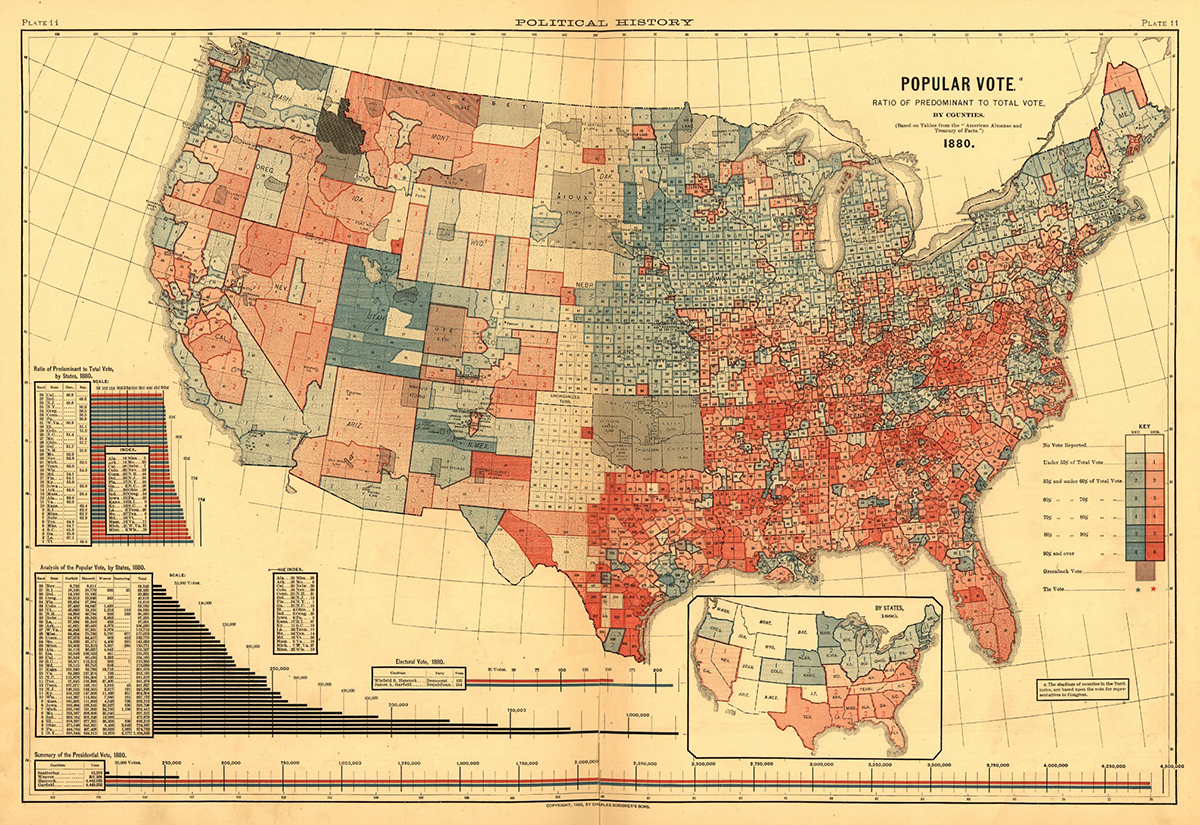
While flipping through “Scribner’s Statistical Atlas of the United States,” first published in 1883, Susan Schulten marvels at the above map from 1880, “the first American attempt to map the outcome of an election”:

The Popular Vote map was the creation of Henry Gannett, superintendent of the census and future president of the National Geographic Society. It was the first map to use shading techniques to visualise American political behaviour. I was struck by the spatial patterns:

the dense chequerboard of eastern counties contrasting sharply with the open crazy-quilt patchwork out West. Then my eye was drawn to the patterns of colour in the eastern states. Just as now, red and blue were used to show which party had prevailed in each county.

The map even looked a little like the 2012 electoral picture, with a preponderance of blue through what we now regard as the Democratic stronghold of the north-east, and red spilling across the Republican South. It took a minute to see that the colours were reversed: here red represents the Democrats and blue the Republicans. So while the map looks familiar, the political landscape has flipped. … [I]t was not until the election of 2000 that NBC’s “Today” show indelibly fixed the colours of American politics: red for the Republicans and blue for the Democrats.

Update from a reader:

I find it fascinating that Utah is one of the only locations that has completely switched (or didn’t switch, depending how you look at it). It’s an interesting artifact of Mormon history and the change of it’s theology and relationship to American culture.

Because Condescension Needed An Explainer

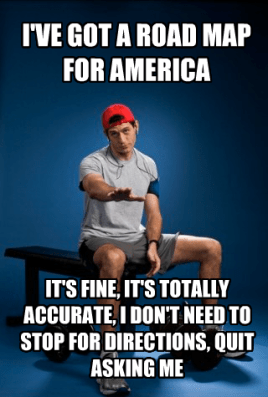
Soraya Chemaly interviews Rebecca Solnit – who coined the term “mansplaining” – about her new essay collection, Men Explain Things to Me:

The term “mansplaining” has resonated with so many women. It shifted the cultural universe ever so slightly (in a good way). Did you expect this response?  

You know, I had a wonderful conversation about a month ago with a young Ph.D candidate at UC tumblr_md2ucm4uUC1rii2yho1_400Berkeley. I’ve been a little bit squeamish about the word “mansplaining,” because it can seem to imply that men are inherently flawed, rather than that some guys are a little over-privileged, arrogant, and clueless. This young academic said to me, “No, you don’t understand! You need to recognize that until we had the word “mansplained,” so many women had this awful experience and we didn’t even have a language for it. Until we can name something, we can’t share the experience, we can’t describe it, we can’t respond to it. I think that word has been extraordinarily valuable in helping women and men describe something that goes on all the time.”

She really changed my opinion. It’s really useful. I’ve always been interested from how much our problems come from not having the language, not having the framework to think and talk about and address the phenomenon around us.

Looking beyond the titular essay, Sady Doyle praises the volume for its scope and ambition:

It’s rewarding just to see the license Solnit gives herself to explore the territory, to pit Sontag and Woolf against each other in one essay and los desaparecidos against the effacing of women’s matrilineal ancestry in the next. …

A writer’s authority is a strange thing, a hybrid of expertise and sheer arrogance. It helps to have an encyclopedic knowledge of facts. But the key to being a good essayist, rather than a good Wikipedia editor, is the willingness to claim the authority of one’s opinions; to say that you know what matters, and why it matters, and (here’s the tricky part) why everyone should listen to you and (preferably) pay you for the privilege.

The right to that kind of self-confidence has always been denied to women. By allowing herself such a wide range of subject matter and approaching it with such confidence, Solnit suggests that the key to defeating mansplaining is not just identifying the problem or giving it a catchy new name, but insisting on women’s right to do a little explaining themselves.

(Image from the Mansplaining Paul Ryan tumblr)

Mike Kinsley’s Unforgivable Prose!

I was hoping to duck the latest Kinsley-Greenwald skirmish because I like both of them personally and admire both professionally. But Margaret Sullivan has forced the issue. The NYT public editor actually writes that Kinsley’s tone was unworthy of the “high standards” of the NYTBR. More tedious thumbsuckery please! And really, was her sense of humor surgically removed at some point? If you can read the first few paragraphs of that review and not have something of a smile flicker around your chops, you have. As for the notion of sneering – it can’t be for this, can it:

Maybe he’s charming and generous in real life. But in “No Place to Hide,” Greenwald seems like a self-righteous sourpuss, convinced that every issue is “straightforward,” and if you don’t agree with him, you’re part of something he calls “the authorities,” who control everything for their own nefarious but never explained purposes.

This is about how Greenwald comes across in the book under review. It is qualified by Mike’s acknowledgment that he has never met Glenn in real life. I really don’t see how that’s some kind of offense, worthy of the school monitor’s attention. It’s part of a litany of dissident characters Kinsley beautifully and hilariously evoked.

Then there is Sullivan’s contention that the review somehow argues that the press has no role in uncovering state secrets – which is why she actually thinks the review should have been spiked. And yet here’s Kinsley’s second fricking paragraph:

There are laws against government eavesdropping on American citizens, and there are laws against leaking official government documents. You can’t just choose the laws you like and ignore the ones you don’t like. Or perhaps you can, but you can’t then claim that it’s all very straightforward.

What Kinsley is criticizing, if I’m reading him right, is the simplistic idea that no conflicts are involved here. It is not axiomatic that all government secrets must be exposed without legal consequences, Kinsley argues, unless we suspend the rule of law entirely or obey it when we like it and not when we don’t. That’s a rather limited point. It assumes merely that there may be a genuine government interest in keeping some things secret, as well as a genuine public interest to know what’s being done in our name. And that these are necessarily sometimes in conflict. But Kinsley is also pretty emphatic about what the press should do: “the process of decision-making — whatever it turns out to be — should openly tilt in favor of publication with minimal delay.” How can anyone read that review and conclude as Sullivan does that

Mr. Kinsley’s central argument ignores important tenets of American governance. There clearly is a special role for the press in America’s democracy; the Founders explicitly intended the press to be a crucial check on the power of the federal government, and the United States courts have consistently backed up that role. It’s wrong to deny that role, and editors should not have allowed such a denial to stand.

Seriously: can she read? Yes, Mike has a low view of journalism. But so low it’s unprintable? So low that the editors should have refused to allow him to express his opinion? Pious piffle.

On the deeper subject at hand, I should add that I am closer to Glenn’s position than Mike’s, but certainly see it as a tough call and a difficult dilemma. The way the US government has acted – especially since 9/11 – has pushed me into the dissident camp. That Obama presided over a vast apparatus of domestic spying – after being elected to roll back parts of the war on terror – is proof positive to me of the need for Glenn’s work. But that’s a contingent judgment about a particular period of time. It’s not an eternal truth. And government is not an eternal evil. And journalists, while having a special and vital role in a democracy, are also not above the law.

Man’s Best Cancer Detector?

Maybe you should let dogs sniff your junk after all:

Researchers used two professionally trained dogs to test their ability to detect prostate cancer from a pool 677 people. One group of participants was cancer-free; the other group ranged from individuals with low-risk tumors to those whose cancer had metastasized to other tissues. The two dogs sniffed urine samples, and identified signs of prostate cancer with a combined 98 percent accuracy. In a few cases, the dogs identified cancer when it wasn’t there — called a false positive — accounting for the remaining 2 percent of cases. That success rate represents a vast improvement over the standard Prostate-Specific Antigen test, which has a false positive rate as high as 80 percent, Bloomberg reports.

But some specialists have their doubts:

A debate currently is raging over whether prostate cancer is overdetected and overtreated, given that most men develop the cancer late in their life and end up dying of other causes. Those who are treated for prostate tumors often suffer problems such as impotence and incontinence, leading some doctors to argue that it might be better to leave prostate tumors undetected.

“Screening for prostate cancer is a very controversial area, and while I would like to think dogs could solve that problem, I don’t think that’s a possibility,” [Charles] Ryan said. “That said, it’s fascinating to think as a scientist these things are out there and actually exist.”