A History Of Sponsored Content

The always-worth-reading Jack Shafer digs up the long history of passing off advertizing as editorial:

Advertisements masquerading as editorial copy date back at least to the late 19th century, when they were called “reading notices,” according to the Encyclopedia of American Journalism. Publishers encouraged the placement of reading notices, which placed brand and company names in news stories without any disclaimers, because it was more profitable than conventional advertisements.

And the critics then sound uncannily like this blog today:

In his memoirs, Washington Gladden wrote about quitting his job as a reporter at the New York Independent in 1874 because he could not convince the paper to stop publishing reading notices and publisher’s notices that looked like news stories. “They seem to Atlantic-Sponsorbe essentially evil, and a weakness to the paper,” Gladden wrote. “My scruple may be a foolish one, but I cannot overcome it.” (Hat tips to Prof. Ronald R. Rodgers for this and several other historical pointers.) Renowned journalist Charles A. Dana despised the form, too, writing in 1895, “Let every advertisement appear as an advertisement; no sailing under false colors.” His sentiment was shared by many colleagues, including Editor and Publisher, which editorialized against them, and Adolph S. Ochs, owner of the New York Times. Idealistic publisher E.W. Scripps, who founded an ad-free newspaper in Chicago in 1911, thought avoiding unlabeled reading notices made “good business sense.”

But reading notices were considered so effective that one 1908 book on advertising devoted an entire chapter to “Puffs, Reading Notices, Want Advertisements, Etc.” The key to writing a good reading notice, author Albert E. Edgar advised, was duplicity. “A reading notice of any kind has a certain amount of value because the public reads them as matters of news and not as items of advertising.”

The core business model of sponsored content is lying to readers in order to whore out more completely to advertizers. Call that what you will – “advanced advertorial techniques” or “partners” – the better the lie the more effective the ad. The small question is whether media sites whose fundamental goal is deceiving readers eventually render themselves obsolete. As the WSJ’s Gerard Baker puts it:

An advertiser wants to advertise in The Wall Street Journal to be seen and to be associated with a brand like The Wall Street Journal, or The Financial Times or Bloomberg, because those news organizations are respected. If [advertisers] manipulate the digital or print operations of those news organizations, it makes the reader confused as to what is news and what is advertising, and the reader’s trust, the very reason that those advertisers want to advertise in those news organizations, goes away.

Nate Silver gives it eighteen months, tops. I suspect that’s optimistic. By which time no one may be able to tell the difference between an ad and a piece.
Quotes For The Day

“The delivery of relevant messages and cultivating user engagement are important goals, of course. That is the point of advertising, after all. But it’s equally important that advertising not mislead consumers. By presenting ads that resemble editorial content, an advertiser risks implying, deceptively, that the information comes from a nonbiased source,” – Edith Ramirez, the chairwoman of the F.T.C.

“The word ‘advertisement’ tells people what is being done to them. The whole point of the word ‘sponsored’ is to avoid calling it what it is,” – Robert Weissman, president of Public Citizen, a consumer advocacy group.

The Truthiness Of Buzzfeed

Over Thanksgiving, TV producer Elan Gale live-tweeted a lengthy, outrageous confrontation with a fellow airplane passenger. It became a viral sensation, understandably amped up by Buzzfeed’s viral algorithms. Pity the entire thing was a complete hoax, designed, according to Gale, to prove that whether something is, you know, true or not matters little in the era of lucrative viral posts. He got his proof. Buzzfeed got 1.3 million pageviews on the hoax. Which is why I’m relieved that Dave Weigel is happy to take a tiny bit of time to wonder why no one checked the story at Buzzfeed, and when the hoax became obvious, why they simply switched out their previous story with another post praising the “epic” scam. Weigel notes:

This is fairly fucked. Yes, people on the Internet want to believe salacious stories. Reporters want to publish stories that people read. If there’s a great reward, and little downside, to be had in publishing bullshit, the Internet’s going to get more bullshit. As one of my colleagues put it, “‘Too good to check’ used to be a warning to newspaper editors not to jump on bullshit stories. Now it’s a business model.”

It sure is – and, along with advertizing deliberately designed to deceive readers into thinking it’s editorial, it could bring $120 million in revenue next year for the entertainment and public relations site. In due course, it appears Buzzfeed came up with a response to Dave. Money quote from BuzzFeed news director Lisa Tozzi:

We used the word “claiming” to describe Elan’s tweets, and updated our post several times as it appeared to unfold—but we should have make that skepticism clearer. We’re not in the business of publishing hoaxes and we feel an enormous responsibility here to provide our readers with accurate, up-to-date information.

Well that’s a relief, until you think some more about it. By gleefully running unchecked hoaxes, and then insisting that they really do care about truth, Buzzfeed muddies the waters still further.  What’s striking to me about Buzzfeed is that they haven’t really sufficiently thought through what it means to deliberately deceive readers by running advertizing as editorial, or what it means to be both an instant entertainment provider whose success is measured in jumping on viral waves seconds before their competitors, and to claim to be journalism.

In trying to be both under one brand, they are unwittingly doing a lot of damage both to a generation’s core understanding of what journalism actually is – the viral hoax was “reported” by “reporter” Rachel Zarrell – and to any understanding of how journalism is any different from copy-writing.

There are many excellent reporters at Buzzfeed doing their best, which is often very good. I don’t like writing posts like this that may seem to them like personal attacks. They’re really not. All I can say is that I don’t think they have fully grasped how being part of an entertainment/public relations site whose core mission is making money can in any way be compatible with the profession formerly known as journalism. Just because you wish it to be so does not make it so. Only when they put their actual journalism in a clearly separate space than their entertainment, and only when they stop deliberately blurring advertizing with editorial, will they be able to retain a journalistic soul. But that, of course, would end their business model entirely.

Previous Dish on the Buzzfeed model here, here, here and here.

Native Ads Will Only Get Worse

Farhad Manjoo joins the fight against sponsored content (WSJ):

There’s a host of research showing that people are good B.S. detectors; we’re naturally, justifiably more skeptical of paid messages than unpaid ones. And, over time, we notice advertising cues and begin to ignore messages that look like ads. That’s why ad formats lose their effectiveness. It’s why you barely notice Web banner ads, billboards, and TV ads, and it’s why advertisers keep paying more to have their brands woven deeper into content. When ads appear as part of content (as in product placement), they sneak past our defenses; they don’t look like ads, so we aren’t as skeptical of them.

The online-ad marketplace is ferociously competitive, and given the wild scramble for ad dollars among Google, Facebook, and Twitter, not to mention smaller media sites, advertisers are in a position to keep asking sites for more. If they begin to notice that ads marked “sponsored” aren’t doing as well as they used to, they’ll demand fainter disclosure, and they’ll get it.

Yglesias is more worried about the likes of Mike Allen. Recent Dish along those lines here.

Mike Allen, Busted, Ctd

Chait reflects on the new Mike Allen take-down:

Playbook goes beyond the routine and wildly promiscuous use of native advertising. Indeed, the behavior Wemple documents would ordinarily amount to a scandal and a likely firing offense, except that it seems to be Allen’s essential job description. As Wemple points out, some of the advertisers are also Allen’s friends. And, of course, his sources also consist significantly of his friends.

The intermingling of media, business, and elected officials that is on gross display once a year during the White House Correspondents’ Dinner, and which Politico both covers and participates in with peerless enthusiasm, is Allen’s vision of how journalism is supposed to function normally. Sources, friends, and sponsors all blur into one mutually protective circle. Last year, Allen gave breathless, PR-esque coverage to Fix the Debt, the pillar of respectable establishmentarian lobbying, and then, within days, announced that the group was sponsoring Playbook. …

The Mike Allen scandal is not that advertisers purchased favorable coverage in Playbook. The scandal is that, at this point, such corruption is unnecessary.

Drum sees the story as the “latest example of the press going into full stonewall mode whenever they’re the ones a story is about”:

Of course [Editor-in-Chief John] Harris refused to say anything. It’s standard journalistic practice. It’s only other people who have to answer questions. It’s outrageous to expect news organizations themselves to do the same.

If the corruption is no longer a scandal, then surely a paper’s refusal to answer serious questions about its ethics is. By what right does Politico demand accountability from those in power, while refusing to engage in even a modicum of accountability itself? The lack of response must lead any objective person to believe the worst: that Playbook is neither ethical nor journalism. More from the Columbia Journalism Review:

Allen is DC’s access journalist par excellence, which is saying something in that town. Most beat journalists toss off the occasional beat sweetener/source greaser to gain access to a newsmaker and soft-pedal negative news to maintain that access. Access is a kind of currency: Get it and you can break news and rub elbows with important people. Allen makes this ugly sausage-making process more corrupt by mixing access currency with actual currency. Buy native ads in Playbook, get embarrassingly favorable news coverage in Playbook.

It stinks to high heaven.

Mike Allen, Busted

US-TAX REFORM-NORQUIST-ALLEN

Dish readers know what I think of “native advertizing” and “sponsored content.” If it’s an advertorial, just call it and clearly label it an advertorial! Full disclosure and transparency are essential. The rest is whoredom, not journalism. When a journalist becomes a copy-writer for big advertisers giving him or his publication money, and does not clearly disclose the conflict of interest, he or she has ceased to be an independent journalist and joined the lucrative profession of public relations.

Read Erik Wemple’s evisceration of Mike Allen’s Playbook and make up your own mind. But to my eyes, it reads like a meticulously researched tale of at least the appearance of blatant corruption. Wemple starts with the kind of test I used for Buzzfeed’s corporate whoredom. Guess which one of these two items Mike Allen wrote and which one was written by the US Chamber of Commerce?

3) The U.S. Chamber of Commerce has an ambitious new agenda to generate stronger, more robust economic growth, create jobs, and expand opportunity for all Americans. Learn more about the Chamber’s American Jobs and Growth Agenda at http://www.uschamber.com/issues. **

4) “U.S. Chamber of Commerce will launch ‘On the Road With Free Enterprise,’ a two-month cross-country road trip to promote ‘the principles of free enterprise and the best of America. Your Free Enterprise Tour Guides will see the sights, check out local events, talk to businesses, and share it [online]. More than 900 teams applied to be the Free Enterprise Tour Guides, and after months of poring over applications, two teams remain: Jen and John, and Nate and Joe. You can vote [here] once per day.’ http://www.FreeEnterprise.com/tour”

Allen wrote the first second press release; the US Chamber of Commerce the second first. [Correction here] But the Wemple examination impresses because of its thoroughness. After a while, the examples are so egregious and numerous they beggar belief. Wemple and the Post unleashed an army of bots onto the Playbook archive and came to the following inescapable conclusion:

It’s about time that Politico’s Allen got his due as a native-advertising pioneer. A review of “Playbook” archives shows that the special interests that pay for slots in the newsletter get adoring coverage elsewhere in the playing field of “Playbook.” The pattern is a bit difficult to suss out if you glance at “Playbook” each day for a shot of news and gossip. When searching for references to advertisers in “Playbook,” however, it is unmistakable.

The most egregious examples are the US Chamber of Commerce, BP, and – yes – Goldman Sachs:

Like BP and the Chamber, Goldman Sachs is a pivotal advertiser for Politico, routinely placing back-page ads in the print product and occasionally “presenting” “Playbook.” Differentiating between those ads and Allen’s blurbs can strain the eyes. Examples: Goldman Sachs fights child sex trafficking (Jan. 23, 2013). Goldman Sachs to assist small businesses in Philadelphia. Jan. 9, 2013. Goldman Sachs helps veterans. (Dec. 14, 2012). Goldman Sachs helps small businesses. (June 12, 2012). Goldman Sachs Business Book of the Year Award! (Aug. 13, 2012). Puff piece on Goldman Sachs’s Lloyd Blankfein. (June 14, 2012).

Allen is also a close friend apparently with BP executive Geoff Morell, something he didn’t disclose when writing a puff item about Morel’s promotion.

Wemple is clear that the rest of the Politico seems very different, covering the powerful with persistence and skepticism, quite unlike Playbook’s relentless cheering of Washington’s corporate business machers. He’s also fair in noting Allen’s incredible persistence and energy as a reporter. But I’ve noticed before how Allen eagerly just gives the powerful a platform rather than holding them to account – and doesn’t even seem to understand that being a courtier to Washington Inc. and Washington’s most powerful is not the same as being a journalist. For my previous posts on Allen’s acting as a p.r. flak for Cheney and Ailes, among others, see here.

And all of this may not subjectively feel to Allen anything other than his reflexive energy and eagerness to please. He has long been a conduit for the wealthy and powerful, rather than a critic of any kind, and he doesn’t seem to understand why this makes some of us uncomfortable. But I didn’t think there was such an obvious connection between the corporations he promotes and their advertising dollars in Politico, which opens up a whole new issue – one noted not so long ago by Michael Calderone. And the mountain of evidence is very hard to refute.

So you wait in the article for Allen to defend or explain himself or for Politico’s editors to push back. But they refused to cooperate with the piece at all! “In rejecting a sit-down discussion, Editor-in-Chief John Harris said the premise ‘is without merit in any shape or form.'” So if corruption is not behind all this, what is? Or is all of this just an accident that requires no explanation at all?

And – not to get all pious about this – but aren’t journalists required to be transparent, when such obvious conflicts of interest are exposed? How can they demand transparency from public officials when they refuse to provide it themselves? Glenn Greenwald, call your office. It looks like we need you even more than we thought we did.

(Photo: Jim Watson/Getty.)

The World’s Most Powerful Trolling

Earlier this week, Forbes put out a “World’s Most Powerful People” list with Putin at the top. I wasn’t kind. (It’s a bit of an epic smackdown, if you want to watch). Simon Tisdall was also gob-smacked:

[T]he praise for Putin from Forbes, a magazine that supposedly champions individual free enterprise, as a man who “has solidified his control over Russia”, is jaw-dropping. If power is to be measured by the successful imposition of authoritarian governance, then surely Kim Jong-un, North Korea’s dictator, should be Forbes’ No 1? On this basis, Saddam Hussein and Joseph Stalin would qualify for emeritus awards.

In point of fact, Putin’s power is largely illusory – a false idol erected and nurtured by a phalanx of Kremlin cronies, and maintained through control of Russia’s fast-depleting oil and gas revenues and an ever more repressive grip on civil society and the media.

The whole farce was obviously a way to get media attention (success!) but also an obvious product of Obama derangement syndrome. Some people cannot see foreign policy in anything but crude schoolyard terms – in which case, Obama’s willingness to give Putin the Syria WMD brief was clearly a sign of the president’s comparative weakness. This vote was obviously designed to stick the president in the eye. And have you looked at Forbes lately? They make Buzzfeed look like a virgin when it comes to advertorial.

More to the point, we’ve seen that Russia’s oversight has – so far – resulted in an unexpected success in destroying the chemical weapons sites by the deadline, which is today. You won’t hear that on Fox – but it’s a huge success. Obama’s avoidance of getting dragged into Syria’s civil war was obviously a wise move; to get an end to Syria’s WMDs at the same time is pretty damn cool. The outcome was a win-win for both Obama and Putin – and the world. And Obama made it happen. Not so powerless after all.

Guess Which Buzzfeed Piece Is An Ad, Ctd

Clearly-not-a-reader writes:

I work for Cision, a global pr/marketing software company. We are looking for sites who have “sponsored content” opportunities, much like advertorials. I was hoping you could tell me whether you and your site The Dish accept sponsored content written by or for brands. If you do, I would love to learn about how much you charge, get your contact information, and get a better understanding of the program so that I can pass that information on to the 10,000 clients of Cision. Thank you for your time.

Meanwhile, David Carr finds a web ad guru who is beginning to wonder whether “sponsored content” might be a mistake for journalism, paving the way for its destruction:

“I completely understand the value of native advertising,” Mr. McCambley said, “but there are a number of publishers who are allowing P.R. firms and advertising agencies direct access to their content management systems and allowing them to publish directly to the site. I think that is a huge mistake. “It is a very slippery slope and could kill journalism if publishers aren’t careful,” he said.

He’s right. Publishers might build a revenue ledge through innovation of the advertising format, but the confusion that makes it work often diminishes the host publication’s credibility.

Business models that treat journalism as a tool primarily for advertisers will kill journalism in the end. Because I mean by journalism not a platform for entertaining corporate-sponsored listicles, but an established fourth estate that readers trust as independent, transparent, and truth-seeking. If journalism is so enmeshed in selling things that ads and editorial are one hard-to-define mush, then its core value – independent editorial judgment – is inevitably debased.

Of course, this may not matter to those who, like the business geniuses behind Forbes, Buzzfeed, the Atlantic et al, are concerned above all with profits. Journalism, for many of them, is just a means to money. Which means, if they keep calling the shots, journalism is in danger of disappearing quietly, like a law repealing itself.

Update from a reader:

A point of clarification about that contact from Cision. That was most likely not a marketing message. Cision maintains a online database of information about media outlets, including online sites. Included in that database of information would be confirmation if that site accepts sponsored content. People like me use that information to determine if we can approach an outlet to place sponsored content. They were probably contacting you just to update their database.

Sponsored Content Watch

Screen Shot 2013-09-12 at 2.12.42 PM

A reader writes:

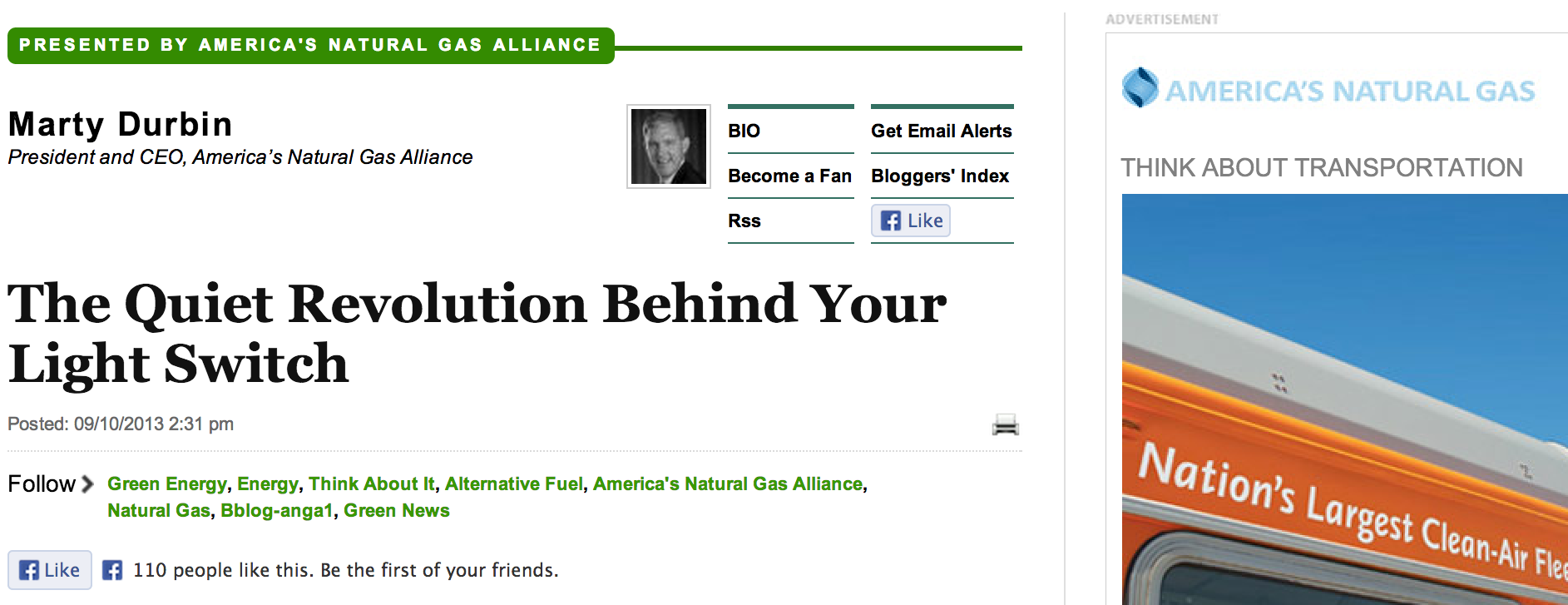
Huff post currently has a sponsored post about PRO-natural gas. They are always posting anti-natural gas stuff on the website, and that’s clearly where they stand. But they still accepted sponsorship for something that goes against their supposed values.

Maybe that’s a brilliant new ad strategy: take a position, unnerve your opponents, and then get them to pay you to run their views in a form that looks almost exactly the same as regular editorial copy. The only flaw in this strategy is running your own position in the first place without getting money for it. Maybe the next phase of sponsored content will go to the next level: websites entertaining bids for paid “articles” for any point of view whatsoever. Then you can let the editorial staff go. The business side can always manage the pro and con paid pieces … and would anyone notice anyway?

Guess Which Buzzfeed Piece Is An Ad? Ctd

Just a little nugget of news I missed last month from the phenomenally financially successful site, Buzzfeed. It has a new feature called a Listiclock, which was developed, of course, with Pepsi. Anthony Ha recently marveled at it:

Every 10 minutes, the minute display will show a list that’s specifically sponsored by Pepsi — apparently, these lists are supposed to be “‘unbelievable,’ fun, and amazing” but aside from a few mentions of Pepzi Next, I’m not sure most readers will be able to detect a big difference between a normal BuzzFeed list and sponsored piece like “10 Traditions You Probably Didn’t Know About.”

Ya think? Then this little gaffe:

This isn’t the first time BuzzFeed has offered a new way to navigate the site as part of an ad campaign, either — a couple of months ago I wrote about the site’s “Flight Mode”, which was promoting GE Aviation’s presence at the Paris Air Show. BuzzFeed President and COO Jon Steinberg told me that ideas often pass back-and-forth between the company’s ad side and editorial side, and that he’s actually interested in exploring a non-sponsored, desktop version of the Listiclock.

At what point will Jonah Peretti acknowledge that it’s all advertizing-as-entertainment and be done with it?