The Men’s Room Doesn’t Exist In Nature

Ted Trautman explores America’s public toilet regulations, which still mandate gender-segregated restrooms in most states and cities:

Many states follow the guidelines laid out in the Uniform Plumbing Code, which stipulates that “separate toilet facilities shall be provided for each sex,” with exceptions for very small businesses as measured in square footage and/or customer traffic. In the eyes of the law in these places, a business with two unisex toilets can be considered to have no toilets at all, since neither facility explicitly serves men or women.

Such laws date back to 1887, according to Terry S. Kogan, a University of Utah law professor and a contributor to the book Toilet: Public Restrooms and the Politics of Sharing. One hundred and twenty-seven years ago, Massachusetts passed the first law mandating gender-segregated toilets, and many states quickly followed suit. Many of those laws have never been substantially modified, with obvious exceptions in progressive enclaves like D.C. and San Francisco, meaning that much of the United States’ toilet-related building codes reflect a literally Victorian prudishness that we might mock in other contexts.

Elizabeth Nolan Brown delves deeper into this regulatory morass:

These days, America’s public restrooms are regulated by two separate federal agencies.

Workplace restrooms are the purview of the U.S. Department of Labor, which sets state guidelines through the Occupational Safety and Health Administration (OSHA). Non-workplace public restroom guidelines are governed, broadly, by the Department of Health and Human Services.

More specific regulations are largely enacted though through state and municipal building codes. These codes dictate exactly how many toilets and/or urinals that buildings, businesses, and other public entities must provide, based on occupancy capacity. And they mandate not only the existence of separate men’s and women’s bathrooms but also how many “fixtures”(toilets or urinals) must exist for each.

Restrooms are still almost exclusively gendered,” writes Suzanne LaBarre at Fast Company. “It’s a form of exclusion that’s written into state building code, presenting an obstacle for gender neutral bathroom advocates.”


Exporting Captain America

Zachary M. Seward finds that Captain America: The Winter Soldier is scoring big in movie theaters worldwide:

America’s greatest export is entertainment, and its improbable brand ambassador is now Captain America. The second installment of Marvel’s movie franchise is drawing huge audiences outside the United States, even in areas of the world that might ordinarily reject a jingoistic superhero clad in red, white, and blue. Captain America: Winter Soldier pulled in $107 million overseas [the weekend before last], even more than its record-breaking $96 million draw in the US. It was the number one film in China ($39 million), South Korea ($20 million), the United Kingdom ($18 million), Mexico ($16 million), France ($12 million), Russia ($7 million), and Australia ($6 million).

Warner Brown explains the appeal in China:

Why has an avowedly all-American hero proved so popular here? Launching the film on a three-day holiday weekend shortly after its stars toured Beijing certainly didn’t hurt. But Winter Soldier also resonates because it keeps the hero’s fundamental patriotism intact while modernizing his conflict for a complicated new era, pitting him against enemies burrowed deep within the government he serves. ”[The new villain] is the very country he loves and protects,” writes one Douban reviewer. “To love one’s country isn’t the same as loving one’s government: This is the main draw of Captain America.”

Update from a few readers:

Twice now, your blog has gotten something about comics totally backwards.

The first time some months ago was by implying that Batman started out in the 1960s Adam West goofy stage, when in reality he killed people (although their deaths are only implied) quite often in his early appearances.

Now you are not just making remarks that are dead wrong about Captain America. You have the character totally wrong, and worse you quote someone who is as well. Captain America has never been the jingoistic “America first, America only” hero. He is the moral heart of the marvel universe. He has actually gone against the government and given up being Captain America, rather than go against his values in the early 1970s and in the mid 2000s he led the anti-government faction in the “Civil War” event. Captain America has only been that sort of character during his original run in WWII and the “commie smasher” era, the later of which has been removed from the character.

The idea that a good-hearted idealist that stands for truth, justice and freedom doesn’t have an overseas appeal because he is dressed up in the American flag is only a skin deep analysis of the character, which everyone seems to acknowledge but ignore anyway. To those familiar with the character the idea Iron Man is popular overseas is much more surprising (because he actually is that sort of character much more so).

Another:

I’ve been a little bit disappointed by the media’s coverage of Captain America: The Winter Soldier but in no way surprised. It starts with the disadvantage of being a comic book movie, which God forbid we take seriously on it’s own terms; but it might also be a symptom of the media’s downplaying dissent in the mainstream. The Winter Soldier is a work of pop entertainment, to be sure, but it takes on establishment civil liberty and defense policies fairly specifically. This has gone mostly unnoticed in the press, but even Brown seems to be only skimming the service on this film’s appeal. It’s essentially the first product of the mainstream American film industry to take on these issues with any genuine focus, let alone in the Obama era.

It’s important to point out that the first Captain America, 2011’s The First Avenger, is Marvel Studios’ second lowest grossing film, largely because it did so poorly internationally. It’s fair to say this is partly because the film was essentially a pastiche of a World War II propaganda film, and took a rah-rah attitude toward American military force. The Winter Soldier is not an intellectualized polemic by any means, but it does very viscerally place the ultimate symbol of Patriotic Heroism at odds with clear and pointed analogues for NSA domestic spying, drone warfare, the president’s Kill List, JSOC, preemptive warfare, and the manipulation of terror to pressure the public into accepting encroaching state power structures. This is a film largely about Captain America explicitly choosing to dismantle the corrupt American paramilitary espionage apparatus, and I think that might have something to do with it’s international appeal.

The Kids Are All Righteous

Adam Grant (NYT) discusses how parents can successfully impart moral values to their children:

In a classic experiment, the psychologist J. Philippe Rushton gave 140 elementary- and middle-school-age children tokens for winning a game, which they could keep entirely or donate some to a child in poverty. They first watched a teacher figure play the game either selfishly or generously, and then preach to them the value of taking, giving or neither. The adult’s influence was significant: Actions spoke louder than words. When the adult behaved selfishly, children followed suit. The words didn’t make much difference — children gave fewer tokens after observing the adult’s selfish actions, regardless of whether the adult verbally advocated selfishness or generosity. When the adult acted generously, students gave the same amount whether generosity was preached or not — they donated 85 percent more than the norm in both cases. When the adult preached selfishness, even after the adult acted generously, the students still gave 49 percent more than the norm. Children learn generosity not by listening to what their role models say, but by observing what they do.

Razib Khan thinks these studies overlook the question of social environment:

To illustrate what I am getting at, imagine two children who are given up for adoption, and whose biological parents are alcoholics. Imagine that you know the biological parents are both carrying genes which are strongly correlated with alcoholism. Both these hypothetical children are adopted into conservative white upper middle class families, one in Orange county California, and another in an affluent suburb of Salt Lake City. Both families are socially conservative, and do not tolerate drinking among their children. My prediction is that the child adopted into a Mormon culture which is far less tolerant of individual choice on the issue of alcohol consumption will have lower risks of being an alcoholic simply because the whole landscape of decisions is going to be altered throughout their whole life. An adopted child with a family history of alcoholism is stilling going to have a higher risk within their population, but the nature of the population is likely to shift the baseline odds.

Katy Waldman focuses on another aspect of Grant’s argument, that children respond better to praise of their character than praise of their choices, but that the opposite holds true for criticism:

In a way, criticism that invokes a kid’s inner nature boomerangs for the same reason that praising her intelligence can: A parent’s estimation of character becomes a prison sentence. For children constantly told they are smart, the pressure of living up to that epithet looms large. Depending on how confident the kid is, the weight of the prophecy sometimes outweighs the thrill of getting complimented. Meanwhile, for children led to believe they harbor secret moral flaws, it’s easier to retreat or throw a tantrum than to fight the “truth.”

Pushing The Envelope

dish_tomoffinlandstamp

Itella, the Finnish postal service, has approved stamp designs based on the homoerotic art of Touko Laaksonen, aka Tom of Finland:

Laaksonen remains a towering and iconic figure in the gay art scene. His sketches, often explicit, were unapologetic depictions of gay sex and relationships. Laaksonen’s subjects were almost always muscle-bound, handsome figures, often bursting out of their clothes. His work, a meditation on masculinity, was also heavy on leather fetish imagery. It’s a pretty risque sheet of stamps. … “The sheet (of stamps) portrays a sensual life force and being proud of oneself,” said graphic designer Timo Berry, who selected the work that will be printed on stamps released this fall. “There is never too much of that in this northern country.”

Martin Schneider elaborates:

Tom of Finland’s images of leather-clad bikers mark the early boundary of what can be considered contemporary queer art designed for mainstream consumption. They shred the boundaries between porn and art. What makes them so intriguing, in a way, is that the male figures have a sensitivity accorded them that makes them something beyond mere “beefcake.” They’re images of pure fantasy, without being oppressive; they are obscurely real. In contrast to the once dominant gay stereotype of the “fairy,” “ponce,” etc., Tom of Finland’s bikers were unquestionably empowering. We salute the progressive minds at Itella who worked to make these stamps a reality.

Check out the risque three-stamp set here. A short documentary about Tom of Finland and his influence is here.

Going For Baroque

Stephen Burt identifies a new current in poetry:

[Nearly Baroque] poetry seeks the opposite of simplicity, preferring the elaborate, the contrived, taking toward sound play and simile the attitude of King Lear: “O, reason not the need!” But it can seem just simple enough in its goals. The 21st-century poets of the nearly Baroque want art that puts excess, invention, and ornament first. It is art that cannot be reduced to its own explanation, that shows off its material textures, its artificiality, its descent from prior art, its location in history. These poets want an art that can always give, or could always show, more.

Burt names the movement after Angie Estes, who wrote in a poem titled Sans Serif, “It’s the opposite of / Baroque, so I want / none of it.” He elaborates:

Again Estes summons the Baroque by name, in a poem entitled Ars Poetica:

I once dreamed a word entirely
Baroque: a serpentine line of letters leaning
with the flourish of each touching the shoulder
of another so that one breath at the word’s
beginning made them all collapse.

This word could stand for any of Estes’s poems. In them, as in much Baroque and rococo art, motion is life: nothing will stand still, and nothing stands up on its own. … Estes’s imagined motions, the serpentine curves of her irregular lines, take her not only from artwork to artwork but also from place to place, stitching together in her imagination, within a single poem, “the chasm of the Siq, the city of Petra / carved in its side” in present-day Jordan, “the unclaimed / cremated remains of those known as / the incurably insane at Oregon State Hospital,” and “the lapis lazuli seas of Hokusai seen / from outer space.”

In Philosophical Fetters

In a review of François Laruelle’s Principles of Non-Philosophy, Keith Whitmoyer considers the virtues of stepping outside of the philosophical domain:

It seems that most philosophers have taken their turn defining (and defending) the meaning and principles of the philosophical enterprise. What virtually all proposals have in common is that they presuppose that this question can be answered within the domain of the philosophical itself itself. In other words, we mostly have a history of philosophers philosophizing about philosophizing – in a word, meta-philosophy.

Meta-philosophy is, in a sense, founded on the assumption that only philosophy thinks, and therefore thinking about the meaning of the philosophical can only take place within the domain of the philosophical itself. There is something strange about this assumption. It seems as if meta-philosophy catches us in a circle. … Is it really the case that we can answer the question, “What is philosophy?” simply by philosophizing faster, stronger, or better and thus end only by duplicating what we were asking about? The problem with meta-philosophy is that, because we end up only philosophizing about philosophizing, we are never able to take a stand on what this is from the outside. The philosophical itself, because it remains the standpoint of inquiry, never truly succeeds in becoming an object of inquiry.

The Best Of The Dish Today

VFYWC#200 Collage

To mark today’s 200th window contest, we put together a new – and improved! – gallery archive to view all of the old contests. As an added bonus, when you click on any of the images in the gallery, you’ll be taken to a slideshow, which could be a fun way to play old contests, especially for our newer readers. Check them both out here.

The entire window view phenomenon on the Dish – and I know it’s the favorite feature for many of you – began a long time ago now, when I was thinking late one night about how to convey some of what I was absorbing from the in-tray. So many readers from so many parts of the globe – and yet they cannot really see each other!  The vfyw-bookhighdea was just to get a view from the window from readers across the country and the planet. Digital photos were easy to take and easy to email. Too easy, it turned out, as within a few days – I was doing the blog solo at that point and was awash in jpegs – I was begging for readers to stop. But you didn’t. Here’s how the feature played out over those first few weeks. We eventually made a coffee table book of the best views from all 50 states and 80 countries, which Chris Bodenner edited.

The first-ever contest is here. The idea was sparked – like most best things on the Dish – by a reader, who liked to “guess where the photo was taken from (at the country level at least) before scrolling down to see the caption.” See how the contest first evolved here. You can discover a few amazing contest-related coincidences here and here (even today’s view had a happy accident). In due course, VFYWC imitators started popping up all over the web, including the NYT and CNN. Llewellyn Hinkes-Jones built a zoomable VFYW game, which likely inspired the Google Maps version, GeoGuessr. Pete Warden created an interactive map and rotatable globe of window views. Data-cruncher Jay Pinho analyzed the feature in the depth. We marked our 100th contest by recognizing two grand champions, Mike Palmer and his teammate Yoko. But the undisputed all-time myplacewashdc206pmchamp is, of course, Doug Chini. His tips for winning the contest are here.
But the genius of the VFYWC lies with Bodenner. He created the contest, curates it, loves it, and has made it the mini-artform it is. Chris is also in charge of all the reader threads, so the contest came naturally to him. He makes it look easy, despite the hours of absorbing and editing down hundreds of emails each week. He doesn’t seem to sleep much, which is a mercy since the contests can take up to six hours to compose. Recently, Chas is shouldering more of the work.

Now the plug. This amazing little thing comes out of this blog and its community, and that blog has only one source of income, its readers. So if you’ve gotten something out of the Window Views or sleuthing through the contest each week, or just enjoy watching others figure it out, and haven’t yet subscribed, do Chris and Chas a favor and do it here. It’s our only way of paying for such work – and for the delight and intrigue and bafflement it produces – along with the scenes of surpassing normality that punctuate our coverage of a troubled world each day. So subscribe! Or buy a gift subscription for someone you want to play the contest with.

Elsewhere on the Dish today, our NSFW Saturday post, “Bottoms Up“, continued to draw the most traffic by far. (Yet only 11 of you publicly liked the post on Facebook. Own up to it, pervs!) Other popular posts included Fox actually taking the lead on calling torture torture, Rand Paul getting under the skin of neocons, and cannabis becoming more and more of a sacrament. Our big Truvada thread continued here. And you can read unfiltered comments at our Facebook page and @sullydish.

See you in the morning.

(Top image: All 200 VFYW contests, composed by Special Teams. Bottom image: A beagle in Adams Morgan.)

Looking Back At The Boston Bombing

Boston Prepares To Commemorate Year Anniversary Of Marathon Bombing

Ian Crouch visited a memorial to the Boston marathon bombing, which occurred a year ago today:

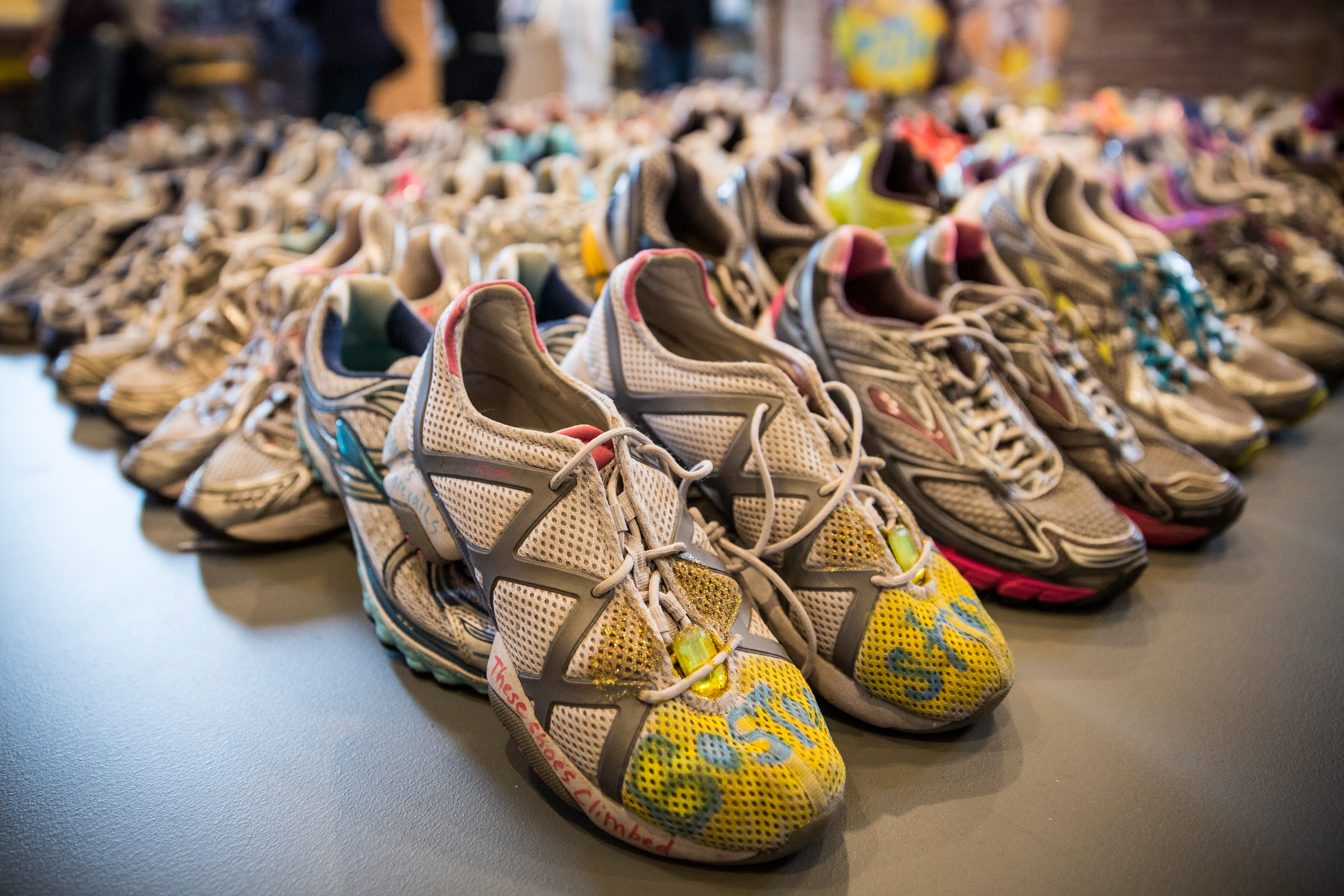
Last week, to mark the anniversary of the attacks, the Boston Public Library opened an exhibition called “Dear Boston: Messages from the Marathon Memorial” at its main branch, in Copley Square. The centerpiece is a collection of more than a hundred pairs of running shoes that had been left at the makeshift memorial. One pair has the word “Boston” on the left toe and “Strong” on the right. Another has a baseball set in each heel. Another features a tag with the number 26.2, the standard distance, in miles, of a marathon. The rest are just plain running shoes—an array of brands in a rainbow of colors, the kinds you see shuffling along the ground on a normal race day. Once shiny and gleaming, they are now dulled and frayed by use, and by the days they spent out in the weather last year.

Other items are a reminder of the simple, handcrafted objects that distinguished the memorial’s impromptu inspiration. The four white crosses are set in a row. Behind glass, scraps of paper communicate outrage and despair. There are signs with quotations from figures ranging from Martin Luther King, Jr., to Jerry Garcia (“Don’t tell me this town ain’t got no heart”). Notes and cards and posters from far-flung places: Istanbul, Morocco, the Philippines. Certain phrases recur, in pencil or pen or marker: “No more hurting people.” “Peace.” “Hope.” “We will finish the race.”

Eric Larson profiles Rebekah Gregory, whose leg was severely injured in the blast. She has undergone 16 surgeries and is now considering amputating the leg:

In the appointment room today, Dr. William McGarvey, Rebekah’s orthopedic surgeon, looks away from the window and asks her to stand. Reluctantly, slowly, she does. Tears spring to the corners of her eyes; her body begins to shake. The skin on her leg, between the scars and stitches, turns purple. She sits back down.

Resting, standing and sleeping — it doesn’t matter, she says. Everything hurts, “like an 11 on a scale of one to 10.”

She’s been taking pain medications regularly — Tylenol 3, Cymbalta and Celebrex — but admits they’ve only been temporary solutions. Minor distractions, at best, from the seemingly endless pain.

The main problem is Rebekah’s foot is drifting inward. The bomb destroyed tissues and bones, and because of where they’re missing, the tendons have nowhere to attach. As a result, they’re pulling from the inside of her ankle.

There’s still shrapnel from the bomb inside her leg. Sometimes, she says, a small piece of metal or BB will lodge out of her calf while she’s sleeping.

(Photo: Runner’s shoes are laid out in a display titled, ‘Dear Boston: Messages from the Marathon Memorial’ in the Boston Public Library to commemorate the 2013 Boston Maraton bombing. Last year, two pressure cooker bombs killed three and injured an estimated 264 others during the Boston marathon, on April 15, 2013. By Andrew Burton/Getty Images)

Regenerative Medicine Is On A Roll

First lab-grown vaginas, now lab-grown noses:

The biomedicine team at the University of Basel has reported the first ever successful nose reconstruction surgery using cartilage grown in the laboratory. The team took cells from five patients’ nasal septums and then grew the cells on a collagen scaffold. The engineered cartilage was then shaped and implanted. The patients were all aged between 76 and 88 and had all lost significant tissue in surgery for skin cancer. … A year after the reconstructive surgery, all five patients said they were satisfied with their ability to breathe and the cosmetic appearance of their nose.

Victoria Turk notes that while the method isn’t coming soon to an operating theater near you, it’s still exciting:

Unfortunately, it’s still a very specialist procedure, which means patient satisfaction isn’t the only factor to consider. The authors wrote in their discussion, “One important question to be addressed in future studies is the cost-effectiveness of a cell-based treatment when compared with the harvest of autologous native tissues,” and added that engineering tissue is a high-cost process.

Nevertheless, it’s a significant breakthrough that has obvious implications outside of this specific nasal surgery. … Suddenly, growing personalised organs from our own cells doesn’t seem quite so futuristic. Now we’ve got vaginas and noses down, you can count on scientists to be working on everything in between. Next step: functioning replacement organs-in-a-box.

Meanwhile, as an addendum to the vaginal-implant breakthrough, Kat Stoeffel interviewed a woman who might get one:

When did you find out you didn’t have a vagina?

I was diagnosed when I was 16 years old because I hadn’t gotten my period but the rest of my body was fully developed. My pediatrician didn’t know what was going on and sent me to a radiologist so I could get an MRI. They scanned and realized I missing my uterus, and through a gynecological exam, also missing the vaginal canal. From there I was sent to an MRKH specialist.

One of the reasons MRKHS gets sensationalized in the news, I think, is that we use the word “vagina” so loosely that the uninitiated can only imagine a Barbie blank space.

That’s the thing. MRKH is basically a genetic mutation, and the genes responsible for external sex organs and internal one are different. So the external ones develop completely normally, everything’s fine and functions the right way, that mutation causes the absence of the internal sex organs. It’s important to know that MRKH can present itself in many different ways, actually. There are some cases where women are actually born with a vaginal canal but no uterus, some women have skeletal issues or kidney problems.