My “Scorn Of Feminism” Ctd

Below is a bunch of reader commentary of the Dish’s recent coverage of gender-based debates like gamergate, catcalling, affirmative consent, and others. A dissenter gets the last word on #shirtstorm:

You have a tendency to hate Internet mobs even when they’re right. Matt Taylor’s shirt was staggeringly inappropriate for a professional workplace, particularly when he’s been tasked to be the public face of his organization on the day of its greatest triumph. He deserves the heat for thinking that was acceptable attire – no matter what the woman who made it for him says. Her opinion ought to be secondary to that of the women who had to work with him (and all the colleagues and supervisors who didn’t question that choice of clothing).

But you can prove me wrong: Wear a Tom of Finland shirt the next time you’re on Bill Maher’s show. Don’t let the culture police win!

Another writes:

Thank you for covering Gamergate. I was mostly unaware of the issue until you brought it up. Now I am beginning to understand its significance. Today, some clicking around on Gamergate brought me to two places that I think are telling about all of this. The first was someone disparaging you, and saying “there’s no way to use the phrase ‘creeping misandry’ and not be laughed out of the room.” The second was this screed by Daily Beast columnist and WAM supporter Samantha Allen. It’s opening lines are “i’m a misandrist. that means i hate men.”

Another reader on “why you can’t be a male feminist these days”:

I’m about the same age as you, Andrew. I believe in equal pay for equal work. I believe in women’s reproductive health, to include abortion without interference from the government, and that it should be part of a basic health insurance policy. I believe a woman should be able to do any job a man does (and as a former infantryman, that took some work on my part). I have several bosses who are women (some younger than myself) who deserve to be in their position and would do well moving further up the org chart.  I believe women should be free from sexual violence and perpetrators should be punished accordingly. In short, I believe everything classic feminism stood for to the best of my knowledge.

That said, there are so many people out there now (my Facebook feed is all about this) who follow what I consider a form of feminism that is exclusionary.

It is an all-encompassing worldview and everything, no matter how far afield, must fit into that worldview. The only thing I can compare it to is a real Marxist, if you’ve met one. Going to the bathroom to them is an integral part of the workers’ struggle (Marxists are the only people I’ve come across like this, so they are what I most easily compare it to). To hear them talk, I clearly have never had a consensual sexual encounter and must therefore be a rapist. At a minimum, I perpetuate the patriarchy and contribute to rape culture. This is non-stop wail I read everywhere I go online. Even though I’m on their side generally, I just can’t support them verbally because, whether they intend to or not, they are including me in their diatribes. I’m quite sure I’m not alone feeling this way. While you will hear it said that there is ‘always a fringe element’, its not true. This seems to be the majority. I’m reminded of the great Robin Williams movie The World According to Garp. In that movie, there is a group of feminists who are so anti-male, they don’t want Garp (or any male) to attend his mother’s funeral. It doesn’t matter what the content of his heart is, what matters is what’s between his legs. And that is what feminism is supposed to be fighting against.

That is why there is a movement for “why I don’t need feminism”. It’s not that they don’t want equality for women. They don’t want equality for women at the unreasoned expense of all men.

Another:

A couple of quick things you can do to at least keep up the pretense of not having a blind-spot where issues of feminism, gamergate and Twitter are concerned:

1) Not use the term “Social Justice Warrior” as an unironic derogative. (You’ve already taken baby steps in this regard.)

2) Not refer to a few people being banned from a platform created by a private company as a “Gender War.”

3) Really just stay away from warfare rhetoric altogether, particularly as a way to disparage and patronize people on the other side of the argument for you. (I’d say this to any offenders on the feminist side of the coin, as well. It’s just oogie.)

4) Maybe run even just one Dissent round-up post on this issue that doesn’t have your qualifying statements and nudgy asides after every quote. This is the only Dish thread in recent memory in which you haven’t published a single post of unqualified dissent. Even your latest “Dissent of the Day” on the matter has a response from you that’s as long or longer than the text from the person you’re quoting. Usually you’re more than happy to air the voices of the people who disagree with you and let them stand for themselves, in their own dissent posts. For some reason, where this issue is concerned, you’re incapable of even pretending to just sit back and listen for a little while.

That last point – “you haven’t published a single post of unqualified dissent” – is empirically untrue. Go here to read a strong female dissent, “the last word on the gamergate furore.” And views from bloggers different than my own are herehere, here and here, to list just a handful of recent posts. A reader links to yet another contrasting view:

Please try to find more feminist critics. Here’s an article from Slate that has the exact opposite take as you on Dr. Taylor’s shirt, using evidence the exact opposite of yours.

Another also thinks our coverage is wanting:

When it comes to racial issues you seem to understand that you simply haven’t had the life experiences to speak in a serious way on the topic without that acknowledgement. As a result, you often quote or defer to the likes of Ta-Nehisi Coates, etc. and take those experiences seriously. You are not a woman, you will never understand what it is like to grow up as a female, work as a female, experience life culturally, interpersonally, electronically as a female. Perhaps it is time you learn to defer a bit on those topics to those that do.

As regular Dish readers know, we are constantly posting content on a wide array of issues related to women, discussed and debated by a range of female voices, including liberal bloggers like Amanda Marcotte, Jessica ValentiAlyssa RosenbergAnn Friedman, Amanda Hess, Rebecca TraisterJill Filipovic, Jessica Grose, Kat Stoeffel, and Tracy Clark-Flory, to name just the most frequent. Follow those links to see their countless contributions to the Dish. Another dissenter conveys a growing feeling in the in-tray:

“Femi-left”?! Seriously, Andrew, you are one shitty, dismissive catchphrase away from me canceling my subscription (and I paid more than the usual, too). I hate to sound like a cranky subscriber at a theatre, and I hate even more the thought of losing your daily deluge of fascinating content, but your complete and utter inability to respond to women’s issues with even a modicum of respect for the opposition is currently cheese-grating my brain. You sound like a parody of Bill O’Reilly performed by a college sketch comedy group. I’ve never sent two e-mails to a website in one day in my life, but … well, here we are.

A reader who appreciates our coverage:

I just read the dissent post regarding your “scorn of feminism” and it made me remember why I love this site. There are so few people taking a logical, well-argued stand against identity politics without actually arguing FOR racism, sexism or homophobia.

I pissed off some family members this weekend by asking why/when the term “oriental” was considered racist. I was not appropriately satisfied with the explanation, “Hello! White privilege.” Asking for more than that is, apparently, a bridge too far, and asking the question itself is considered insulting and somewhat racist. Yeah, maybe not tightly related to issues around feminism, but it seems like the left, at this moment, is very very concerned with policing speech. Look at the response to Colbert’s comedy routine, or the move to rename the “Washington Redskins.”

As I’ve been mulling this over, I think there are two primary things that bother me about this. The first, is that by creating a set of rules (you are not allowed to say x, or y, or question this in any way), liberals are creating an easy way to identify those who are in the group and those who are out. If you don’t use the right words and follow all the rules, then we can ostracize you and treat you like shit. Which, let’s be honest, is a LOT more fun that listening to people and creating a respectful dialog.

The other thing that bothers me, is that policing language is cheap. The left seems to have found a way to be both self-righteous and not actually do anything hard. We make take a stand against the word “Redskins” but no actual change is going to happen in the lives of said Native Americans. They will still be poor, still live in devastated communities, and still die young. But it’s a lot easier to change the name of a football team than it is to go work for $20K/year at a food bank or homeless shelter out on the reservation.

So, yes, thank you for being a voice of reason in all of this. If we are going to have a free society, then it needs to be able to tolerate open debate.

One that note, the far-left blog Feministing wondered about the above episode, “Is South Park turning feminist?”:

Obviously there are issues with the gendering of this episode, such as the assumption that no girl would ever find farting funny (I sure do), that no guy would ever find queefing funny, and of course the avoidance of the fact that girls do indeed fart ourselves. Not to mention the reduction of the entire feminist movement into queefing rights.

But that’s what South Park does best: Takes an social movement or trend and highlights extreme stereotypes to bring to light the most ridiculous elements of that movement. So I didn’t really find my sexism-alert piqued by this episode and actually found it pretty funny. I felt like it was more the hypocrisy of certain taboo subjects that was more under attack here than anything else. It was certainly brave of the creators to even mention queefing at all, probably the most taboo of all taboo bodily functions.

One more reader ends us on a deadly serious note:

Thanks for posting on the Indian sterilization mess.  One aspect you left out of your analysis is how there’s a women’s rights angle to this as well.  Male sterilization is far less invasive and far safer than female, and yet disproportionately India’s program targets women.  There are a lot of reasons for that, but it can’t be denied that the patriarchal nature of India’s society definitely plays a big role.  The whole situation is beyond horrifying, not just because of the senseless deaths at the hands of misguided government programs, but because it reveals how little India values one half of its population.

Please please please give this story as much air time as you did the crazy thought-policing of Twitter by “feminist activists” and Gamergate. I hate to see feminism reduced to a bunch of Americans whining about people saying not-so-nice things about them on the Internet when elsewhere women are literally dying of neglect.  If women’s rights in this country have descended to the level of suppressing free speech, then clearly it is time to move our attentions elsewhere.

Obama’s Authority To Act On Immigration

Linker thinks it highly suspect:

What is so galling about the president’s pending circumvention of federal immigration law is that the White House hasn’t even attempted to justify it on grounds of necessity — no doubt because any effort to do so would be risible. The nation obviously faces no immigration emergency that could possibly justify the kind of extralegal action that Obama is contemplating. Cultivating a new constituency for the Democratic Party certainly doesn’t rise to that level, but neither does a big-hearted attempt to stop often cruel deportations of individuals and families residing in this country illegally.

Along the same lines, Douthat hits back at the argument that Obama’s actions don’t matter because they can be reversed by the next president:

As long as the United States elects its chief executives it will always be true that one president’s unilateral policy move can be theoretically reversed by the next one. But that reality doesn’t really tell us much of anything about whether a particular moves claims too much power for the executive branch itself.

Even in the fairly unlikely event that Chris Christie or Marco Rubio cancels an Obama amnesty, that is, the power itself will still have been claimed and exercised, the line rubbed out and crossed; the move will still exist as a precedent, a model, a case study in how a president can push the envelope when Congress doesn’t act as he deems fit.

Which is why it would have unreasonable to expect, say, liberal and libertarian critics of George W. Bush’s expansive claims of wartime authority to be mollified by being told: “Don’t worry, when you elect a president, you can run Guantanamo and the black sites and the N.S.A. the way you want, so stop complaining and just focus on the next election.” Those critics did focus on the next election, and in 2008 they won it, and put a liberal constitutional lawyer in the Oval Office in Bush’s stead. But in the end the Bush administration created precedents and facts on the ground that his notionally civil libertarian successor just accepted, and claimed powers that a liberal president has often (if oh-so-reluctantly) exploited to the hilt

Benjamin Wittes fails to see what laws Obama is breaking:

Republicans are tossing around all sorts of rhetoric about Obama’s decision to proceed unilaterally. John Boehner has floated the idea of litigating the matter. Some Republicans have described such an “amnesty” as a constitutional crisis. Some have even talked about impeachment. All of that assumes, of course, that the coming action is illegal, that the statute itself doesn’t give Obama authority to decide to stay his hand with respect to lots of deportations. Yet I have seen no news story or legal analysis that contains an actual argument to that effect. …

Obama himself has sown doubt about this own authority to effectuate this policy outcome without congressional involvement—stating in the past that he would love to do it, but did not think he had the legal authority. But at least as I read the relevant provisions of the Immigration and Naturalization Act, the statute actually gives him wide discretion to decline to deport non-criminal aliens who are legally deportable. Specifically, it contains no directive requiring the administration to pursue garden variety deportation cases. In fact, it has very little to say at all—except with respect to aliens who have committed crimes—about what happens if the President just doesn’t feel like deporting people. That silence seems to me to convey the authority not to act, both in the case of an individual whose circumstances authorities find compelling and also in the case of five million people whose circumstances authorities find compelling or whose status authorities choose for policy reasons to regularize.

A Setback For Abenomics

Japan’s economy is officially in a recession again, after its GDP shrank for two consecutive quarters. An increase in the country’s sales tax in April is believed to have been the tipping point:

“No part of Japan’s economy looks encouraging,” said Yoshiki Shinke, chief economist at Dai-ichi Life Research Institute, who had the weakest forecast in a Bloomberg News survey, with a 0.8% growth estimate for real GDP. “Today’s data will leave another traumatic memory for Japanese politicians about sales tax hikes.” For Prime Minister Shinzo Abe, the report probably guarantees he will put off the tax increase scheduled for October 2015, a move that people familiar with the matter have said will trigger a snap election next month. Japan also tipped into a recession after a 1997 consumption-levy rise, leading to the fall of the government of the day.

Sure enough, Abe called a snap election today to secure a popular mandate for delaying the next planned tax hike. Matt O’Brien faults the prime minister for putting the brakes on fiscal stimulus and turning toward austerity while the economy was still too weak:

The problem … is that the government has started working at cross purposes with the central bank.

See, at first, the government was spending money to jumpstart growth, and the Bank of Japan (BOJ) was buying bonds with newly-printed money to do the same. It was enough to send unemployment down to 3.6 percent now, and inflation finally up into positive territory. But then, six months ago, the government became more worried about its debt of 230 percent of GDP than it was about the recovery. It raised the sales tax from 5 to 8 percent, and the economy promptly tanked. The BOJ has responded by buying even more bonds with even more newly-printed money, but not before domestic prices, as measured by the GDP deflator, began falling again, this time at a -0.3 percent pace.

Abenomics, in other words, has gone from being fiscal and monetary stimulus to fiscal austerity and even more monetary stimulus—and that, at least for now, has brought back deflation.

The Bloomberg View editors also blame a lack of fiscal stimulus … twenty years ago, that is:

[M]ost economists agree it would have been much better if Japan had done two things after its asset-price bubble burst in the early 1990s: pursued a much more ambitious fiscal stimulus program, and moved quickly to force banks to recognize losses and recapitalize.

Instead, Japan’s ill-timed effort to balance its budget with a consumption-tax increase in 1997 sent the economy into recession, and a paralyzed banking sector contributed to an extended period of stagnation that has done much more to worsen the debt burden than well-targeted government spending would have. From 1993 through 2013, gross government debt grew at an average annualized rate of 5.3 percent — a pace that normal economic growth would have largely neutralized. In the absence of that growth, the gross-debt-to-GDP ratio went from 80 percent to more than 240 percent. That’s by far the highest among 179 countries tracked by the International Monetary Fund.

Danny Vinik hopes the US doesn’t make the same mistakes:

[I]it’s very easy for policymakers to cut off the growth if they implement dumb policies, as Japan did with the VAT increase. In particular, this means that the Federal Reserve should not raise interest rates from zero until workers actually see significant wage growth. So far, Fed Chair Janet Yellen has demonstrated a commitment to ignoring inflation hawks inside and outside the central bank. She must continue to do so. It also means that Congress cannot raise taxes on broad swaths of Americans or make significant cuts to government spending

Tyler Cowen is surprised that anyone is surprised:

Unemployment in Japan already had fallen to about three and a half percent.  So how much of a miracle could Abenomics accomplish in the first place?  Not much, not even for committed Keynesians.  Commentators have grown to expect so much of the Phillips curve these days, but still a mechanism for the output boost is required and the Phillips curve (at best) holds only in some contexts.  Japan simply hasn’t had that many laborers to put back to work.  Getting more women in the workforce, as Abe has tried to do, is a positive development, but that is not mainly about macro policy nor is it mainly about the short run.

In the same vein, McArdle extracts a lesson about the limited powers of policy:

Despite a really good package of reforms,  Japan’s economy is still so fragile that a 3 percent hike in the sales tax  (even one accompanied by a $51 billion stimulus program) is enough to push it back into recession. …

What this suggests to me is that there may simply be limits on what good economic policy can achieve.  This is not a very useful thing for an economics columnist to write, because then what are we supposed to suggest week after week?  But there it is: Japan’s economic problems, particularly its long demographic shift, may simply not be very amenable to better policy.  Japan’s exports have a lot more competition than they used to, and the country is heading for the demographics of an Assisted Living facility.  Better monetary policy won’t change either of those facts.

Ben Casselman adds that Japan’s unexpected slide into recession “should also give pause to economists in the U.S.”:

When the Bureau of Economic Analysis said the U.S. economy contracted at a 2.1 percent rate earlier this year, most economists shrugged it off as a one-off fluke driven by bad weather. They appear to have been correct: The U.S. went on to post its best consecutive quarters of growth since the recession. But that outcome was far from guaranteed. As I noted at the time, negative quarters are rare outside of recessions. Economists are notoriously terrible at forecasting downturns: Most economists failed to “predict” the last U.S. recession even after it had already begun. (They also miss in the other direction, forecasting recessions that never took place.)

Tumblr Of The Day

Bad Kids Jokes, also on Twitter:

Dylan Matthews recommends it:

Bad Kids Jokes is a Tumblr that offers exactly what the name promises. “I moderate jokes on a Kids Jokes website,” the person behind it writes, as though “kids jokes websites” are a recognizable genre of website. “A lot of joke submissions can’t be published because they don’t make any sense, the child got a genuine joke completely wrong, or they’re a bit too rude for kids … so I publish them here instead.” The result is 33 pages of child-penned Dadaist nonsense, much of it concerning bodily discharges and/or the perfidy of teachers, and all of it hysterical.

Chewing Over Executive Action On Immigration, Ctd

I’ve been struggling with the issue of precedents for Obama’s proposed deferral of deportation initiative, so it behooves me to link to Mark Krikorian’s argument that the Reagan and Bush deferrals should not be counted as apposite. His first point is numerical:

Despite claims at the time that “as many as 1.5 million” illegal aliens might benefit from the policy, the actual number was much, much smaller. In 1990, Congress passed legislation granting green cards to “legalization dependents” — in effect codifying the executive action Bush had taken a just few months earlier. That (lawful) measure actually cast the net wider than Bush’s action, and yet only about 140,000 people took advantage of it — less than one-tenth the number advocates claim.

But could it be that the purported beneficiaries of the current deferral are also being over-estimated? What matters, surely, is how many children Reagan and Bush thought would be protected by their executive actions, if we are looking for a precise precedent of presidential intent. And the Reagan/Bush precedent did give the deferred the right to work. There’s also the argument that as a percentage of the total population of illegal immigrants, the numbers are not so dissimilar. In 1990, there were an estimated 3.5 million illegal immigrants in the US – so deferring deportation for 1.5 million meant deferring it for 43 percent of the relevant population. In 2014, there are 11.7 million illegal immigrants, of which up to 4 million would be affected by the proposed deferral. That’s 34 percent or 42 percent if you include the DREAMERs. Seems like a rough precedent to me.

Then Kirkorian argues that the Reagan/Bush precedent was a mere tidying up after the 1986 amnesty – and not a unilateral attempt to bypass the Congress:

It was a coda, a tying up of loose ends, for something that Congress had actually enacted, and thus arguably a legitimate part of executing the law — which is, after all, the function of the executive. Obama’s threatened move, on the other hand, is directly contrary to Congress’s decision not to pass an amnesty. In effect, Bush was saying “Congress has acted and I’m doing my best to implement its directives,” while Obama is saying “Congress has not done my bidding, so I’m going to implement my own directives.”

But a tidying up can mean many things. In this case, it meant giving a reprieve from deportation that the law did not itself contain. Yes, it was subsequently superseded by the 1990 law – but that indicates to me that it needed a law to make it more than an executive decision. And yet that executive action nonetheless went ahead.

It seems pretty clear to me that Obama may not be as out on a limb as some Republicans are claiming – but that he is pushing his luck in ways that, as I’ve argued before, are likely to hurt him and even the cause he seeks. He could make immigration a political liability for Democrats rather than for Republicans; or at the very least be credibly described as an initiator of partisan conflict, with unforeseen consequences. If I were advising POTUS, I’d urge that he use this threat as a way to negotiate an expeditious immigration reform bill. If that fails, by all means blame the Republicans. But it would be an act of great recklessness – both for his future and his legacy – to press ahead regardless.

Some Suggestions On Gender Wars

Here’s a modest proposal that might help us bridge some differences: an avoidance of arguments in the gender debate that there is no legitimate debate to be had. There is always a debate to be had in any area of human inquiry or life – because most social and political questions weigh one good against another. So, to take an obvious example, the fight over “affirmative consent” balances the security of women from assault and rape against the due process rights of the accused. These things conflict in a liberal polity – because in a liberal world, moral, collective imperatives cannot properly come at the expense of individual injustice.

And it is simply a fact that there are cases of false allegations of rape, just as there are false accusations of every sort of crime. They’re very small in number, and we may exaggerate the problem, but they do exist. My instinct, for what it’s worth, in almost all these cases is to believe the woman. That goes for most alleged crimes and offenses regarding gender, including harassment in the workplace. Readers may have gotten the wrong impression from me about this, but from Anita Hill to Paula Jones, I’ve long supported the women’s side in some of these high profile cases. But there is always another side, and that requires some consideration. Even Bill Clinton deserved that. And what troubles me is the assertion by some on the fem-left side that there is only one side ever. And that even questioning that assertion is a sign of moral failure.

Take this piece from the Guardian today, lambasting Jed Rubenfeld’s nuanced take on the question in Sunday’s NYT. And notice not the engagement with another point of view, but a blanket dismissal of its right even to exist:

You might think that someone given a platform at the New York Times, like Yale law professor Jed Rubenfeld was in Sunday’s paper, might have done more than simply note that women are attacked “in appalling numbers” and colleges mishandle rape cases … The worst offense is Rubenfeld’s apparent belief that there is a “debate” to be had – as if there are two equal sides, both with reasonable and legitimate points. There are not. On the one side, there are the 20% of college women who can expect to be victimized by rapists and would-be rapists; on the other side is a bunch of adult men (and a few women) worrying themselves to death that a few college-aged men might have to find a new college to attend.

That echoes Ezra Klein’s endorsement of expelling male students accused of rape without due process. The contention is that it is neither legitimate nor reasonable to worry about someone being punished for a terrible crime he did not commit. And if this is something that worries you, then you really need to be educated by those more informed on the issue before you open your mouth:

If you can’t talk about rape without blaming victims, don’t talk about rape.

If you do happen to express concern about individuals losing due process in defending themselves from a charge that will follow them their entire life, you are one of the following: a male (ugh); a rapist-excuser; a rapist-enabler; or a “regressive rape apologist.” Or even worse, you are a “rape-truther” even if you cite three actual cases of alleged false accusations. The TPM piece that used that term did not prove that those cases didn’t exist, it merely insisted that they cannot exist. Remember “trutherism” was coined to describe delusional maniacs who believed the US government was behind the 9/11 attacks, despite massive, voluminous, unimpeachable evidence that this was not the case. But a college rape case we don’t even know the details of? This is a way not of engaging in debate, but of shutting it down.

Over the years, I’ve learned the various tricks to prevent free and open discussion: you’re not educated enough to talk about it; you’re male/female/black/white/gay/straight/Jewish/gentile or whatever and that disqualifies you from an opinion; you’re irresponsible even to raise the issue. But the over-arching theme is simply describing an argument as a moral delinquency rather than an intellectual mistake. If that is the nature of our public discourse, we are no longer in a discourse at all. We are in a church.

Will Obama’s Executive Amnesty Prove Popular?

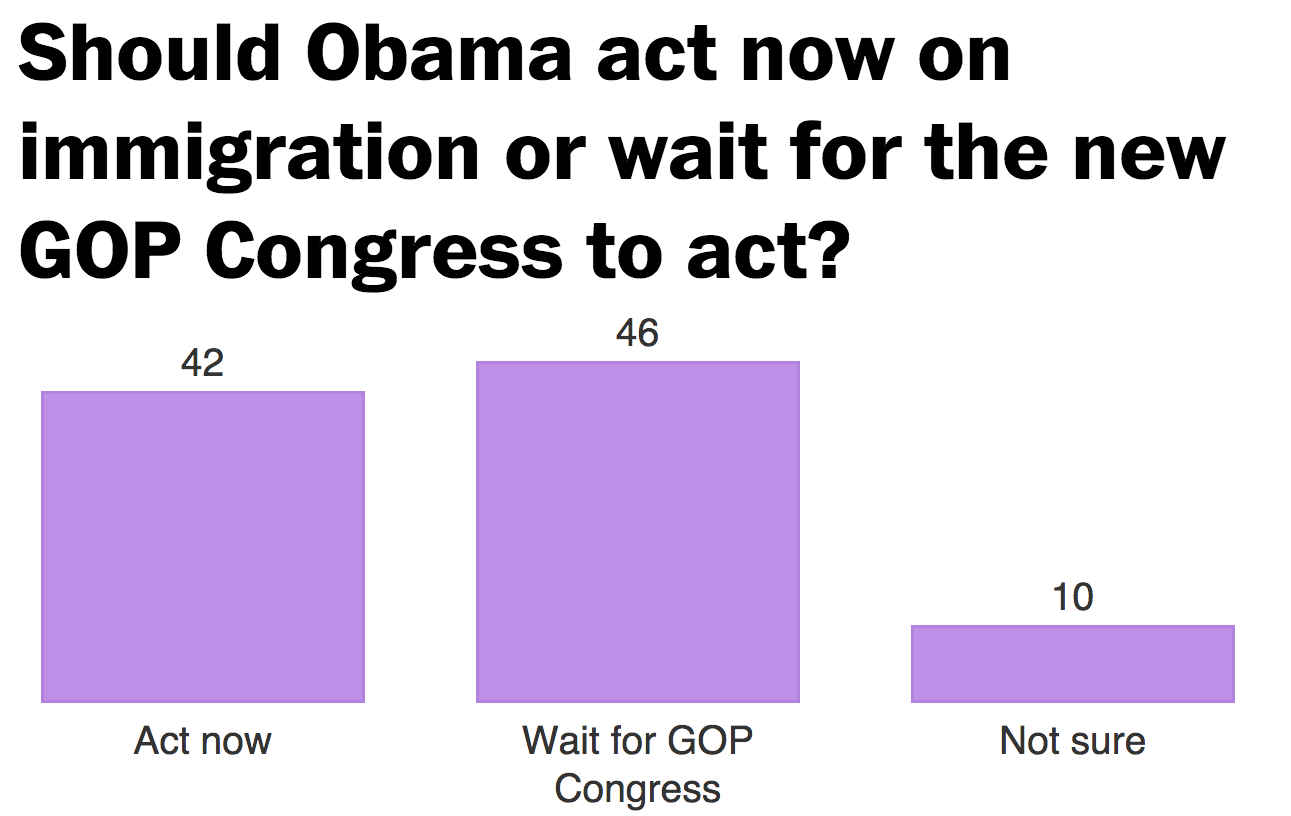
Should Obama Act

Americans are split on whether Obama should take action:

The split is somewhat counterintuitive, since a strong majority of Americans approve of what is likely to be the key element of the executive action: effectively legalizing millions of immigrants who are here illegally. As Post pollsters Peyton M. Craighill and Scott Clement pointed out over the weekend, 57 percent of those who voted on Nov. 4 favored legalization for these people, while 39 percent wanted deportation, according to exit polls. And even that split was actually narrower than most polls have shown.

But in politics, the process matters too, and many of those who otherwise support legalization also appear opposed to or hesitant about doing so without the regular checks and balances of the legislative and executive branches.

Yglesias bets that the executive action will help Democrats:

Hill staffers who believe in the political power of immigration reform point out that one of the biggest substantive drawbacks of executive action — its very tenuousness — is a political asset. What discretionary authority giveth, discretionary authority may taketh away, after all. If a Republican wins the White House in 2016, there will be no checks and balances to stop him from ordering the deportation of millions of immigrants granted relief by Obama. This dramatically heightens the stakes, not just for the immigrants themselves (who of course won’t be eligible to vote) but for their friends, family, coworkers, and employers.

Of course the higher stakes also involve higher stakes of backlash. But from the viewpoint of the party that benefits from higher turnout, the risk-reward ratio looks good.

Josh Marshall is on the same page:

If there are 5 million people who are affected by this order, the number of people who either have family ties to these individuals or affective relationships with them is much larger. I don’t know if it’s 15 million or 20 million or 40 million. But it’s a lot more than 5 million people who will feel acutely the fate of these people hanging in the balance with the 2016 election. And advocates on both sides of the immigration divide, deporters and pro-immigrant activists will press the issue throughout the 2016 cycle. The 5 million affected can’t vote and won’t be able to for years. But many family members, friends, community members and employers can.

Jennifer Rubin, on the other hand, argues that “it is essential that every Democratic senator and congressman in the new Senate take a vote (be it on the merits or on cloture of a filibuster) on the issue of executive action”:

At some point, they will need to face the voters and explain why they abdicated their responsibility and power to the executive branch. Maybe this is why Sen. Claire McCaskill (D-Mo.) declared about executive action on immigration, “I am not crazy about it,” although she blamed the GOP-controlled House for not acting on the issue. For someone who understood the voters’ intentions well enough to vote against Sen. Harry Reid (D-Nev.) as the new minority leader, surely she could see that the voters dislike unilateral action as much as they dislike the Reid era in the Senate. In any case, make each Democrat vote.

Frum selects another ripe target:

The president’s plan would be costly. The vast majority of those who would gain residency rights under the president’s reported action will be poor. Their low incomes will qualify them for means-tested social programs just as soon as their paperwork is in order. This will not be a small-dollar item. Forty-one percent of the net growth in the Medicaid population between 2011 and 2013 was made up of immigrants and their children. Legalize millions more poor immigrants, and sooner or later, programs from Medicaid to Section 8 housing vouchers to food stamps will grow proportionately. It’s not widely appreciated how much past immigration choices contribute to present-day social spending. In 1979, people living in immigrant households were 28 percent more likely to be poor than the native-born. By 1997, persons in immigrant households were 82 percent more likely to be poor than the native-born. Wittingly or not, U.S. immigration policy has hugely multiplied the number of poor people living in the United States. The president’s plan will put millions of them on the path to qualifying for welfare benefits.

Meanwhile, Bouie dubs Obama’s executive order a defeat for Republicans:

Democrats weren’t going to relent on immigration. Latinos are an important part of the Democratic coalition and key to the party’s effort to change the partisan dynamic in states like North Carolina, Georgia, Texas, and Arizona. And while Latino disappointment wasn’t determinative in this year’s elections, it’s dangerous for Democrats to delay action through 2016, both on the merits—there’s no guarantee of immigration reform in 2017—and on the politics; absent action on immigration, Latinos might just sit out the presidential election, dealing a blow to Democrats in key states like Florida, Colorado, and Nevada. (To that point, it’s no surprise that lawmakers from the latter two have urged Obama to move with executive action on immigration.)

Healthcare.gov Works – Finally

Waldman pays attention to the site’s success:

The news, an old saying goes, doesn’t cover successful airplane landings. But there’s one extremely notable successful landing happening right now, and unless you’ve gone to the inside pages of your newspaper, you might have missed it: open enrollment for the second year of the Affordable Care Act exchanges has begun, and in its first day, the federal exchange signed up 100,000 customers with only minor technical glitches.

But McArdle warns that this “open enrollment period isn’t the biggest test for Obamacare in the next 12 months”:

The biggest test will be what happens on or around April 15th.

That’s the first time all the people who didn’t buy insurance will get hit with the individual mandate penalty, and the ones who thought that it was a nominal $95 fee are in for a nasty shock. April 15th will also be the first time that people who got too much in subsidies are going to be asked to pay back some of that money.  I do not have hard figures on this, but my basic experience in personal finance and tax reporting suggests that approximately zero percent of those affected will be expecting the havoc it will wreak on their tax refund.  Brace for a wave of taxpayers angrily complaining to congressmen and their local newspapers.  The size of this pressure — and how the administration handles it — will tell us a lot about the future of this program.  As will Tax Day in 2016, when the penalties get bigger.