The Dish Model, Ctd

Jeff Bercovici reports that The Atlantic is also exploring a meter for its digital content:

“Paid content is going to be a big area of focus for us,” says Scott Havens, The Atlantic’s president. Havens is in the process of putting together a “paid content SWAT team” whose brief will include everything from overhauling The Atlantic’s tablet products to experimenting with a metered pay wall like the one The New York Times implemented two years ago. “It’s not definitely happening, but it’s definitely part of the mix,” Havens says of the metered model. “We’re watching what’s going on out there, and I think the conditions are right for experimentation.”

The Dish Model: The Data

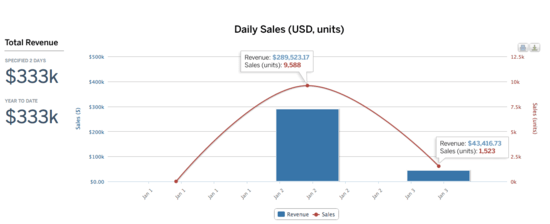
Basically, we've gotten a third of a million dollars in 24 hours, with close to 12,000 paid subscribers (at last count). On average, readers paid almost $8 more than we asked for. To say we're thrilled would obscure the depth of our gratitude and relief.

More details below. All of the graphics can be enlarged by clicking on them. The number of subscribers and the total revenue that has come in as of 1:15 pm ET today (credit card and Tinypass fees take a small bite out of the revenue number) is below:

Daily_Sales

The next graphic breaks down subscription revenue by price paid and shows the number of subscriptions at that price. This includes only the 10 prices that have brought in the most revenue:

Top_Products

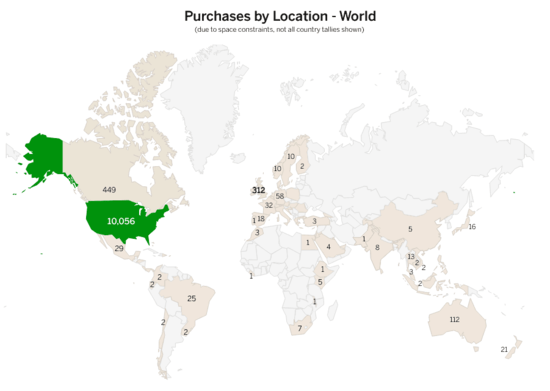
The number of subscriptions in each country:

Dish_World_Map

Go Canada and Britain! The number of subscriptions in each state:

US_Map

If our goal was an annual income of somewhere around $900K (we erred on the safe side), we have gotten a third of the way there in 24 hours, which is why we're all somewhat gob-smacked. We feared it would take far longer for us to get that kind of support. Total number of paid subscribers? Almost 12,000 right now. That's still only 1 percent of our total monthly readership – so we have plenty of room to talk more of you into subscribing before the meter hits. And the current number is misleading because of that. We really won't know how effective this is going to be until we actually have the meter in place. That's the only true measurement of how many readers will eventually pay to read the Dish.

But as a kick-off, this has been, well, words fail. We don't know how to thank you enough. Except to work harder than ever to make the Dish everything it can be in the future.

If you've held off so far, please think about giving it a go. We're still in the foothills of the mountain we need to climb. At the basic price, it's around a nickel a day. Simply as an experiment in figuring out how to make journalism work in the new media world, it's a pretty good investment. In return, we'll stay as transparent as we can (this post is a downpayment) – and answer only to you.

Pre-subscribe here.  My explanation of the move is here. And, er, you rock. But we knew that already.

The Dish Model

Unlike Mr Morgan (prove him wrong by pre-subscribing here), Felix Salmon likes our new economic model. From his conclusion:

Sullivan is burning no bridges here. If this works, great; if it doesn’t work, I’m sure that there will be a fair few publications out there willing to add their names to the list of places which have hosted the Dish. It’s what the financial types call a free option. And I’m very glad that Sullivan is taking the plunge, to see just how much money is out there for someone looking to make it on subscription revenues alone. I only have one request for him: please be very transparent about the numbers!

We will. We were waiting for a solid 24 hours of data before letting you know (and that is now up). We’re gathering that data as we speak and will report back to you later today. We’ve struggled with the obvious questions of transparency: if the subscriptions come in as a disappointment, would publicizing that become a self-fulfilling prophecy? Or would it help spur more support? If we do really well, would that encourage readers who haven’t subscribed to take a free ride? Would it generate complacency?

Eddy1After some urgent soul-searching, we’ve decided that this is your blog and that you deserve to see as much behind the curtain as possible, without disclosing individual employees’ private information. We just have to trust that the data won’t hurt the site, whatever side of the line we fall. So, as soon as we gather up all the data, we’ll give you our rough calculation of our estimated budget for our first year and data on how much progress we have made so far. Felix isn’t far off with $750,000 – but we were a little more conservative in guessing future unknown technological costs, and so we calculated a slightly higher number, and a steeper hill to climb. I’m a fiscal conservative, remember.

But basically, we think we should be as accountable to our readers as we can, and leave a lot of the financial mystery, spin and secrecy of the old media behind. One other reason we’ve decided to ignore the risks of transparency is because our ambitions are effectively open-ended. Our initial budget is simply for what we currently provide readers. But if we can do better, we will plow the extra money into commissioning long-form journalism, and hire an editor or two to edit it. We would really love to use the Dish’s bloggy base to enrich long-form writing, just as we are trying to support poetry. My own dream is a monthly tablet magazine called Deep Dish, which would have the best of the month’s Dish (with some reader-threads all brought together, a window view gallery, a couple of photos) and two or three really deep dives into subjects that come up in our unending conversation. Getting the blogosphere to bring back long-form is a really subversive idea. But I think we could have a go at it, if you help us by pre-subscribing (do it here! Or the adorable hound gets it!). So even if we were to hit our target, we can still appeal to readers to help us become more ambitious. We will of course hit a limit at some point – and we won’t really have a good grip on what that number is until mid-February at the earliest, after the meter has actually been installed. But we’ve decided to give you the numbers up-front because we trust you get what we’re trying to do. We are resigned to many free riders with a freemium model as open as ours will be. But we figure the more honest we are with you, the more reasoned you can be in your support (or not). Alyssa Rosenberg wants a thousand business models to bloom:

I hope their business model becomes sustainable not because I think we need it as a sole light forward in a dark publishing landscape. Rather, I think we need a lot of models, so new entrants into the market have lots of paths to sustainability. Some products that have been prestige for the entire run of their existence, like The New Yorker, will be able to flourish in their walled gardens without ever venturing out into a more open marketplace. Others, that have both passionate and casual readers, and perform the services both of delivering basic news information and offering up longer, more proprietary analysis, like the New York Times and the Dish will do well with metered models.

Projects like ThinkProgress and Pro Publica, which want a certain amount of independence from corporate interests and protections from the vicissitudes of the advertising marketplace, will successfully justify their necessity to a variety of non-profit funders. Rather than aiming to be among the most privileged and valued of products and individuals from the start—a position that guarantees financial support, but that doesn’t clarify the nature of the product they’re distributing—publications and content distributors would do better to know the fundamental nature of their business, and to choose a revenue support model based on that.

Paul Constant agrees that our model won’t work for everyone:

This will no doubt inspire many bloggers to consider adopting a reader-funded model. Those bloggers should remember that Andrew Sullivan is one of maybe five names that could make a reader-sustained blog financially viable.

Dish Independence: Reader Reax II

Dishness-explained-II

A reader writes:

In 19 years of heavy Internet use, I have never – not once – paid money for original written online content. Until now.

Another:

My partner always jokes that we don't pay for anything except food and our mortgage because I pirate everything else – movies, magazines, music, e-books. But you hooked me this time. I subscribed and did so happily. 

Another isn't onboard:

I'm a reader since 2003 who won't be paying. I realize 20 dollars a year is not much. To me it's the principle. For better or worse I like my Internet free. Friends come and go. I'll miss you but with so many other free sites available that void shall be filled elsewhere. Best of luck.

A reminder to our reader and others that the vast majority of Dish content will remain free to non-members. Another is less torn:

So, wait … Andrew moves to New York City, complains about both the cost and the environment for weeks and now wants to charge readers to subsidize him and his staff living in Manhattan? Surely the same talent could be had in DC? 

I probably will join, though. I do think it’s a shame that information and good public discussion is shifting into a "pay-to-play" operation. When I was in college, most news outlets were completely free and I got such a great variety of different perspectives, helping me form a worldview. With individual accounts to pay for each of these voices, it’s going to price a lot of people out of the market.

Another tough sell:

I've been thinking about whether or not I want to subscribe all day, and, right now, I have to say that it's a no. Your blog is compelling, but there are many compelling blogs out there. I don't feel that you ever truly atoned for Betsy McCaughey, and that's pretty hard to ignore. 

People can make decisions about this based on whatever they like. But I hope the criterion is not some sin I have committed in the past or some outrageously dumb thing I will inevitably say in the future. Those can either not be undone or are integral to this blog. Another:

I was pissed when I first saw that you would charge for content. I'm 100% sure there's a way around it – I've gotten around pretty much every paywall on the Internet. So why treat your future one differently?  Well, firstly, I knew an intern of yours from last year and I knew that he was treated fantastically well. This seemed encouraging. But more importantly, I've been a Dish-head for years. I'm probably to the far-left of most readers, and I'm constantly telling my Republican family that if they want to make intelligent right-of-center arguments, to read your blog. I don't particularly like a lot of your politics, but I respect the hell out of them, 98% of the time anyway.

Next, I've had letters put on the blog twice. It was really cool to feel like a part of the team, if only for a fleeting second. A highlight of my week, both times. But lastly, the real conundrum, if not for very long, is the cost. I'm working for a year, in the middle of law school, so I can pay for my last year of law school. I'll graduate with $180K in student loans. I've pretty much maxed out my credit, came up $8000 short for this year, and am literally saving every penny I can, because damnit, I'm going to be an awesome lawyer. 

But even as I say 'no' every time friends or coworkers ask me to go out for drinks or dinner or a movie, I go home and read The Dish. I read many of the linked articles, too. I watch the videos. It's most of my entertainment and intellectual life right now. I spend WAY more than that average 17 minutes on the website every day. So what's it worth to me? A lot more than $20. But that's what I gave (sorry, I promise for more when I get a fancy career somewhere!) and I hope my little portion helps keep the blog afloat.

Another:

I just purchased your $19.99 pass. What I'm most excited about is your decision not to rely on advertising to supplement the subscription income.

I might have bought a pass anyways, since I'm a regular reader and want to support both your work and the decentralization of media, but to me the decision to eschew advertising is the really exciting idea. The standard line about this is that if you're not paying for the product, then you are the product. I know that's simplistic, but I think that being forced to cater to advertisers has all sorts of pernicious effects on privacy, framing, content, and even choices about coverage, and I am eager to see if moving away from that model has some unexpected positive side effects.

Another:

Congrats on the new model, I'm here to help. I signed up for $20.13 this year. Next year it will be $20.14, $20.15 in 2015, etc. That way, your income will rise with inflation, assuming of course inflation is only around 0.05%. Good luck.

Another:

Before I signing up, how much side boob will be featured on the new Dish? 

Sorry, only side beard here. Another:

I laughed when I read the poll question, "Have you gotten your parents to start reading The Dish?"  Not long after you began blogging, I got my then-13-year-old daughter to start reading The Dish.  (She’s 24 now, and still a fan.)  I also make it a point to mention your blog to my 50something peers; when I find a fellow Dishhead, it’s a real treat.  

I was delighted to read your news, I've sent in my subscription (plus a little extra for all the wonderful hours of reading you’ve given me), and wish you many more years of mind-expanding, sometimes exasperating but always interesting (except for the beards), blogging.

Another:

Thank you for not making it $0.99 for the first four weeks and then some hard-to-find amount automatically billed thereafter. I rewarded you a bonus $5.01 just for that. If only the NY Times would treat me so well.

Another:

I have a deeply personal connection to the Dish. This past year I went through a painful divorce that involved sorting out custody for our two kids, setting up a new home, and upending the life I’ve built over the last 14 years. Hands down the worst year of my life. Throughout the year, one of the few daily constants has been the Dish. It’s something I turn to every morning when I wake up alone. I feel like I’m part of a community in a way I don’t as a reader of the NYT or New Yorker – even though I’m a silent reader who has never solved a VFYW content. Thank you and the entire Dish staff for everything. I look forward to many, many more years.

Another:

I'll be subscribing tonight on the home computer (I'm still "old fashioned" that way).  The early rabid passion of Dish-heads will likely lead to many purchases above the $19.99 price, but it's important to note that this isn't a sustainable model. In fact, early comments you've posted indicate that people are paying up for ten years when they've received the Dish for free.  Well, that won't apply next year. 

Here's a thought: the photo of you and the staff celebrating your independence featured you all in the great Dish t-shirts. Take a page from NPR – for a subscription of $50 (you pick the level), you get a Dish t-shirt as well. You can also think about this along the lines of rock music – many musicians look to break even on the concert tickets, and make their money on merchandise. Certainly you could think of other level-based incentives once the initial first year rush to support the subscription model fades.

Earlier feedback here. A lot more to come. To be a part of an independent, ad-free Dish, go here and subscribe. We are incredibly grateful for your support.
Dish Independence: Tweet Reax II

Heh. But it’s not a paywall. To reiterate: No one coming to the Dish home-page will ever be stopped. All links to individual posts will be outside the meter and as free after we launch as they are now. The only meter arrives at the “Read On” posts, whose full text you have to be a member to read. Even non-members will be able to read a certain number of “Read On” posts a month, free and in full. Dish alum Zack reiterates something else for us:


Subscribe to TPM Prime here. My full pitch for Josh’s new venture here.

Why Not Chase Ad Dollars?

Maria Popova explains why she asks for donations instead of running ads on her site, Brain Pickings

There's a really beautiful letter that a newspaper journalist named Bruce Bliven wrote in 1923 to his editor. It was about how the circulation manager had taken over the newspaper, deciding what went on the front page. Today, search engine optimisation is the "circulation management" of the internet. It doesn't put the reader's best interests first – it turns them into a sellable eyeball, and sells that to advertisers. As soon as you begin to treat your stakeholder as a bargaining chip, you're not interested in broadening their intellectual horizons or bettering their life. I don't believe in this model of making people into currency. You become accountable to advertisers, rather than your reader.

Dish Readers: Who Are You? Ctd

Dish Readers: Who Are You?

Back in December 2011, we posted the Urtak survey seen above as a quick and easy way to get a better sense of you, the typical Dish reader. We first brainstormed questions we’d like most to know about you, and then we allowed you to brainstorm and add your own questions – and answer them. The reaction to the reader-driven survey was overwhelming – responses nearly eclipsed the 1.5 million mark. If you didn’t respond to the questions at the time, or think you may have missed some added by readers, go ahead and click through the quick and easy Yes/No questions above. Analyze the results of the survey here. Some cross-tabs from the Urtak blog:

[Andrew Sullivan’s] readers under the age of 35 are less likely to have cried in response to a Dish post. Cold-hearted youth! His married readers would be less interested in attending an annual conference of Dish readers. His Jewish readers are almost three times more likely than their gentile counterparts to have attended Ivy League colleges. His Republican-voting readers are more likely to have emailed him. And his gun-owning readers are more likely to make more than $100,000/year.

Readers also sifted through the data:

I was shocked to find out that FIFTY percent of your readers who took your poll were atheists like me. I’ve always respected your Catholicism and read every word of your debate with Sam Harris years ago, but I think that this is living proof that there are a lot of nameless, faceless, intelligent skeptics out there – many of whom are aligned with you on most other important issues. I think it just goes to show how independent and anomalous you are.

Well, that’s a nice way to put it. Another writes:

I suspect you already knew the rough answer to this question, but it still must be jarring to see that 78% of Dish readers answered yes when asked “do you consider yourself a liberal?” while only 9% answered yes when asked “do you consider yourself a political conservative?” As you know, I’m one of those liberals, tried and true. I think people like me read The Dish because we’re craving an actual intelligent, well-reasoned political opponent. A point of view based in reality but skeptical of liberal political thought. We want to have real political arguments, but they’re impossible to have with know-nothing movement conservatives.  The Dish is where we come to grapple with the patriotic, intelligent, small-c conservative, loyal opposition we wish we could get from the GOP.

Another:

Holy cats, Andrew. The survey of your readership is an eye-opener in many ways, but my greatest take-away from the results so far is: I am one of only 22% of your readers who is female, and the rest of your readership appears to be largely comprised of straight men around my age, a good percentage of whom are unmarried, non-religious, liberal, and voted for Obama. And many of them have dogs!

You’re damn straight I’d come to that annual gathering …

Explore the data for yourself here. Thanks again to all our readers who took a few minutes to answer and submit questions. The most original submission among them:

Would you pay to see Andrew shave his beard live on The Dish with proceeds going to “cure” Marcus Bachmann?

Dish Independence: Your Questions, Ctd

A reader quotes a previous one:

"Please consider allowing comments in the paid site." NO! NEVER! PLEASE! In general, I HATE comment sections; they so often turn into cesspools, despite everyone's good intentions.  But your "curated comment section" is one of the best things about your blog. I've already signed up for the paid site, but if I get wind that there will be an open comment section, I'll probably try to get my money back.

Another reader reminds us that "if people want comments, they can go to the Dish Facebook page and comment there till their heart's content – and I don't have to see it." Another:

Delighted to see you striking out on your own.  I think it's high time.  I pay for the NYT, the FT, and the Economist, and I think your move is another signal of the quality differentiating itself.  I wouldn't pay for just any newspaper, and I wouldn't pay for just any blog.  But you've set yourself apart. 

That begs a separate question, though.  If we give enough, would you all consider setting aside the resources to build dedicated apps/web apps for your subscribers?  I'd love to have a clean, specially designed iPhone/iPad interface, and with the web apps the NYT and FT are now using, you wouldn't need to go through Apple (and for that matter, you could probably do a pretty easy port to Android).

Apps – or at least a customized mobile version for the home-page – are definitely forthcoming, once we get our footing with the new Dish. Another reader:

Have you ever thought of a limited merchandise offering? I can't be the only one who'd love to have an official DishHead teeshirt or ball cap. It would be fun to recognize each other at the local coffee shop.

Merchandise is very much on our radar. Back in December 2010 we launched some limited edition t-shirts (the ones featured in our staff photo). We are holding off on any subsequent merch until we have stabilized with the new transition, but stay tuned. Another reader dissents:

If you are going to start off on your own, start off right. Don't go for that $19.99 crap; be honest and direct and ask for $20.00. 

I have just finished law school and have to last until I can take the bar in February. My only income is some money from my Dad; I have to make my savings last. I don't even pay for the local Sacramento Bee, but I sent in my twenty and wish you the best.

We are immensely grateful. Join him in subscribing to an independent, ad-free Dish here.

New Year, New Dish, New Media: Blog Reax

Dustyrock

Matt K. Lewis wishes us well:

Though Sullivan concedes that “no one really knows” whether or not online readers will pay for a blogger’s content, others (like Glenn Beck) have proven that it is at least possible to make money from online subscriptions. Say what you will about his politics, as a blogger, Sullivan is a visionary. And by maintaining his own brand — and “ownership” of his blog — he has proven that he is a free agent, capable of moving from outlet to outlet without losing his audience. If anyone can pull it off, it might be Sullivan.

Rod Dreher says he has subscribed:

Longtime readers know that Andrew and I have argued and fallen out over various issues over the years, and have agreed on some of them as well. The thing about Andrew’s blog is that even when it drives me crazy, I keep reading it. I have to. I want to. He and his team are scooping up stories and information that means something to me. I don’t care about pot, and I don’t care about Obama love, and I don’t care about the evolution of gay culture — three of Sully’s big themes. I think Sully is often unfair to his enemies, especially the Pope.

What I do care about is the broader cultural coverage the Dish team aggregates, which has for years given me lots to think about, and, of course, to blog about. And what I do care about is reading opinion journalism that engages me and makes me argue with it, even when it ticks me off. I love The Dish sometimes, I hate it other times, but above all, I read it, several times a day. With so many sites out there clamoring for one’s attention, that’s quite an accomplishment.

Therefore, I’m happy to support them financially, and to invest in a journalism model that means something to me personally. I encourage you to do the same.

Brad DeLong is also supportive:

Let me say that I will never, never, never forgive Andrew Sullivan for what he hired Charles Murray to do to the New Republic–or, for that matter, for any other of his manifold sins against the Holy Ghost. Nevertheless, he and his myrmidons are always worth reading, and definitely worth funding now that they go Full Utopian on us.

Mistermix compares our new business model to others in the industry:

This is a variant of the subscription model other sites like the Times and Gannett papers are using, except that it sounds like a lot of the Dish content will always be free. In practice, those subscription models end up looking a lot like public radio or TV – it’s pretty easy to get the content for free even after you’ve reached a limit, so "subscribers" tend to be voluntary. Sully has a huge readership, so I assume that enough people will pony up $19.99 a year to pay for him and his two under bloggers, and his site will still get a lot of hits since you can still view a lot of the content without a subscription. He won’t be hosting ads on the site, which is an indicator of just how badly the Internet ad market is cratering.

Just on a factual note, the Dish has seven employees (five staffers and two paid interns), not just three, so the budget is a challenge, but the rest of the paragraph is largely correct. Steven Taylor probably won't subscribe:

Sullivan has been at the forefront of blogging since the beginning, so I will be curious to see how this plays out, although I am unlikely to be a subscriber, given that I have more free content to read now than I have time for (which is the biggest threat to this model to begin with).

Drum worries that "as free access gets rarer, blogging is going to get harder":

[T]his is a trend that's a real problem for blogging. I currently subscribe to three newspapers: the LA Times, the New York Times, and the Wall Street Journal. This costs me over a thousand dollars a year, but I need to have access to all these sites to do my job decently. But as more and more media sites start erecting paywalls, I simply won't be able to afford to keep up all the subscriptions. Andrew's 20 bucks a year is obviously fairly small change compared to subscription fees from big media operations, but as more and more sites go down this path, my choices are going to get harder and harder.

And Joyner does some math:

To be sure, clicking through for nothing is a different kettle of fish than being a paying customer. At least in the early going, though, a lot of people will sign up out of sheer loyalty for past services rendered. Hell, I did that for Josh Marshall’s site at a substantially higher price and most of its content is still free; I’ll almost certainly do it for Sullivan. Still, off the top of my head, I figure they’ll need at least $500,000 a year to cover salary and basic operating costs. That’s 25,000 $19.99 subscriptions.

I can't disagree on the math. And as the numbers come in, we're on our way. We'll report on the day's results when we have more data. But the trend is pretty amazing. Keep it going by pre-subscribing here.