The Liberal Reagan, Ctd

Obamas-Crucial-Six-Months-SD

If I had one single reason for supporting Obama in the last election, it was that he and he alone had the strategy and perseverance to end the Cold War with Iran. He hasn’t done that yet – but he has, with remarkable global unity, started down a diplomatic path that could liberate the forces for moderation and democracy in that country, and unwind a dangerous ratchet toward war. That was always his larger promise from the get-go: not just to end the disastrous wars in Afghanistan and Iraq; not just to end the torture regime that made a war criminal of the president and ruined both our moral authority and the integrity of our intelligence-gathering; but to begin to defuse the deeper forces of polarization and conflict that seemed only likely to intensify after 9/11. I have always seen Obama as the antidote to Bush. This weekend, he fully inhabited the role.

For this blog, the question of Iran has particular resonance. Patrick, Chris and I truly soldered our partnership in the heady days of the Green green-peaceRevolution, as we became immersed in every tweet, every gesture and every tragedy of that great awakening. I know Dish readers were glued to those events as well – and feel the relief and exhilaration of this partial but still real breakthrough.
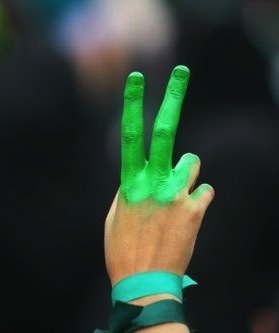
Which is why we should make this clear: this blog favors this agreement primarily because of our love of and admiration for the people of Iran. We saw them in June 2009 dare to believe that their long nightmare of isolation, extremism and theocratic rule might end one day. And there are times when commentary on all of this too easily misses their central place in this diplomacy. We are doing this not just because it is in the interests of the United States for there to be peace and non-proliferation in the Middle East; but because it as an act of basic respect toward the people of Iran. They were the ones who risked their lives and fortunes to fight against theocracy in 2009 and they are the ones who recently elected the most moderate leaders allowed. And we owe it to them to reciprocate their courage and perseverance. To be sure, Rouhani is not all of the regime, but he is very much a part of it, and has the sole democratic legitimacy. Not to engage this newly elected leader’s diplomatic outreach would be to turn our back on fledgling democracy in the Middle East – and kindling those democratic forces was and is the best response to the polarization unleashed in the crime of September 11, 2001.

Now consider this: in the past few months, Obama has both begun to remove the threat of WMDs in Syria through diplomacy and found a way to ensure that Iran’s irrevocable nuclear know-how will be verifiably channeled into peaceful, civilian use. These two acts of diplomacy compound one another to make the world a much more peaceful place. Yes, there remains a risk. Of course there does.

But there was also a risk in reaching out to Gorbachev in the 1980s, and yet two Cold Warriors, Reagan and Thatcher, chose to do business with him. And they were right to. As with the Soviets and the arms race, there comes a point when the pain inflicted on the other party by sanctions is so great you have maximal external leverage for reform. Too much and the sanctions would be counter-productive; not enough and we would only have military power as a lever. It takes judgment to know if the time is ripe to take yes for an answer. But, in my view, Reagan was as right to embrace Gorbachev as Obama is to reward Rouhani.

Reagan’s pragmatism and genuine horror of nuclear weapons have not been replicated in today’s Republican right. But those qualities defined him and his legacy just as much as his ideological fervor did. Obama is today acting on exactly those principles – as well as those of president George H W Bush, and Dwight Eisenhower. He is, in other words, the corrective to the second Bush and the neoconservative propensity for both utopianism and war (always a deadly combination). He is, yes, fulfilling his initial promise – to bring about the change we can still believe in and to rekindle the hope that region so desperately needs.

Update from a reader:

Hearing news of the deal with Iran makes me incredibly happy. I am a first-generation Persian and have lived happily in the United States all my life and have never truly understood our country’s issues with Iran. Understandably, there is the tumultuous political history for the past 40 years, but it’s even weirder that it took so long for this deal to come around. My family’s immersion into American life, along with thousands of other Iranians, has left me wondering why Iranians and Americans can get along but Iran and America can’t.

But really the problem was that the two countries just won’t – or at least it used to be that way. And it wasn’t until each leader decided to seize upon the opportunity to talk again. You highlighted the Green Revolution extensively and always showed an enormous amount of respect towards Iranians. You remained skeptical of the mullahs and the Ayatollah while always seeing the best in the people. Not everyone dedicated daily attention to their marches for freedom and the impact of bringing them back into the international community. So it’s with Obama and Rouhani (with the Ayatollah’s backing or permission we don’t know) that finally found a way to make it happen.

I’ve never thought of myself out of place in the US and adore the Stars and Stripes, so I can’t tell you how great it is that my ancestral home and my home are finally moving towards peace.

(Photos: Getty Images)

The GOP’s Answer To Obamacare?

Yuval Levin and Ramesh Ponnuru respond to a few of my recent thoughts on healthcare in America. I’m really grateful for their engagement. Here’s one basic thing on which we already agree: before the ACA, we did not have a free market in healthcare. We had, as I rather crudely put it, “the most fucked-up, inefficient and inhumane socialized system on the planet.” What is encouraging about their work is that they are actually proposing something that might make that socialized system less perverse and more amenable to the power of market decisions, as well as being humane. The ACA does all that, as well, but its market mechanisms are embedded within a more elaborate government-organized scheme.

They propose a system based on the catastrophic insurance model. Let’s call it Catastrophic Plus:

We are not proposing a regime of universal catastrophic-only policies, with perhaps some supplementary coverage packages on top of that. (There have been some proposals of that sort by others.) We propose, rather, to build on today’s insurance market, in which most people get tax-preferred coverage through an employer while other people get non-tax-preferred coverage on their own, by allowing those other people to have the same benefit provided through a credit they could use to help them buy insurance.

The credit would be sufficient to pay the premium of catastrophic-coverage policies (more or less by default; if you put a huge amount of money on the table in, say, $5,000 increments that can only be used for insurance, insurers will rush to offer coverage with $5,000 premiums and adjust co-pays and deductibles accordingly). So people who now pay no premium costs and therefore have no insurance could pay no premium costs and have catastrophic coverage. Nobody would have any economic reason to forgo such coverage, while the economic reason to pursue it (to gain some protection from extreme unexpected costs) would remain in force. Protection from catastrophic costs is the core benefit that health insurance offers, and this would be a way to make it available to all. But people who now buy more comprehensive coverage in the individual market, or who would like to, would see its cost to them decline by the amount of the credit, and so could purchase it far more easily, while most people would presumably continue to receive employer-provided coverage as they do now.

What this does is retain government subsidies for healthcare insurance but equalize them for employment-based insurance and individual insurance. That’s something I would happily get behind. But one of my core worries is that these catastrophic policies would not allow for routine, preventive care – and so end up as a false economy. Here’s their response to that point:

There is no clear reason to think people would skimp on preventive care in such a system. People tend to value preventive care, and we’re just saying they should be better enabled to choose insurance options that provide what they value, and that this should be done in a way that encourages insurers and providers to seek the most efficient and appealing means of running a health care and insurance system.

The clear reason, I’d counter, is that people cannot afford it. If they only have Catastrophic Plus, the kind of care that would lower costs by preventing, say, cancer by early screening and detection, would be beyond their means. Of course, a huge amount depends on how much of a subsidy individuals could get. What’s positive about L&P’s proposal for high-risk pools for those with pre-existing conditions in the individual market is that they are not squeamish about the cost. (Here’s their model in one iteration.) But at some point, if it’s significant enough, the ACA seems preferable for the solvency of the system as a whole because of its clear minimum provisions for preventive care.

The deeper trouble, it seems to me, is that insurance as a model is a guard against low-probability but high-impact events. And yet healthcare cannot be seen simply in that way – because part of it has to be non-catastrophic. This has only gotten worse over time. As medicine has moved past the relatively inexpensive prevention or cure of terrible illness toward the much more expensive and open-ended maintenance of health and longevity, insurance remains a terribly unsatisfactory model. Except for all the others. And denying someone a treatment that could save or transform their life is qualitatively and morally different than denying them a new PS4 or iPhone.

I also totally get L&P’s desire to find some way to connect the price of this good with demand. Someone has to pay for it – and the market is a much better mechanism for figuring the best price out – and making it visible to people – than a government central plan. My problem is that this is one market where experts really do know better.

Patients-as-consumers are in a terribly weak position when it comes to knowing what goods to purchase or which ones might actually work for them at a reasonable price. And so in healthcare, consumers are very different animals than in many other sectors. There are many instances in which consumers in this market are not price-sensitive at all. What price can be put on the ability to breathe right, or survive cancer or HIV infection?

I’d add one other thought. The bigger the pool for insurance, the more robust and efficient it is. This is not an argument for socialism or collectivism; it’s a reflection on the nature of insurance itself. The advantage of the ACA’s individual mandate is that everyone gets into the same pool. The patchwork nature of L&P’s approach would not replicate that. It would have to create high-risk pools for around only four million people that are much less stable. There are, in other words, obvious economies of scale here which L&P cannot take advantage of in the same way fully national systems – for all their flaws – can.

As for restraining costs, I’d like to press them on end-of-life issues. A huge amount of the cost of healthcare is consumed in the last days of people’s lives. A nudge toward living wills could make a huge difference, and if some on the right could face down the “death panels” canard, it would be a mitzvah. Ditto on apparently small things like co-pays as a percentage of costs rather than a flat fee. What say they?

But the R&P model is definitely a serious start for an alternative if the ACA collapses under its own clunky beginning. At some point, someone in the actual Republican party is going to need to hone something like this proposal. Then we can have a more constructive debate about addressing these problems rather than a zero-sum war on the only practical reform on the table.

Doctor Who?

The Guardian has a great interactive guide to all the doctors over the last fifty years, if you need a refresher before the imminent 50th Anniversary episode.

It would be hard for me to express how powerful this television show was in my fledgling imagination. I never missed an episode, and got really hooked in the Patrick Troughton years. Yes, that Doctor’s male assistant, Jamie, was one of my first crushes. I just wanted to be him in some inchoate way that would eventually evolve into sexual and emotional attraction. Maybe it was the kilt that did it. There are also episodes in the Pertwee years which I can still close my eyes and remember vividly – The Green Death was my favorite (with giant maggots threatening Surrey!). But Tom Baker and Sarah Jane Smith became the iconic Doctor and his assistant for me – and for lots of Who-nerds growing up with me at the same time. Baker in some ways created the character in its fullest, final incarnation: querulous, curious, funny, fearless and yet also all-powerful. (You can watch his debut above). Then as I went to college (no TV there) and to America, I lost touch, except for occasional winces at what I thought were gimmicky and tawdry attempts at revivals in the late 1980s and 1990s.

But it lived on in my dreams. Almost every anxiety Green_Death dream I ever had in my teens was situated solidly in the Doctor’s world. I was never the Doctor – always his assistant – in these dreams. I knew my place and was just glad to be around him. The dreams invariably took the shape of a classic Doctor Who scenario – walking gingerly down strange, dark corridors waiting for some scary monster to jump out and grab me. Of particular note were the Cybermen, who for me exceeded the Daleks in their inhuman, soulless scariness. The explanation for this, I realized later, was that in the episodes in my youth, the Daleks couldn’t get up the stairs to my bedroom at night. They were on wheels! The Cybermen? They could knock down the front door and march up the stairs in an instant.
Even in my twenties, these dreams persisted. They were, I think, both about longing to exist in another kind of world; and also about seeing as the ultimate authority this quirky, non-violent, superior intelligence made Time Lord flesh in the Doctor. I realize now that this is a very English idea of inter-galactic power – all brain and close to very little brawn, and deeply moral, even when confronting the purest of evil.

The Doctor never kills, unless by accident; his enemies are always defined by their love of violence, their lack of a moral compass and what the English would regard as an absence of that Orwell virtue “decency”. You knew that aliens were evil because they kidnapped hostages, killed indiscriminately, and could even use torture at times. The Doctor always won by virtue of never sinking to their level – and laughing uproariously when they tried to intimidate him. The show is just as moralizing as Star Trek at times – but free from most sentimentality and filtered through irony. The Doctor was so often kidding.

I see the new and brilliant re-imagination of the TV show – with its huge global success – as my generation’s tribute to the spark of imagination that lit up our youth. I’m as old as Doctor Who – the show, not the Time Lord. I was born in the same year and grew up with the Doctors. The show was as familiar to me as weekly mass as a kid. Even now, there is something immensely comforting about watching it – recalling those old plots that occasionally resurface, or the feeling I had seeing the same monsters at 50 that I did at 5. A television show has this power in a way a single book never can. It unfolded before me as my own life did – and I lived a small part of it in thrall to those vistas of time and space that the Doctor invited me into, and where he taught me never to be afraid or humorless. Or cruel.

The Political Threat Of Soaring Inequality

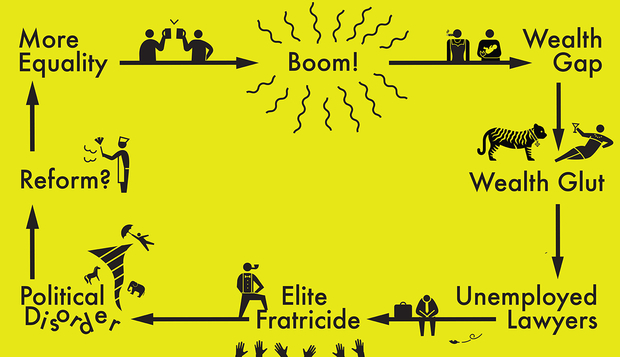
I read several pieces today that, together, were a somewhat grim insight into the acute social and economic crisis of our time. The first is a challenging and persuasive historical account by historian Peter Turchin of what Aristotle first observed in The Politics. The graphic (by Jennifer Daniel) is a crude but powerful summary of an historical pattern we see again and again in human history:

iedj9axTRNMI

In this cycle, I’d say the US is roughly in the elite fratricide moment, which means very choppy waters ahead. Turchin’s thesis is basically the following: the eternal tension between liberty and equality has a recognizable shape in historical and economic cycles, which are perhaps better understood today. The optimal moment for successful societies is when the middle class dominates, where political institutions reflect a mass interest in governing the society well, because everyone feels they have a stake (so more people than usual want and need collective success), and because they share some basic commonalities in experience, and so can find a way to compromise.

When societies grow more unequal, commonalities fray. Wealth accumulates among the few, who begin to see the polity as something to be used for private interests rather than engaged in for public-spirited reform. But as wealth at the top grows and grows, and as more and more of the middle class attempt to become part of the super-wealthy club, the loss of economic demand among the increasingly struggling majority puts a crimp in the social mobility of the wannabe elites. So we have a wealth glut: hugely wealthy one-percenters and a larger group of under-employed or unemployed professionals. It’s from these disgruntled elites that you will get the tribunes of the new plebeians. And they will be guided by revenge just as destructively as the top one percent is now guided by naked self-interest.

What disappears in this moment of the cycle is the lubricant for all successful polities: a sense that we are all in this together. When that crashes into economic stagnation, and the fight for a slice of the pie gets even more frenzied, you’re in for some serious social unrest – which will either lead to a period of reform or to further social and economic disintegration.

So do we have elite fratricide? When a Harvard and Princeton alum like Ted Cruz emerges as a wildly swinging wrecking ball for the entire global economy, you bet we do. When Republicans up the ante on judicial appointments by trying to prevent a president from filling any vacancies and when the filibuster has become much more common than, you know, actual legislation, ditto. When the response to that is to scrap one of the last remaining mechanisms for legislative balance and compromise, ditto. When a major political party offers nothing on a major social and fiscal problem, like our grotesquely inefficient form of socialized medicine, but is content merely to attack, attack and attack the law of the land and sabotage it, ditto. When a former Tory prime minister breaks ranks and accuses his elite successors of ignoring the impact of growing social immobility, ditto. When news channels decide to become propaganda channels, and when there are close to no major media institutions retaining trust as neutral arbiters of our national debate, ditto. When elite sister breaks with elite sister over an appeal to the masses, ditto.

You can probably add a whole litany of additional data points yourselves. But to my mind, what matters now in politics is finding a party or a candidate that recognizes this core problem and tries to ameliorate it.

Obama was and is such a person, but the response to his moderate reforms shows how deeply intractable this crisis now is. It may have to get worse before it gets better – and that may mean a dangerous period of unrest and dysfunction. But the challenge remains: how do we reverse this centrifugal force on the polity, especially when it has been put on steroids by the globalized economy? At some point, someone among the sane Republicans and sane Democrats is going to have to run on a robust and aggressive platform of reform that can – yes – begin sharing the wealth and tackling the entrenched and destabilizing perquisites of the super-rich, as well as tackling the populists who engage in selfish and dangerous exploitation of the resentments of our time.

For now, though, we actually have a figure in the middle of this polarizing vortex still straining to forge a middle ground. He’s our president. If he doesn’t succeed, someone else more radical will follow him. That’s why I, as a conservative, continue to support him. It’s time to leave ideology in the dust and see our predicament with unblinking eyes. It’s time for a conservatism that can grasp the necessity for reform – despite the ideology that made sense thirty years ago but has obviously become incapable of adjusting to our time – and build a new majority from the center on out. That small-c conservatism – the type that cares about the coherence and stability of the polity above all other considerations – can take shape among Democrats and Republicans. If Obama cannot succeed in it, more radical options will present themselves. But if real reform cannot find an anchor in this society anywhere, we will all face the consequences.

Mike Allen, Busted

US-TAX REFORM-NORQUIST-ALLEN

Dish readers know what I think of “native advertizing” and “sponsored content.” If it’s an advertorial, just call it and clearly label it an advertorial! Full disclosure and transparency are essential. The rest is whoredom, not journalism. When a journalist becomes a copy-writer for big advertisers giving him or his publication money, and does not clearly disclose the conflict of interest, he or she has ceased to be an independent journalist and joined the lucrative profession of public relations.

Read Erik Wemple’s evisceration of Mike Allen’s Playbook and make up your own mind. But to my eyes, it reads like a meticulously researched tale of at least the appearance of blatant corruption. Wemple starts with the kind of test I used for Buzzfeed’s corporate whoredom. Guess which one of these two items Mike Allen wrote and which one was written by the US Chamber of Commerce?

3) The U.S. Chamber of Commerce has an ambitious new agenda to generate stronger, more robust economic growth, create jobs, and expand opportunity for all Americans. Learn more about the Chamber’s American Jobs and Growth Agenda at http://www.uschamber.com/issues. **

4) “U.S. Chamber of Commerce will launch ‘On the Road With Free Enterprise,’ a two-month cross-country road trip to promote ‘the principles of free enterprise and the best of America. Your Free Enterprise Tour Guides will see the sights, check out local events, talk to businesses, and share it [online]. More than 900 teams applied to be the Free Enterprise Tour Guides, and after months of poring over applications, two teams remain: Jen and John, and Nate and Joe. You can vote [here] once per day.’ http://www.FreeEnterprise.com/tour”

Allen wrote the first second press release; the US Chamber of Commerce the second first. [Correction here] But the Wemple examination impresses because of its thoroughness. After a while, the examples are so egregious and numerous they beggar belief. Wemple and the Post unleashed an army of bots onto the Playbook archive and came to the following inescapable conclusion:

It’s about time that Politico’s Allen got his due as a native-advertising pioneer. A review of “Playbook” archives shows that the special interests that pay for slots in the newsletter get adoring coverage elsewhere in the playing field of “Playbook.” The pattern is a bit difficult to suss out if you glance at “Playbook” each day for a shot of news and gossip. When searching for references to advertisers in “Playbook,” however, it is unmistakable.

The most egregious examples are the US Chamber of Commerce, BP, and – yes – Goldman Sachs:

Like BP and the Chamber, Goldman Sachs is a pivotal advertiser for Politico, routinely placing back-page ads in the print product and occasionally “presenting” “Playbook.” Differentiating between those ads and Allen’s blurbs can strain the eyes. Examples: Goldman Sachs fights child sex trafficking (Jan. 23, 2013). Goldman Sachs to assist small businesses in Philadelphia. Jan. 9, 2013. Goldman Sachs helps veterans. (Dec. 14, 2012). Goldman Sachs helps small businesses. (June 12, 2012). Goldman Sachs Business Book of the Year Award! (Aug. 13, 2012). Puff piece on Goldman Sachs’s Lloyd Blankfein. (June 14, 2012).

Allen is also a close friend apparently with BP executive Geoff Morell, something he didn’t disclose when writing a puff item about Morel’s promotion.

Wemple is clear that the rest of the Politico seems very different, covering the powerful with persistence and skepticism, quite unlike Playbook’s relentless cheering of Washington’s corporate business machers. He’s also fair in noting Allen’s incredible persistence and energy as a reporter. But I’ve noticed before how Allen eagerly just gives the powerful a platform rather than holding them to account – and doesn’t even seem to understand that being a courtier to Washington Inc. and Washington’s most powerful is not the same as being a journalist. For my previous posts on Allen’s acting as a p.r. flak for Cheney and Ailes, among others, see here.

And all of this may not subjectively feel to Allen anything other than his reflexive energy and eagerness to please. He has long been a conduit for the wealthy and powerful, rather than a critic of any kind, and he doesn’t seem to understand why this makes some of us uncomfortable. But I didn’t think there was such an obvious connection between the corporations he promotes and their advertising dollars in Politico, which opens up a whole new issue – one noted not so long ago by Michael Calderone. And the mountain of evidence is very hard to refute.

So you wait in the article for Allen to defend or explain himself or for Politico’s editors to push back. But they refused to cooperate with the piece at all! “In rejecting a sit-down discussion, Editor-in-Chief John Harris said the premise ‘is without merit in any shape or form.'” So if corruption is not behind all this, what is? Or is all of this just an accident that requires no explanation at all?

And – not to get all pious about this – but aren’t journalists required to be transparent, when such obvious conflicts of interest are exposed? How can they demand transparency from public officials when they refuse to provide it themselves? Glenn Greenwald, call your office. It looks like we need you even more than we thought we did.

(Photo: Jim Watson/Getty.)

A Way Forward For The ACA?

cdn-media.nationaljournal.com

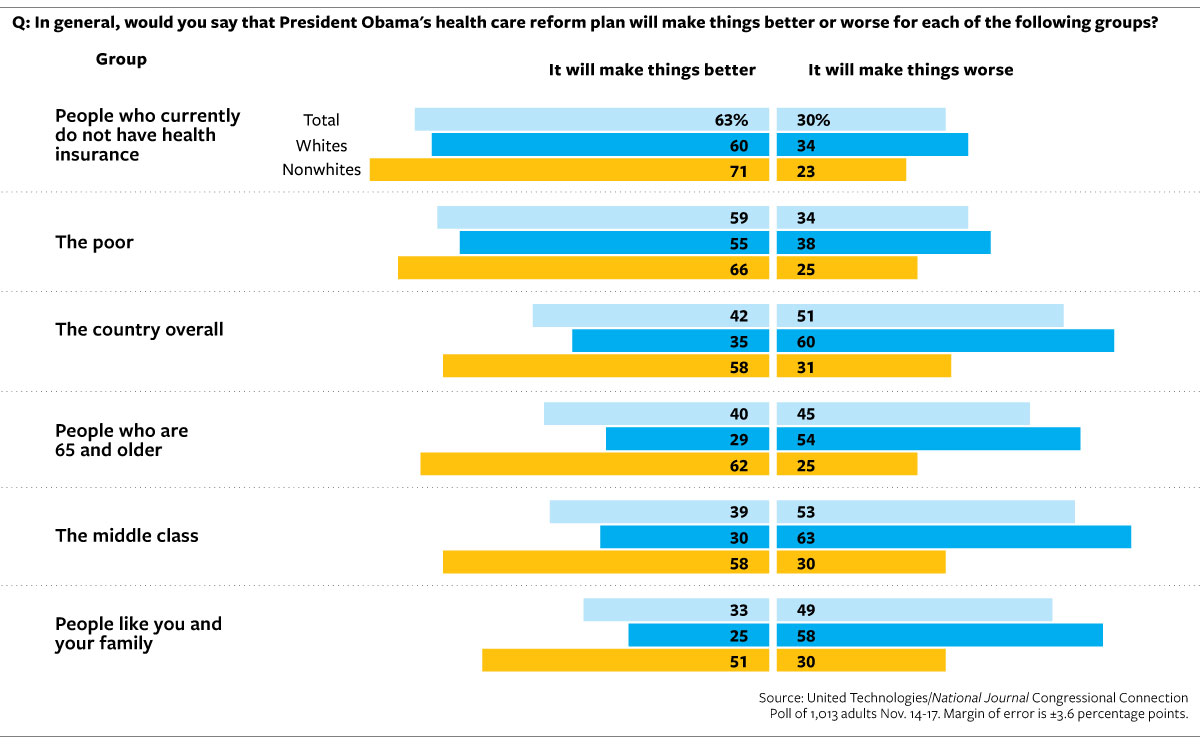
The good news for the president is that support for the law has not collapsed, especially given the massive – and largely deserved – shellacking of the wobbly website. A new United Technologies/National Journal poll makes for fascinating reading:

Amid all of the turmoil surrounding the law, solid majorities of Americans continue to say they believe it will “make things better” for people who do not have health insurance (63 percent) and the poor (59 percent). Only about one-third thought the law would “make things … worse” for each group. In each case, that’s a slight improvement in the overall judgment since the July poll. Back then, 58 percent thought the law would help the uninsured and 55 percent believed it would benefit the poor.

My italics. And there’s a distinct racial imbalance here. 58 percent of non-whites say the law will benefit the country overall, while only 35 percent of whites believe that. The danger for the administration is that many whites therefore see this as a transfer of wealth to nonwhites and away from them. But given our shifting demographics, that’s also a danger for Republicans.

Just as striking to me is the finding that support for repeal of the law has not grown, even as frustration has mounted: in July support for repeal was at 36 percent and is now at 38 percent. Those preferring to “Wait and see how things go before making any changes” numbered 30 percent in July and now is at 35 percent. 23 percent backed a third option: “providing more money so the law is implemented effectively.” That amounts to a 58 percent majority for keeping the law and trying to make it work. That strikes me as an important corrective to some of the hysteria in the Beltway.

I think all this comes from the realization that the status quo ante was a nightmare, and that it’s still early days for the ACA. Which is, again, a warning to the GOP: repeal is not going to win any converts unless you have a viable alternative that tackles some of the core problems, i.e. the millions of uninsured, the grotesque inefficiency of the American private healthcare sector, and the bar on getting insurance for people with pre-existing conditions and the maddening unreliability of any private insurance plan.

Add to this the tantalizing possibility that the federal website may soon be obsolete. Why? Because you can already get a lot of critical info from other sites like eHealth and the administration is now prepared to delegate the subsidy application process to insurers and online brokers. Andrew Sprung makes the case:

As of now, eHealth will give you price quotes incorporating your estimated subsidy, based simply on the single number you provide for your household income. It will also hold information for any plan you select and notify you when enrollment is available on eHealth — that is, when the site can initiate the subsidy application.

If you want to eliminate the middleman, once the government allows third parties to process the subsidy application, you can use a non-transactional comparison site like ValuePenguin and apply directly through the insurer offering the plan you choose. Many (I suspect most) insurers on the exchanges provide plan summaries online and enable online applications.

Once the government does outsource the subsidy application process — if eHealth and other online brokers can handle the traffic — someone please tell me: who needs HealthCare.gov? Its front end, that is, which always should have been easy. All that really matters is the back end: whether an application can be processed accurately in reasonable time. Perhaps the insurers and brokers will be able to expedite the process on behalf of their prospective customers. If insurers and brokers can take the complete application, all the government needs to do is refer users to functioning online brokers and the informational sites.

This seems to me to be a very pragmatic way to get around much of the site’s (and the ACA’s) start-up problems. But maybe I’m being too optimistic here. What am I missing?

Obama Agonistes

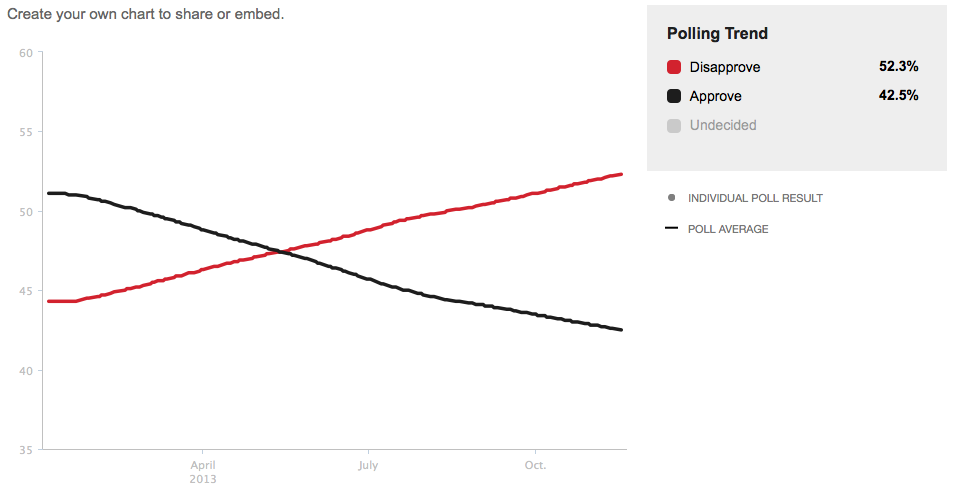
The major clusterfuck of the website, the breaking of an unequivocal promise, and a media eager to prove it’s not a lapdog to the president have all combined to bring the president down. The latest polling is grim. Here’s the poll of polls on Obama’s approval, since January:

Screen Shot 2013-11-19 at 11.52.17 AM

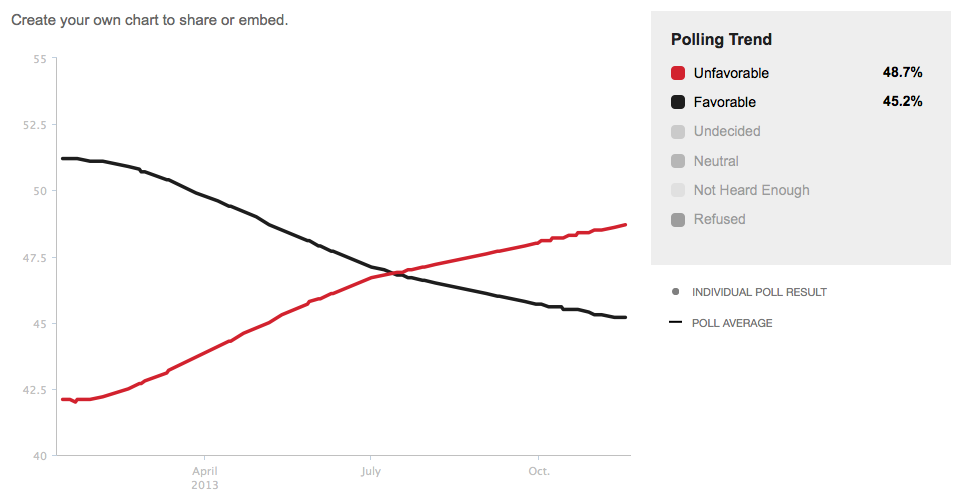
Here’s the favorability chart for the same period:

Screen Shot 2013-11-19 at 11.54.53 AM

The question is: what does this mean and what does it portend? I don’t know, but I can express how this has changed my view of the president. On the core question of whether I believe the president deliberately lied to us, I’m inclined to believe he didn’t. His explanation of his broken promise last week was depressing but convincing to me. And I’m not alone: “By 52 percent to 44 percent, Americans say they think he told people what he thought was correct at the time.”

As for the website debacle: Canada and the UK had similar disasters when they attempted something on this scale. And the refusal of many states to set up their own exchanges made the burden on the federal website far greater than might have been imagined. The relative success of many of the states’ own sites is more proof that federalism works, and more proof of the sabotage of the law of the land that Republicans have engaged in.

But what I cannot get past is the management failure. Walter Russell Mead made a strong case on this yesterday:

Obamacare is the single most important initiative of his presidency. The website rollout was, as the President himself has repeatedly stated, the most important element of the law’s debut. Domestically speaking there was no higher priority for the President and his staff than getting this right. And the President is telling the world that a week before the disaster he had no idea how that website was doing.

I’d cavil about the ACA being the single most important initiative of his presidency (pulling the world out of an incipient second depression and carefully unwinding the Bush-Cheney catastrophe in foreign policy beat it, in my view). But it sure is a key element in his domestic agenda for his second term. It was going to require a real focus to get the federal government to work on this core matter. And yet the president was somehow blindsided by this fiasco. One wonders: what on earth was he doing this past year? He clearly understood the importance of the website’s functionality, and yet he didn’t get into the innards of the government to avoid a debacle.

Substantively, I think the ACA may well have the last laugh.  We are certainly primed by the press for comeback stories. But I can’t predict the future, except that the core issues that the ACA deals with are not going away and even the nihilist GOP will have to offer something at some point to address them. What I do know is that the president was inexcusably AWOL on this for the past nine months. And that matters.

Protected by too-loyal staffers, let down by contractors, sabotaged and distracted by the Republican war on him, he lost his grip on his own agenda. That is now embedded in my consciousness, and that of many others. For a candidate who insisted that a president should be able to walk and chew gum at the same time, there’s no escaping the failure.

But, to revisit a theme, what matters in a president is not that he is flawless. It is how he responds to the flaws, once exposed. Obama always said he would not be a perfect president, and, unlike others, I found his presser last week to be consistent with much of what he has said and done in the past. He’s also president for the next three years. What we should observe is how he now reacts; how he shuffles staff; how he re-applies himself to the nuts and bolts of the federal government in the months ahead. Unlike Bush, we know he’s capable of this. We’ve just seen him coasting incompetently on healthcare in his second term thus far. To suddenly extrapolate from that a failed presidency is absurdly overblown, especially given the huge achievements already under is belt, the remaining potential for the ACA to work, and the enormous prize of ending the Cold War with Iran that is now within his reach.

He has been humbled and chastened. That’s a good thing. But reveling in that, rather than acutely watching how he adjusts in response, is a function of obsession with the man rather than concern for the country. He’s under probation now. His potential success will matter just as much as his obvious and glaring current failure. And unlike some, I want him to succeed in this. Because I want this country to succeed as well, and its current healthcare system is so profoundly inefficient and ineffective for so many that the status quo is simply not an option.

Introducing Deep Dish

andrew-sullivan-i-was-wrong-cover

From the beginning of this experiment in the new media economy, we’ve said that one day, we’d like to add a monthly magazine to the Dish. Today, we’re launching a prototype, and we’re calling it Deep Dish. It’s a skeletal first issue, but we hope it sketches the kind of things we want to publish in the months and years ahead.

What we’re trying to do – to put it bluntly – is to reinvent the idea of a magazine through a blog.

I love magazines – but the web has not been kind to them. The web tends to favor the quick hit and the rapid fire of blogging; and long-form journalism, magazines’ previous specialty, has taken a hit as a result. Online, no one wants to read a long piece, as they sit at their desks or check their iPhone on the bus. The tablet has changed that a huge amount, but it’s still a struggle. Our idea is to do something relatively simple: connect an already vibrant and subscriber-based blog community (that would be you) to monthly long-form pieces in all the variety that the web can support. We know we have the kind of committed readership that the best long-form writers love to reach. And we think we have the ability to find those writers. We want to connect the two.

It’s monthly because you already have too much to read; and it’s called Deep Dish because we want to use it to provide substantive but compelling depth to online journalism. Plus, I like puns.

The first issue is bare-bones, compared with our eventual hopes. With a handful of staff, and a commitment first and foremost to creating and innovating the Dish every day, it’s frankly the most we can accomplish right now. Since we haven’t yet reached our annual goal of $900K for just putting out the Dish, it’s an act of faith as well as an act of entrepreneurship.

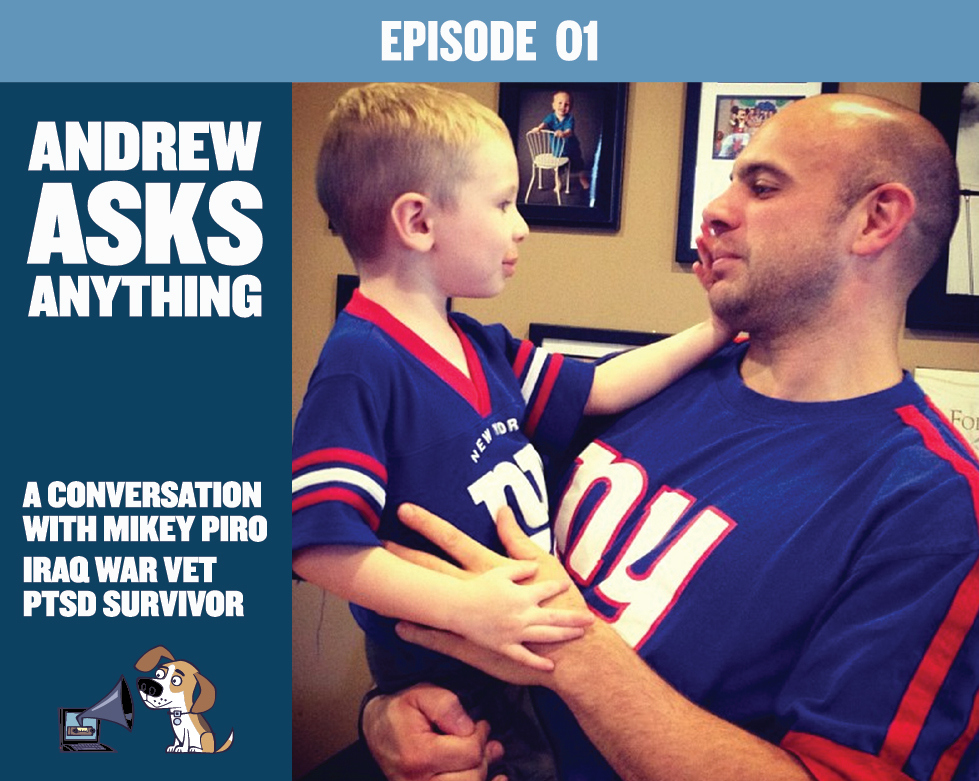
But it’s a start. Our first issue has two long-form pieces: an eBook, I Was Wrong, which is an edited diary-like chronicle of my blogging of the Deep Dish LogoIraq war from 2001 – 2008; and a 100-minute conversation with a remarkable former Iraq war commander, Mikey Piro, who now deals with PTSD, and in our conversation, tells the story of his war – on the ground and in the front-lines. Together, we hope they provide a deeper look at the narrative of the core event of the first decade of the 21st century.

We intend to follow up each month with long-form journalism that is close to the polar opposite of our daily blogging, yet fueled by its thriving community of readers. We’ve already begun taping a series of audio conversations called “Andrew Asks Anything” of which Mikey Piro is our first. I wanted to create something deeper, more intimate and less constrained than a television or radio interview. I didn’t want to interview anyone so much as enter into a conversation with another person, in which both of us have something to say and learn. It grew out of my one early experiment with such a sprawling, recorded after-dinner chat with Hitch.

I’ll also be writing long-form essays of the kind I used to produce for the Atlantic, the New York Times Magazine, Newsweek and Time. We’ll also use Deep Dish to create edited eBooks of some of the Dish’s best reader threads – from the death of pets to the cannabis closet. Soon, we  hope to have the resources to pay outside writers for the kind of long-form journalism that is increasingly under threat of extinction: lengthy piro-banner1investigative reports, New York Review of Books-style reviews, and sustained arguments and essays that require more than a column’s length. I have ambitions for long-form video as well; adventures in photography (an eBook of the best window views around the world, for example); and a continuing commitment to the publishing of poetry. In other words, we want to begin creating the kind of content we often link to.

Think of it as the Dish – but deeper, longer and uncut. You can check out our inaugural issue here. But Deep Dish is not as accessible to the world as the Dish. It’s behind a real paywall, which means it is for subscribers only. We wanted to offer the 32,000 or so subscribers  a token of gratitude for their amazing support this year, but also to show everyone else (a million monthly readers) what subscribing to the Dish could help spawn: a new business model for long-form magazine journalism.

There are signs that our own model of subscriber-based online journalism is beginning to bear fruit. Here’s a piece by Mathew Ingram on Beacon, a new media start-up he summarizes thus:

Beacon wants to give journalists who may not have the ability — or the desire — to run their own site a way to connect with readers who might want to subscribe.

It’s a collective version of the Dish model – for those who have not had thirteen years to build an online readership. We deeply hope it works. As long-form struggles to survive, and as “sponsored content” or page-view trolling gain more and more traction in the media, we want to pull in the very opposite direction – toward more reader-writer interaction and support, toward subscription-based journalism that can focus on the quality of content, rather than on the need to placate corporate advertisers with unprecedented leverage over struggling news sites or to rack up pageviews.

So here’s our first prototype. As always, we welcome feedback of all kinds, including your ideas of what we could do with Deep Dish in the months and years ahead. Our regular in-box is always open, and we read it carefully.

If you’re a subscriber,  just click here to read and listen to the first issue. (If you can’t access Deep Dish, you probably need to sign in with your username and password. If you need help signing in, check out this help page. If you’re still having trouble, email us at support@andrewsullivan.com.)

If you haven’t yet subscribed but want to read the eBook – the kind of journalistic accountability for error Paul Krugman called for today – or listen to the podcast (perhaps the most intense and humbling public conversation I have ever had), you can get immediate access to Deep Dish and unlimited access to the Dish by subscribing [tinypass_offer text=”here”]. If you’ve been hemming and hawing, this is an opportunity not just to help us, but to help others pioneer a new business model for long-form quality magazine journalism. Subscribe [tinypass_offer text=”here”]. It takes two minutes and it’s just $1.99 a month or [tinypass_offer text=”$19.99 a year”]. Or more, if you really want to help us turn this prototype into a more sustainable reality.

Only you can make it happen. But welcome to the beginning of what could be our future.

The Cheneys And The Republicans

Dick Cheney Poses For A Family Photo

For quite a while now, the GOP has lived with a rather spectacular contradiction over homosexuality. It was perhaps best summed up by the split between George W Bush and Dick Cheney in 2004 over the federal marriage amendment. Bush backed the amendment – you can read my real-time response that day here – and Cheney didn’t. So on a major issue of social policy – one on which the 2004 election was waged in Ohio – the ticket was split. Well: not so split. Bush – we were led to believe – was not exactly energized on this subject. His wife and daughters all backed marriage equality. In his personal life, Bush wasn’t a hater or a man lacking in empathy. Far from it. But Rove knew the base, and knew what could deliver it. So, with the aid of his then-closeted campaign honcho, Ken Mehlman, Rove won Ohio. With Ohio, he won Bush’s re-election.

Ask yourself: on what ticket in living memory did a president and vice-president publicly disagree on an issue that was critical to winning the election? And there you see the clash. Republican elites had gay friends, offspring and key aides. Yet the Republican base continued to view gays as some kind of threat to the family. The electoral math won. I remember – those were the days – when I was invited to meet Rove in the White House early in the first Bush term, and pressed the case against the FMA, or any variant thereof. Rove simply told me that there were many more Christianists than homos, and that mathematical reality dwarfed any arguments, however meritorious. It wasn’t the first time I had seen utter cynicism on this issue in high places – it was hard to beat the Clintons for that. But the baldness of the cynicism – the reflexive refusal even to address the actual rights and wrongs of the matter – was never better expressed than by Rove.

Cheney got a pass – but he shouldn’t have. He boldly came out for marriage equality explicitly … in 2009. In the vice-presidential debate of 2004, he bristled – as did the public – at being confronted by the fact that he was hurting his own family on this issue. But at some point, the contradictions – and their deep moral consequences – had to emerge. And now they have in full bloom. Liz Cheney, not a homophobe in my personal memory, is nonetheless opposing her sister’s right to marry – anywhere. Actually, she is in favor of her sister and her wife being stripped of all legal protections the moment they come into their family’s home state. Let me put this more clearly: Liz Cheney is attacking her sister’s dignity and civil equality, in order to advance her political career. In a word, it’s disgusting.

It’s not made any better by Liz Cheney’s response:

I love my sister and her family and have always tried to be compassionate towards them. I believe that is the Christian way to behave.

To which I would like to respond on behalf of Mary and Heather and the rest of us: fuck your compassion. Just give your sister the basic equality and security for her own family that you have for yours.

At some point, even the most cynical of politicians has to understand that this issue is not abstract. It affects your own sons and daughters, brothers and sisters. You cannot publicly attack your own sister’s family and say you love her as well. It does not compute. And Liz Cheney does not even have the excuse of being of a different generation. She’s my generation. She knows better. She has seen her sister’s life up-close. So major props to Heather Poe, Liz’s sister-in-law, for calling her out:

Liz has been a guest in our home, has spent time and shared holidays with our children, and when Mary and I got married in 2012 — she didn’t hesitate to tell us how happy she was for us. To have her say she doesn’t support our right to marry is offensive to say the least.

Of course, principled differences of opinion are compatible with family values. Some members of my own extended family don’t agree with marriage equality. I live with that, but I’d be lying if I said it doesn’t sting. But they’re not actively campaigning on the issue and even trying to use it for political gain.

What you’re seeing here is the Republican elite’s hypocrisy finally being called out – in the most public way possible. By refusing to stay silent while their sister and sister-in-law acts as if it’s still 1996, Mary Cheney and Heather Poe are standing up for their own integrity. They are therefore now leaders of the gay rights cause – even though many on the gay left will doubtless give them no credit. Because this cause is not just a public and political one; it is a personal and moral one. And the ability to pretend that you can do one thing in public and another in private is becoming more attenuated by the day.

(Photo: Congressman Dick Cheney and wife Lynne pose for a photo with their two children Liz (L) and Mary and Basset Hound Cyrano at their home in Casper, Wyoming in March 1978. By David Hume Kennerly/Getty Images.)

Yes, Alec Baldwin Is A Homophobic Bigot

I’m glad Dan agrees with me on the core point. But why on earth does he feel the need to qualify it? That is the question. Why are progressives held to a lower standard than conservatives? Should they not be held to higher standards? Many readers – depressingly – take Dan’s position or worse:

I feel slimy doing this but I am going to “defend” Alec Baldwin. I am now 38, I do not consider myself homophobic or a bigot. I am from the San Francisco bay area and I have had family, friends, employers are co-workers who are gay. I will vehemently advocate for gay rights during discussions with co-workers and I will not vote for bigoted politicians. I have frequented many gay bars with my wife because the partying is better.

However, when I am angry, I frequently use the phrases, cocksucker, faggot, bitch or a combination of the three words. Does this make me homophobic? Perhaps. Unfortunately I also use racial slurs. I am a third-generation American of Mexican descent and I use all type of slurs – anti-white, anti-Mexican, anti-black. I did grow up in a racially diverse area and we would always joke around with each other using racial slurs. I can only say in my heart and in my head I do not have negative feelings towards gay people or any race. I consider myself a conservative but voted for Obama in small part because the racist strategy used against him was so offensive to me.

Here’s a question. When my reader says he uses racial slurs, he doesn’t cite them. Does he use the word “nigger” or “kike” in public, in anger, I wonder, as Baldwin did in a homosexual context? If he did, would it be relevant to qualify it by saying he voted for Obama or loathes racist political demagoguery – and that he should thereby be given a pass? Ask yourselves that.

Another reader:

As you stated, Baldwin’s anger was merited. But you and everyone else should be very careful in throwing around the word “homophobe”, since being implicated as a homophobe is sort of a big deal. To say that Baldwin has contempt for gays is ridiculous. People who protest gay pride parade and spit on gays are homophobes. People who fire gays for their sexual orientation are homophobes. People who get cut off in traffic, lose their temper and yell “you stupid bitch” aren’t male chauvinists – they’re just being assholes at that moment.

Baldwin was pissed off and threw out a word that invokes the most pain possible.

I want to unpack this sentence, because it is important:

Baldwin was pissed off and threw out a word that invokes the most pain possible.

So Baldwin regards calling another man a “cocksucking fag” a way to inflict the most pain possible. That means he has to buy into the logic of the stigma in order to wield it as a weapon. What he’s implicitly asserting, by choosing those words, is that a man who sucks another man’s cock is a terrible thing to be. It’s a classic form of demonizing gay sexuality. It’s laden with the tones of schoolyard anti-gay bullying.

Then he uses a term that is routinely used in this context (there are other much more benign contexts I have no trouble with) to imply another man is inferior to other men, because he is effeminate, i.e. a fag. I’m sorry, but this is homophobia in its rawest form. If I heard someone yelling “cocksucking fag” to another man on the street, I’d immediately know what was going on, wouldn’t you? And whenever I have witnessed such a thing, I have intervened and protested.

There are many ways to vent in public. “Asshole,” “douchebag”, “fuck you!”, to cite a few more obvious ones. Since living in New York, I have heard many more variations on the theme. But a man who instinctively uses misogynistic or homophobic slurs as weapons in public is not just another angry New Yorker. If this were a one-off, it would be one thing. But Baldwin’s record on all this is appalling. Two years ago, he allegedly had another confrontation with a photographer:

At one point, at the beginning of the confrontation, It sounds like Alec says to the photog, “I know you got raped by a priest or something.” Then, in an effort to assert his dominance, Alec got right in the pap’s face … and in a menacing tone said, “You little girl.”

Baldwin again denies it and there may be some confusion over the precise wording. But this is textbook schoolyard homophobia, laced with the familiar memes of anal sex and the threat of thuggish violence against a gay man demeaned as a woman. (Notice the obvious rank misogyny embedded in that as well.) Even Mel Gibson – for all his foul anti-Semitism – never physically threatened a Jewish person while calling him a “kike.” Then there were the infamous tweets of earlier this year, directed not at a random person, but someone he actively knew was gay:

George Stark, you lying little bitch. I am gonna f%#@ you up … I want all of my followers and beyond to straighten out this fucking little bitch, George Stark. @MailOnline … My wife and I attend a funeral to pay our respects to an old friend, and some toxic Brit writes this fucking trash … If put my foot up your fucking ass, George Stark, but I’m sure you’d dig it too much … I’m gonna find you, George Stark, you toxic little queen, and I’m gonna fuck…you…up.

Again: the classic, unreconstructed homophobia is so obvious it takes one’s breath away. He has called other men “bitch” and “girl” while threatening violence – hate crimes – against them. Again: note the stigmatization of gay sex: “I’d put my foot up your fucking ass … but I’m sure you’d dig it too much.” He is threatening to anally rape a gay man – and is only restrained by the foul thought that a gay man would actually enjoy being raped. How much more hateful can it get?

And in all of these cases, he reflexively and comically lies afterward. He either denies everything – even when you can hear him on tape, for Pete’s sake, even when it’s in his own tweet! – or claims preposterous ignorance. I mean seriously, he has subsequently claimed he had no idea that the word “queen” had homosexual connotations and yesterday tweeted this (and, again, I swear I am not making this up):

Rich Ferraro from @glaad informs me that c’sucker is an anti-gay epithet. In which case I apologize and will retire it from my vocabulary.

At this point, it has become a joke that could work pretty well on 30 Rock – where, by the way, he is a brilliant comic actor.

One final point: is this a witch-hunt of someone – exactly the kind of thing I really try not to engage in, especially on gay issues? Am I being too sensitive?

I’d say this: I hope that Alec Baldwin as a human being really isn’t a homophobe in the depth of his heart and soul. He may well not be or may try not to be. Friends speak well of him. We all harbor prejudices; we’re all human; of all people, I know what it’s like to get angry and say or write stupid things. People are complicated. They can be bigots in one context and the opposite in another. I’m a sinner as well.

The reason I cannot let this go is the precedent it sets. Baldwin is not just an actor; he hosts a political show on MSNBC. He behaves as a political actor with his support of various causes, all of them noble. He has set himself up as a pro-gay progressive. If we concede the point that because you are somehow formally pro-gay, it doesn’t matter if you hurl murderous homophobic threats against people in public, then we have sold our soul.

I’m not talking about poorly written sentences – like Richard Cohen’s. I’m not gleaning subtle tropes in someone’s prose that might lead to suspicions of bigotry. I’m talking about the crudest of anti-gay epithets yelled in public repeatedly, combined in most cases with a threat of violence. If we excuse even that for the greater cause, then it seems to me we have nothing but cynicism left. And that level of cynicism is deeply corrosive of a civil rights movement.

In my view, the gay rights movement is not, at its core, about enacting legislation, or merely a political struggle. It is a moral case for the equal dignity of gay people, and for mutual respect. What deeply troubles me is not so much that one hot-headed actor is a bigot, but that his public support for gay causes is effectively buying him a right to perpetuate the vilest canards and hatreds that have demeaned gay people for centuries. What disturbs me is that pro forma support for various gay organizations or causes gives this man permission to perpetuate the foulest forms of bigotry – and never take full responsibility for it, and to do it again and again, with no penalty or the faintest sense that he has really done something terribly wrong by his own alleged standards.

It isn’t Alec Baldwin who troubles me so much. It’s his liberal enablers.