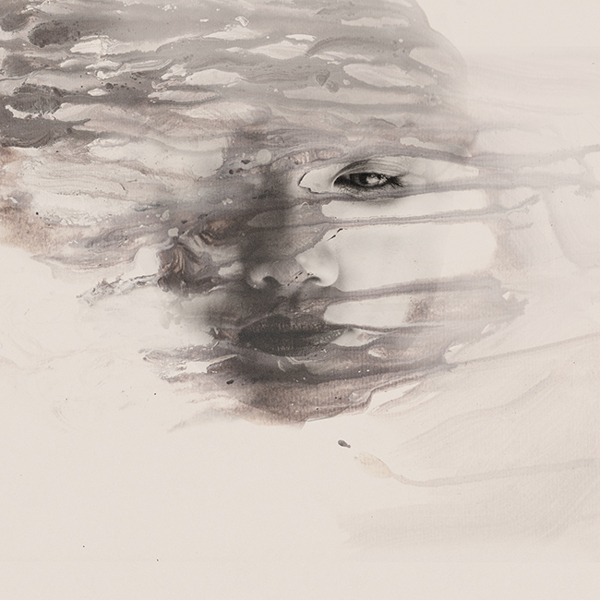
Mixed media by Januz Miralles, from the series “Nothing To See Here.”
Mixed media by Januz Miralles, from the series “Nothing To See Here.”
Author Barry Hannah’s response:
Twenty years ago I was out in the woods alone. The weather was clear and very cold, but felt good. I had a Pall Mall in my hand and I walked into an old abandoned cabin of the Roosevelt era. Inside the cabin was just a bit warmer than out. A dusty tin bed with a thin mattress on brown springs. I wanted to light the Pall Mall very badly but I waited a while for the dark. The hairs of a feral dog lay in a circle on the planks in front of the hearth. In the last grip of faint grays, I lit the cigarette and the smoke felt exquisitely good inside me. I knew I was pledged to something. This lonesomeness, this cold lost place I would soon warm up. Nobody knew where I was, nobody. It wanted to be lived in here. I knew life would be sad but quite fine then. I felt a hum of joy in my head. Like some old muttering conquistador stumbled up with a flag to ram the staff into God knows what mud.
Forever afterward I would crave abandoned rooms in lost places, me with my pencil and paper. I would mount a small country here. The frame was already there, you were not really a conquistador, let’s not kid our girlfriends. But you would warm up and put something in this hole. It might leak a little bit but it would be yours. From all my military readings I have gleaned the comment most pertinent to me and the gals and pals desperately given over to the writing life. The writer meant Korea and Vietnam, but he put his truth to the exact same glory and grief of our efforts: It’s the war we can’t win, we can’t lose, we can’t quit.
I’m waiting, however, for the future priest to be kicking around the shards of our old cabins. He finds some pages. My God, it’s paper, ancient paper. He bends over, holding the cigarette pack-size computer to his shirt pocket so it won’t fallout. Poor devils, the old scribes, jabber jabber, yadda yadda, he says.
But wait, this is pretty good.
In a review of Barbara Fredrickson’s Love 2.0, Barry Schwartz latches on to another theory:
“Do you love your spouse?” becomes the wrong question; “Are you loving your spouse?” is the right one.
A critic might quarrel with Fredrickson for calling these moments of resonance “love” rather than something else. Why not keep “love” as we have always used it and coin a new term for the moments of positivity that Fredrickson is talking about? I don’t think this is a big deal, but, aside from helping to sell books, the virtue of redefining love in this way is that it encourages people to think hard about whether what they’ve been doing in the service of love is actually meeting its objective. And I can’t overemphasize how striking the evidence is that Fredrickson marshals in support of her position. Not just psychological evidence, which would be important enough. But also neural evidence, neurochemical evidence, cardiovascular evidence, and even evidence of effects on gene expression. This line of work may end up changing both what we mean by love and what we take as evidence for love and its effects.

You have until noon on Tuesday to guess it. City and/or state first, then country. Please put the location in the subject heading, along with any description within the email. If no one guesses the exact location, proximity counts. Be sure to email entries to contest@andrewsullivan.com. Winner gets a free The View From Your Window book. Have at it.
Former prison librarian Avi Steinberg describes why teaching creative writing in prison is so important:
Many people who came to my classes were eager to improve their skills at writing letters. Prison is a lot like the 19th century. Letter writing continues to thrive there. There is a particular urgency to writing in prison—a letter is the difference between having a relationship with a person on the outside or not. Writing is the relationship. Like those old Victorian letters, the prose itself is heated by this dynamic.
There are so many ways in which creative writing is suppressed in prison.
So much of writing in prison is associated with sheer malice and with legal warfare (inmates and staff members are constantly writing grievances and incident reports). There is little free speech in prison and no private property. Your cell can be searched at any time and your writings can be confiscated. Anything you say can and will be used against you—that’s the literary culture of the place.
And suppression could come in other, less obvious forms. Many inmates had gone through addiction recovery programs that incorporate writing assignments into their regimens. Perhaps this kind of writing serves its therapeutic purpose but, from a literary perspective, it’s stifling. It trains people to tailor their stories to the tastes of recovery-think, and to strangle these stories with the homogeneous language of the program. After I saw the 10th consecutive essay that described how someone had “hit rock bottom” I realized that I would have to figure out how to get my students to write in their own voices.
When they were coming up with the details for Raiders of the Lost Ark, George Lucas, Steven Spielberg, and writer Lawrence Kasdan recorded their spitballing sessions, and a transcript (pdf) is now available online. Patrick Radden Kaffe is fascinated:
As the screenwriters Craig Mazin and John August pointed out recently on the Scriptnotes podcast, one delight of reading the transcript is watching Spielberg throw out bad ideas, and then noting how Lucas gently shuts him down. Spielberg, who had sought to direct a Bond movie—and, astonishingly, been rejected—thought that their hero should be an avid gambler. Lucas replied that perhaps they shouldn’t overload him with attributes. (Lucas himself had briefly entertained, then mercifully set aside, the notion that his archaeologist might also be a practitioner of kung fu.) There’s a good reason we seldom get to spy on these conversations: really good spitballing, like improv comedy, requires a high degree of social disinhibition. So the writers’ room, like a therapist’s office, must remain inviolable.
Spielberg fires off ideas with an adolescent’s stamina—and not all of them are bad, either. In fact, among his spontaneous interjections are some of the most iconic episodes in the film. “I have a great idea!” he exclaims. “There is a sixty-five-foot boulder, that’s form-fitted to only roll down the corridor, coming right at him. And it’s a race. He gets to outrun the boulder!”
Following the revelation that one of their editors had “plagiarized whole sections of a 13,000-word music guide,” the arts and culture site Brightest Young Things has taken down all of its content for a full audit. Roy Peter Clark, meanwhile, downplays claims that plagiarism is suddenly more of a problem that it used to be:
I smell a whiff of panic in the air. My colleague Craig Silverman dubbed the summer of 2012 — for its several literary transgressions — as the “Summer of Sin.” He cites “a cavalcade of plagiarism, fabrication and unethical recycling.” But he might just as well have written about 1981 when the “Jimmy’s World” scandal at the Washington Post rocked the journalism world. He might have time-traveled to 1934 and listened to city editor Stanley Walker complain about how many young reporters were “faking” their stories.
I see no persuasive evidence that literary abuse is more common today than in yesteryear. In the cut and paste culture of digital technology, plagiarism may be easier to commit, but it is also easier to detect. Standards may appear in decline when, in fact, media crime fighters such as Silverman are simply more assertive and armed with better Geiger counters.

Alison Gash chronicles same-sex adoption victories and how they were won:
Where marriage equality advocates had little choice but to engage in open political battles and bring high profile constitutional court cases on behalf of their fundamental rights, the fight for same-sex parental rights has mostly played out in obscure family courts, with few reporters present, and with advocates consciously delaying or avoiding high court review. This below-the-radar strategy created a foundation of “facts on the ground”—tens of thousands of intact gay and lesbian-headed families with children-well before most conservative activists were even aware the phenomenon existed, making their subsequent efforts to block same-sex parenting an uphill fight.
(Photo: Frank Martin Gill sits with his six-year-old foster son, known as N.R.G., after the Third District Court of Appeal in Miami ruled that Florida’s ban on gays adopting is unconstitutional on September 22, 2010 in Miami, Florida. By Joe Raedle/Getty Images)
It means more than you think:
According to a recent paper by the economist Andreas Wagener, people are twice as likely to cough during a concert as at other times. Furthermore, they are more likely to cough during modern, atonal music than during better-known repertoire and they cough more during slow or quiet passages than during fast and loud ones.
The classical cough, then, is no accident but rather a form of communication disguised as involuntary physiological tic. “Because of their ambiguity – they may always be forgiven as bodily reflexes – coughs are a noisy substitute for direct, verbal communication and participation,” Wagener writes. “They allow for social interaction up to contagious herding, propagate (possibly incorrect) assessments of the performance and reassure concert-goers in their aesthetic judgements.”
Coughers might thus be rebelling nonverbally against the hierarchy imposed on them – that of powerful, noise-making performers and submissive, silent audience.

Friday on the Dish, Andrew responded to reader dissent on Bill Clinton’s gay rights record, explored the implicit distinction between infertile straight couples and gay couples in marriage equality arguments, turned objectification back on men. In honor of Good Friday, he sent a prayer out to David Kuo and all others suffering hardships as Franz Wright provided us with some verse to contemplate and Pope Francis distinguished himself through his humility.
In political coverage, Greenwald found humor in a divorcées defense of “traditional marriage” as Rush Limbaugh threw up the white flag on marriage equality, and Al Tompkins asked for television access to SCOTUS. John McWhorter criticized “evolving” politicians, John Podheretz finally got Obama, Timothy B. Lee disputed the Mercatus Center’s definition of freedom, and the Iraq War’s cost continued to climb.
In assorted news and views, Daniel Victor debunked a Twitter #myth, Conor Friedersdorf saw more paranoia than protectiveness in Bloomberg’s surveillance, and Will Oremus weighed the ethics of genetic screening. Readers pushed back on the paucity of public defenders, debated pre-nups, and provided perspective on sexism in the tech industry. Elsewhere, they traced male-on-male adulation from Casablanca to True Romance, and shared their experiences with gay rape. George Zornick revealed the high toll at home for victims of military sexual abuse, Marines ran out of doors to kick down, and Michael Zwerin jazzed up World War 2.
Meanwhile, we squirmed at the sight of blood, Penn hospitals fired smokers, and Kleiman shifted the drug war’s focus to booze while Europeans substituted home-brewed narcotics for heroin. Spring break failed to stimulate and Aaron Carroll distanced himself from whiny doctors. Christian Wiman based his religion on shared suffering, E.B. White despaired at an early example of sponsored content, and John Vidal blamed the unseasonably cold weather on global warming. We said “buenos dias” in the VFYW, and narrated nunchuck practice in the MHB, while the easter bunny made an early appearance in the FOTD.
– D.A.
(Photo by Dan Kitwood/Getty Images)
The rest of the week after the jump:

(Photo by Adam Jan/AFP/Getty Images)
Thursday on the Dish, Andrew traveled the long road from persecution to equality, highlighted key DOMA moments, and hammered the Clintons for their opportunism on marriage equality. Elsewhere, he was encouraged by the Atlantic’s movement on sponsored content.
In politics, history repeated itself with concerns about children in unconventional marriages, Tom Goldstein balanced DOMA and Prop 8, and EJ Graff prepared for the marriage equality fight to continue beyond the DOMA ruling. Maggie Gallagher waited for divine judgment as the anti-equality movement continued to fade. The Greater Israel Lobby kept the West Bank under Israeli control, marijuana reform marched on, and the War on Terror aggravated the recession while torture thwarted justice.
In miscellaneous coverage, Frum traced the origins of America’s gun culture, a reader plugged domestic uses for drones, and a dongle divided the tech community. Ronald Bailey looked ahead to smaller farms, Reuven Brenner cashed in on early graduation, and Jake Blumgart cheered on his alma mater with sweatshop-free apparel. Marriage created the commitment that strengthened relationships, a reader shared his pre-nup horror story, and we crunched the numbers on rape in the gay community.
Elsewhere, The Americans impressed, Ferris Jabr toned with the help of tunes, and readers mouthed off on our monthly subscriptions. Buzz Bissinger splurged on Gucci, Mark Dery considered the American love of the British Monarchy, and anti-Semitism lingered in Britain. Jon Hamm’s privates begged for privacy, the Economist unveiled modern attitudes toward sex in the Arab world, and TNC felt more afraid in Paris than on the streets of Baltimore. We traded german shepherds for St. Bernards in the MHB, attended a retro lesbian wedding in the FOTD, and watched a backyard blizzard in the VFYW.

(By Jewel Samad/AFP/Getty Images)
Wednesday on the Dish, Andrew dove into the arguments in today’s DOMA hearing, encouraged anti-equality advocates to lead by example rather than oppressing others, and applauded the influence of the younger generation on their parents. Elsewhere, he prophesied a dismal future in journalism and refused to look away from the ongoing violence in Syria, which has now spilled over into Lebanon.
In Supreme Court coverage, Jon Rauch searched for a graceful out for the justices on Prop 8, while Dale Carpenter predicted an inconclusive ruling and we peeked into the courtroom as readers looked for a comprehensive ruling. NOM blew a tone-deaf dog-whistle, Nate Cohn lowered his expectations for the South’s support of marriage equality, and a trickle of equality endorsements turned into a flood, while we wondered who would be next. SCOTUSBlog gave us the odds on DOMA, Kennedy got right to the key point, and Ari Ezra Waldman explained why the “standing” issue applies for DOMA. While Ezra Klein found plenty of children who could benefit from a stable household, Edie Windsor overcame discrimination, with or without the government’s approval, and provided us with an enthusiastic FOTD.
In assorted news, Tony Dodge argued that the Iraqi Civil War was avoidable, readers waded into the debate over graphic war imagery as we explored blood-phobia, and technology made medical cost projections impossible to trust. Gary Becker tied immigration to the birth rate below the border, the recession forced families to call hotels home, Silicon Valley struggled with sexism, and readers disputed the comparison of Weez’s hacking and entering an unlocked house.
Meanwhile, an edibles maker chimed in on mellow highs, John Jeremiah Sullivan revealed our ignorance of animal consciousness, and two British papers joined the ranks of the metered. Channing Tatum gave George Clooney the thumbs up, TV watchers exercised their control, and Game of Thrones gave us a fantastic history lesson. We traveled to the Great White North in the VFYW, bopped with a big baby in the MHB, and VFYW contestants homed in on Hastings-on-Hudson.
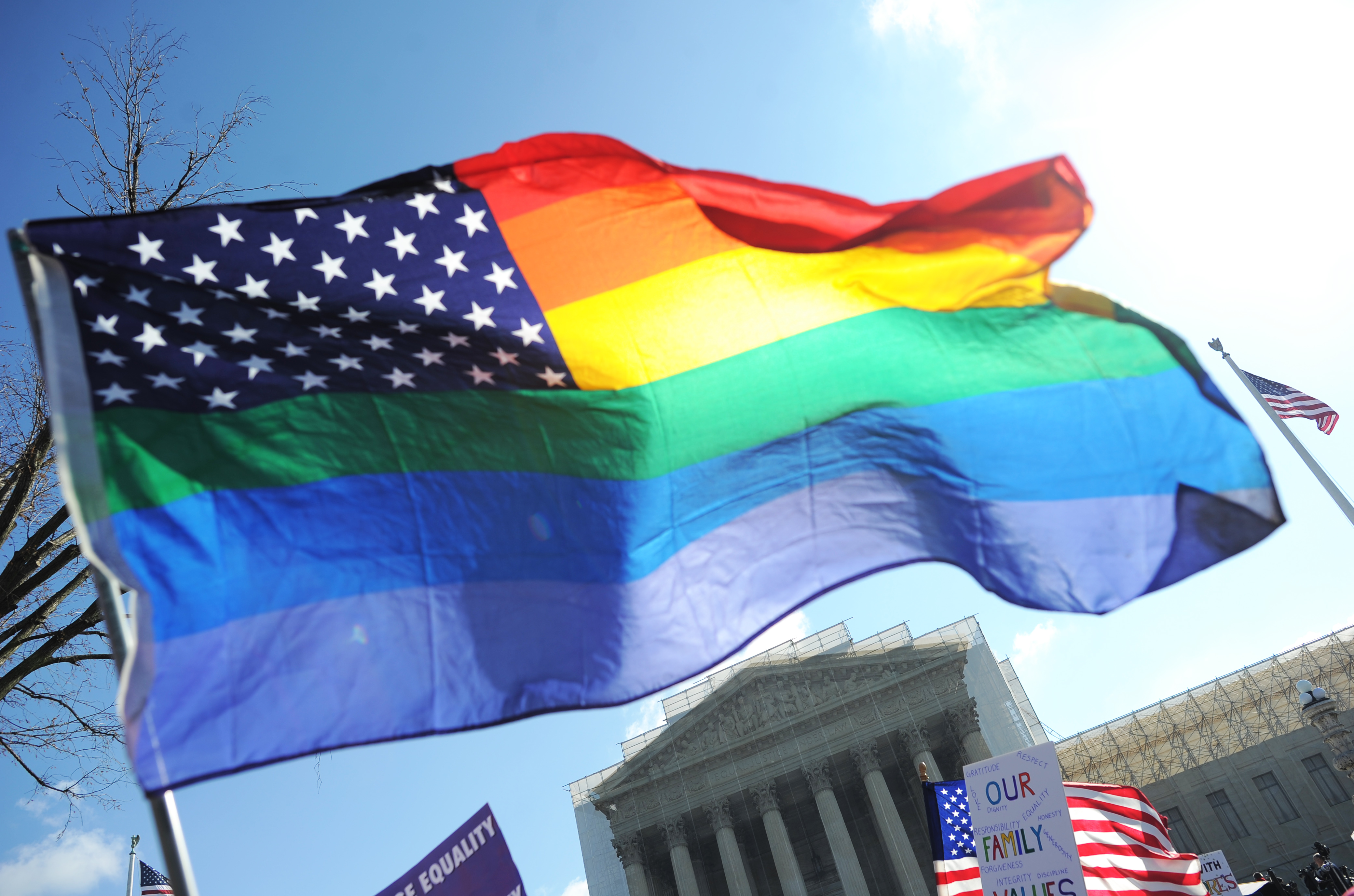
(Photo: Jewel Samad/AFP/Getty.)
Tuesday on the Dish, Andrew examined the differences between his appearance on Charlie Rose and the WSJ’s editorial, hoped that the benefits of marriage would soon be equal opportunity, parsed the arguments, and celebrated the early signs of a moderate outcome. Elsewhere, Douthat described a world without the Iraq war and Boris took a beating from the British press.
As the Supreme Court heard arguments in Perry v. Brown, past SCOTUS decisions bucked popular opinion, Cass Sunstein explained the benefits of a narrow ruling, and Greenwald heralded the defeat of defeatism. Josh Barro made the fiscal case for marriage equality as Frum completed his turnaround, McArdle connected marriage equality and “traditional morality,” and Allahpundit looked ahead to marriage equality’s role in the 2016 primaries. Nate Silver found hope in marriage equality’s steady polling advances, as Republicans divided along demographic lines and Christie picked the wrong side of a Jersey wedge issue. We took Twitter’s temperature on the hearing, compared Perry to Roe as readers chimed in, and applauded straight allies. Scalia and Olson exchanged questions, we reviewed “standing,” Lyle Denniston played out the possibilities in a deadlock, and Dale Carpenter read the tea leaves, as even the lawyers had trouble making predictions. After all this time, MLK Jr.’s and Hannah Arendt’s words continued to ring true, and the struggle for marriage equality was nothing new.
In assorted news and views, a reader pointed out Weez’s wrongdoing, Freddie deBoer poo-pooed the Pebble watch, smartphones proved a popular target for thieves, and robots took over the valet stand. Carl Zimmer defended “basic research,” money mattered in March Madness, and we envied the “sleepless elite” while distracting ourselves to get rid of earworms.
Meanwhile, we pondered prenuptial agreements, Elizabeth Samet questioned the belief that soldiers make the best politicians, Brits narced on their neighbors, and TNC dove into the deep end to learn french. A butterfly perched precariously in the FOTD, we stopped by Senegal in the VFYW, and peeked in on panda playtime in the MHB.

By Brendan Smialowski/AFP/Getty Images
Monday on the Dish, Andrew teamed up with a liberal lawyer to promote marriage equality, applauded the truth evident in Will Portman’s coming out, and called attention to the lack of data showing any harm to children of same-sex couples. Meanwhile, he cheered Rand Paul’s sanity on pot, drew parallels between conservativism and taoism, regretted the US’ choice to embrace torture in order to depose a torturer, and explained the new monthly subscription option on the Dish.
In political coverage, Obama worked his magic in Israel and struggled to reclaim his earlier levels of popularity. Ben Merriman considered conservativism in Kansas, the justice department jailed another hacker, and Julia Ioffe investigated Russia’s role in the Cyprus banking scandal. On the eve of the Prop 8 hearings, Tim Murphy set the deadline for marriage equality evolutions.
In assorted coverage, we added more details on name-changing customs at home and abroad, educational attainment was inherited, clinics offered à la carte pricing, and Rob Rhinehart gave up solids. Christian Caryl brought war imagery to the fore and Hitler convinced with his conviction. While goats thrived on global warming, Eduardo Porter worried about natural gas leakage, Tom Chatfield tried out a better keyboard, and David Zax reached the limits of his innovation.
As Passover began, Maxwell House monopolized the Haggadah, while elsewhere a reader sought a softer high, and Matt Soniak explained why toothpaste ruins orange juice. George Eliot couldn’t fool Charles Dickens, Lord Byron gave rise to vampires without writing a word, and Piers Anthony coped with his unhappy childhood. German shepherds frolicked in the MHB, and winter stuck around past its expiration date in the VFYW and the FOTD.

(“The Deposition” by Dominique Ovalle)
Last weekend on the Dish, we provided an eclectic mix of religious, books, and cultural coverage. In matters of faith, doubt, and philosophy, Thomas Merton taught us how to pray, Reinhold Niebuhr found the essence of Christianity, and Jody Bottum pondered the ways Pope Francis eludes contemporary political categories. Dominique Ovalle urged us to believe in the beautiful, Marc Hopkins investigated the ways jazz music can contribute to Christian worship, Valerie Weaver-Zercher sized up the market for Amish romance novels, and Richard L. Rubenstein remembered a guru’s advice about outgrowing religion. Andrew Ferguson argued that philosophical materialism can’t be lived, Emma Woolerton revealed why Lucretius presented his philosophy in the form of poetry, Kurt Gray explained why playing the victim is the best way for a guilty person to escape blame, and Caitlin Doughty noted the benefits of confronting one’s own death.
In literary and arts coverage, T.R. Hummer mused on a possible recording of Walt Whitman, Darryl Pinckney recalled an embarrassing encounter with James Baldwin, and Tom Jokinen asked if a certain amount of infatuation led to writing good biography. Brad Leithhauser contemplated various authors’ versions of Hell, Colin Dickey surveyed the literary career of opium addict Thomas De Quincey, David McConnell discussed his book about six notorious killings committed by straight men against gays, and Grady Hendrix fondly looked back at MAD magazine’s film satires. David Mamet ruminated on the role of the dramatist, the herbalist Olivia Laing considered the symbolism of Shakespeare’s plants, Greg Bottoms penned an open letter to photographer William Eggleston, and Tom Bissell thought about the literary potential of the video games. Read Saturday’s poem here and Sunday’s here.
In assorted news and views, Lizzie Plaugic unpacked a report on marriage among the millenials, a couple survived long-distance dating with the help of technology and the photogenic dog they shared, Eric Jett lamented missing the golden age of the booty call, and Garance Franke-Ruta offered a theory about why women have difficulty climbing the corporate ladder. Peter Foges told us all about rose champagne, Martha Harbison wondered if some beer drinkers could be addicted to hops, and Katie Arnoldi described how cartels have seized control of the human trafficking business. MHBs here and here, FOTDs here and here, VFYWs here and here, and the latest window contest here.
– M.S. & D.A.
 The Dish