Overrun With Indies?

Contemplating this year’s Sundance festival, Manohla Dargis makes a request of movie producers (NYT):

[T]ake a moment and consider whether flooding theaters with titles is good for movies and moviegoers alike. Because no matter how exciting Sundance will be this year, no matter how aesthetically electrifying, innovative and entertaining the selections, it’s hard to see how American independent cinema can sustain itself if it continues to focus on consumption rather than curation. There are, bluntly, too many lackluster, forgettable and just plain bad movies pouring into theaters, distracting the entertainment media and, more important, overwhelming the audience. Dumping “product” into theaters week after week damages an already fragile cinematic ecosystem.

Tim Wu has a great counterargument, writing that “making lots of films to yield a few hits is not dangerous to independent film but exactly how independent film sustains itself—and ultimately how it improves Hollywood”:

Who exactly gets hurt if too many movies are made?

If making films weren’t challenging and fun for the people involved, they wouldn’t do it. As John Kenneth Galbraith wrote decades ago, we live in an affluent society, with plenty of surplus cash, much of which ends up in the arts. More art means more bad art, too, but so what? … It may sound strange, but visible failures are the sign of a fertile cultural industry.

Ultimately, the only real victims are film reviewers like Dargis, whose job is complicated and made tiresome by the duty of watching so many films. … This leads to a suggestion for the Times’ critics: namely, that the paper’s ambition of reviewing every film that is “released” in New York City theatres is folly and entirely too twentieth-century. (The Times reviewed nearly nine hundred films in 2013.) The significance of a release is eroding in every media market—film is just the latest. Just as book-review sections long ago gave up on trying to keep track of every book published, it is pointless to review every film released, especially when the real life of most films happens on the small screen anyhow.

(Video: Trailer for Computer Chess, winner of the Alfred P. Sloan Prize at the 2013 Sundance Film Festival)

Why Is Lightning Getting Less Fatal?

dish_lightning

Rebecca J. Rosen investigates the question:

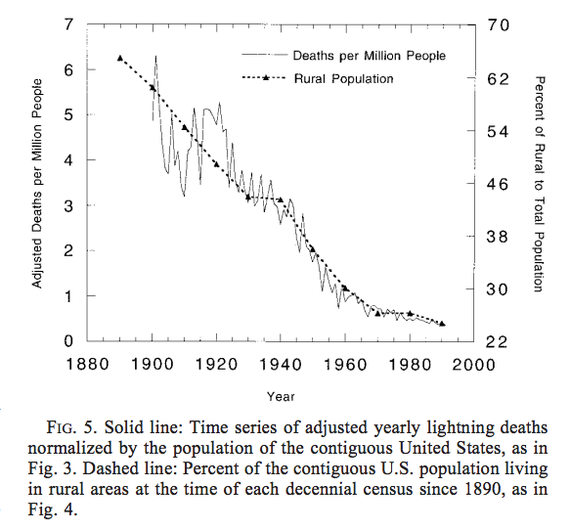
In the lightning-death literature, one explanation has gained prominence: urbanization. Lightning death rates have declined in step with the rural population, and rural lightning deaths make up a far smaller percent of all lightning deaths (see figure at right). Urban areas afford more protection from lightning. Ergo, urbanization has helped make people safer from lightning. …

But is the move from farms to cities what is driving the decline? Sure, lightning deaths and the rural population both declined during the 20th century, but so did a lot of other things, for instance, the percent of people living without electricity and plumbing, two infrastructural improvements that also help make your home less vulnerable to lightning. Of course, the development of better infrastructure—what I’ll refer to as modernization—is related to urbanization, but it is not limited to urban areas. Over the 20th century, rural infrastructure modernized as well. How can we know how much each is driving the decline in lightning deaths?

There’s one number we’d really need, and that’s the death rate for the rural population over time. If the rural rate held steady, than urbanization is responsible. If it too dropped, we’d be able to get a glimpse of the relative merits of the urbanization and modernization theories.

When Urban Beautification Turns Ugly

SPAIN-DEMO-BURGOS

In Burgos, Spain, plans to “turn the district’s main street into a traffic-calmed, bike-friendly boulevard with subterranean parking have caused an outcry that has turned explosive”:

Why is the boulevard being resisted so bitterly? The answer comes down mainly to the perception that the city is mismanaging its money. The city has earmarked roughly €8 million for an essentially cosmetic project – one that will also replace free parking with paid spaces – while badly needed government services are being cut elsewhere to help the city manage its debts. As a 35-year-old unemployed woman told El Pais: “We have to pay our debts and create a surplus of social benefits before creating this reform that will only beautify the city.”

Zooming out:

Across the continent, we see urban beautification plans proposed as solutions to any number of knotty social problems, whether it’s pedestrianization plans in crisis-hit Athens or a blueprint for a futuristic elevated cycle highway through one of London’s poorest districts. The reaction to projects like these is often cautious approval – any investment is better than nothing. But when such plans take place simultaneously with cuts to education and training, or alongside lack of investment in genuinely affordable housing that will allow residents to remain following improvements, attitudes shift. Urban improvements are supposed to boost general human happiness, but in cases like Burgos’ they can seem like false fixes that fail to address the more complex, deep-rooted issues that shape people’s lives.

(Photo: A tourist is sketched next to policemen during a demonstration in Barcelona on January 17, 2014 in support of locals from the city of Burgos protesting against planned construction works to revamp Vitoria street, the city’s main thorough-fare. After a week of protest, Burgos’ mayor announced today the abandonment of the project. The nightly protests began on January 10 and have spread from Burgos, to Madrid and to the town of Valladolid. By Josep Lago/AFP/Getty Images.

Dish Renewal: Your Technical Questions

199reax

[Re-posted and updated from earlier today]

A common query:

Your renew link isn’t working for me. Why not?

Make sure you are logged in as a subscriber. You can check this by confirming there is a blue SUBSCRIBER button in the upper-right corner of the Dish. If it’s red and you subscribed last year, you’re not logged in. If it’s red and you haven’t subscribed yet, you can do so [tinypass_offer text=”here”]. Remember that the only subscribers who can access the renewal process are those who subscribed last year before March 21 (i.e. Founding Members). All of the post-March 21 subscribers are already on auto-renewal. Another reader:

I renewed my subscription earlier this week but your home-page still shows I have subscribed only until 2/2014.  When will it get updated?

This is likely because the cookie between the Dish and our partner Tinypass needs to be refreshed. That will eventually happen on its own, or if you prefer, you can clear your browser’s cookies (guide here) and then log back into the Dish, at which point the expiration date will definitely be correct. Regardless, this temporarily incorrect date will not affect your billing or your access to the Dish in any way. Another reader:

So I received your email last night and immediately went to renew, but I did not for one very small but cogent reason. When I logged on, it said I was going to subscribe for a year and then it would auto-renew me for the next year, which was fine, but it also seemed to indicate that the year would run from the date of my renewal purchase rather than starting at the end of my current fm-renew-buttonsubscription, which doesn’t expire for another three weeks, on Feb 4. So I did not renew, in order to avoid double-paying for the three remaining weeks. But I plan on going back on February 3 to renew then.

It is, of course, possible that this is not true, and the renewal would actually begin after me current subscription runs out, but if so, it certainly doesn’t indicate that on anything I could find at the renewal site. It may sound unreasonable to worry about those three weeks, but I’m counting every penny and it matters.

Don’t worry; when you renew, your existing subscription will automatically extend by a full year (or a full month, if you’re on the monthly plan). So to use the reader’s example, if your annual subscription runs out on Feb 4, 2014 and you renew today, your credit card won’t be charged again until Feb 4, 2015. Another reader:

I just renewed my subscription, and I went from $60/year to $102/year, but it’s now spread out as a recurring $8.50 monthly charge.  I think I’m on autopilot for a monthly renewal [A: Yes, you are].  But I have technical question: as you know, credit cards expire – so how do I update that information when the time comes?

Our partner Tinypass will send you an automated email if your credit card is close to expiring, and you’ll be able to update your credit card information at any time by logging into your account on the Tinypass website. One more reader:

Last year I gave more than $20, and this year I increased it even more.  Even though my subscription is set to auto-renew, I would ask that we be sent a reminder before the fact, because I may want to bump up my amount yet again in year three. (By the way, to top things off, I just bought five gift subscriptions for a group of friends with whom I debate every day via email.  Much of what I share with them comes from you, so I figured they deserve full access.)

We are currently working with Tinypass to create a reminder email that subscribers will automatically receive when their annual subscription is approached its next renewal date. Stay tuned.

We hope this post helps. If you run into any problems, please email us at support@andrewsullivan.com. Update from a reader:

Thanks for the post about renewal technical questions. I hadn’t yet renewed, since I was waiting for my first week of February due date. Now that I know I won’t miss out on subscription time, I renewed just now.

Another did as well:

Glad to renew. Well worth it. Besides, I was afraid that, in your next post on the site, you’d have more pictures of the dogs, only this time with guns at their lampoonheads …

Seriously, the community you’ve developed is truly unique and amazing. There is simply nowhere else online I can go to get what I get out of your site. It starts with the political commentary, sure, but that’s only the beginning. It’s always fascinating to see a stray post on some topic (e.g. late-term abortion) turn into a full-fledged discussion in which people provide deeply personal testimony that truly illuminates the topic at hand.

If I may borrow a British phrase, I’m chuffed to have seen several of my comments make it into the blog. Playing even a small part in this ongoing conversation is a real kick.

One more:

I just renewed as a founding member for $100 because that’s what I give other causes I believe in. I don’t see this as a subscription, but as a cause. The cause is independent journalism and opinion and particularly your wide-ranging subject matter and, even, your wide-ranging moods. Journalism and opinion with a human voice, not a drab, careful, NPRish institutional voice. Like that other reader who recently renewed, I often email you to chill out when you’re flipping out, and, I too tend to skip through the god stuff (and the poetry). But, at the same time, those quirks are what gives the Dish its human voice that I cherish so much. It’s like those irritating little character traits in my daughters that make me love them even more. Fuck, dude, you’re family!

Subscribe here to join him at the rowdy dinner table. And the renewal link is here for Founding Members (i.e. those who subscribed before March 21 last year). Happy weekend to all, and thanks for the great start to Dish sustainability.

(Photos of readers used with permission)
The Science Of Literary Escape

Nick Carr investigates what’s going on in our brains when we read deeply:

What is it about literary reading that gives it such sway over how we think and feel and maybe even who we are? Norman Holland, a scholar at the McKnight Brain Institute at the University of Florida, has been studying literature’s psychological effects for many years, and he offers a provocative answer to that question. Although our emotional and intellectual responses to events in literature mirror, at a neuronal level, the responses we would feel if we actually experienced those events, the mind we read with, Holland argues in his book Literature and the Brain, is a very different mind from the one we use to navigate the real world.

In our day-to-day routines, we are always trying to manipulate or otherwise act on our surroundings, whether it’s by turning a car’s steering wheel or frying an egg or tapping a button on a smartphone. But when we open a book, our expectations and our attitudes change. Because we understand that “we cannot or will not change the work of art by our actions,” we are relieved of our desire to exert an influence over objects and people and hence can “disengage our [cognitive] systems for initiating actions.” That frees us to become absorbed in the imaginary world of the literary work. We read the author’s words with “poetic faith,” to borrow a phrase that the psychologically astute Samuel Coleridge used two centuries ago.

“We gain a special trance-like state of mind in which we become unaware of our bodies and our environment,” explains Holland. “We are ‘transported.’” It is only when we leave behind the incessant busyness of our lives in society that we open ourselves to literature’s regenerative power.

That doesn’t mean that reading is anti-social. The central subject of literature is society, and when we lose ourselves in a book we often receive an education in the subtleties and vagaries of human relations. Several studies have shown that reading tends to make us at least a little more empathetic, a little more alert to the inner lives of others. A series of experiments by researchers at the New School for Social Research, reported in Science in 2013, showed that reading literary fiction, in particular, can strengthen a person’s “theory of mind,” which is what psychologists call the ability to understand what other people are thinking and feeling. “Fiction is not just a simulator of a social experience,” one of the researchers, David Comer Kidd, told The Guardian newspaper; “it is a social experience.” The reader withdraws in order to connect more deeply.

Dieting Like The Digerati

Allison Davis notes a nerdy health culture taking root in the Bay Area:

For [biohacker Dave] Asprey and other Valley denizens looking to disrupt diets, the real focus isn’t weight loss or well-being. It’s surviving a punishingly work-centric way of life, and figuring out how to apply the ideals that govern their professional world – innovation, optimization, efficiency, quantification – to the human body.

This approach to dieting has existed almost as long as Valley culture itself. The ideas behind bodyhacking and the Quantified Self movement got their start with the SiliconValley Health Institute, which was founded in 1993: Its aim was to look outside of mainstream medicine to find out not just how to treat or prevent illness, but how to optimize the body’s potential. Those ideas have now seeped into the mainstream with the popularity of fitness-tracking devices and diet apps. It’s predicted that the wearable fitness-device market will surpass $1 billion in revenue in 2014.

For a roundup of Dish coverage on wearable tech, go here. Previous Dish on Soylent – the liquid food substitute developed by nerd culture – here and here.

Well, There’s One Name Off The No-Fly List

This week, after a nine-year court battle, former Stanford student Rahinah Ibrahim became the first person to successfully challenge her placement on a US government’s watch list:

Ibrahim’s saga began in 2005 when she was a visiting doctoral student in architecture and design from Malaysia. On her way to Kona, Hawaii to present a paper on affordable housing, Ibrahim was told she was on a watch list, detained, handcuffed and questioned for two hours at San Francisco International Airport. The month before, the FBI had visited the woman at her Stanford apartment, inquiring whether she had any connections to the Malaysian terror group Jemaah Islamiyah, according to the woman’s videotaped deposition played in open court.

U.S. District Judge William Alsup ordered the government to either purge her name from the list, or certify that it has already been removed. Federal watch lists contain some 875,000 names.

Jeffrey Kahn comments:

Judge Alsup’s ruling is a game-changer for the Government, the latest in a series of reversals resulting directly from this litigation.

The Government’s previous positions, that the district court lacked subject matter jurisdiction over the No Fly List and that a foreign national such as the plaintiff was not entitled to make claims of constitutional injuries, were both rejected by the Ninth Circuit Court of Appeals in 2008 and 2012.  The Government has now also lost its core position that internal agency oversight, whether by the FBI (whose Terrorist Screening Center creates these lists) or by the Department of Homeland Security’s “TRIP” redress program, provides sufficient protection against erroneous deprivation of a variety of liberty interests.  According to Judge Alsup, “The government’s administrative remedies fall short of such relief and do not supply sufficient due process.”  A judicially enforced remedy is therefore required.

Scott Shackford examines the twisted logic behind the government’s position in this case:

The administration’s efforts to “vigorously” contest the case went so far as to ordering an airline to not let Ibrahim’s daughter board a flight to San Francisco in December to testify at the trial. Given the petty tactics used by the feds in this case, one wonders if they even have any reason other than “OMG! Terrorists!” to keep the order sealed. If, for example, you were an actual terrorist, wouldn’t you already know why you’re on the no-fly list and once you found out, wouldn’t you be able to figure out what information the feds would likely have on you to keep you from flying? Are the feds trying the argue that the average terrorist has so many balls in the air − like the evil mastermind in some television spy serial − that he or she needs to sue the government to find out which ones they’ve figured out? The existence of the no-fly list itself and the discovery that one is on it provides enough information to create concerns for any actual terrorist that the feds know something is going on.

Our Water Security System Is Leaky

Reflecting on the WV chemical spill, covered by the Dish here and here, James Salzman warns that “water systems present an impossibly big target to protect from intentional acts or accidents”:

The good news is that poisoning a water system is hard to do. Putting a few drops of cyanide in someone’s glass will lead to a gruesome death. Putting a few drops, or even a few barrels, in a reservoir is pointless. Reservoirs generally hold anywhere from 3 million to 30 million gallons of water. Even assuming one could back several trucks up to the reservoir and dump their loads without being detected, one would still need to get huge quantities of the poison in the first place. The Department of Homeland Security keeps track of biological and chemical agents that might be used by terrorists, and these substances are not easy to come by in large quantities.

But, in his estimation, accidents “give special cause for concern” and argues “it would be foolhardy to ignore [West Virginia] as a one-off event”:

First, we need to pay closer attention to the structural integrity of chemical storage near water bodies. At a time of reduced agency budgets and pressure for deregulation, we need to acknowledge that officials ensuring compliance with health and safety regulations, such as tank safety requirements, keep us safe. Second, water authorities need the resources to ensure effective detection and rapid communication. These are critical in minimizing harm when threats do arise.