Chloe Angyal finds that a dwindling number of women keep their maiden names:
The highest that figure was was 23 percent in the nineties. By the early aughts, it had dropped to 18 percent. In 2011, TheKnot.com surveyed 19,000 newlywed women and found that only 8 percent kept their last names; 86 percent took their husbands’ names, with the remaining 6 percent presumably modifying or hyphenating. Meanwhile, the median age at first marriage for American women has reached an all-time high of 26.5 years, meaning women spend longer establishing their professional identities before they walk down the aisle. They’re also more likely to stay in the workforce after marriage.
Angyal also discusses women who change their names but continue to use their maiden names for their jobs. Jessica Grose is one of them:
Because my profession is so public, I think of my maiden name as my public face. It’s almost a mask, really—it allows me to be a particular person that I can keep somewhat separate from my personal self. In this age when tweeting and Facebooking are part of the job of being a journalist (or a singer), it’s important for me to feel like I have a private identity that I don’t have to share.
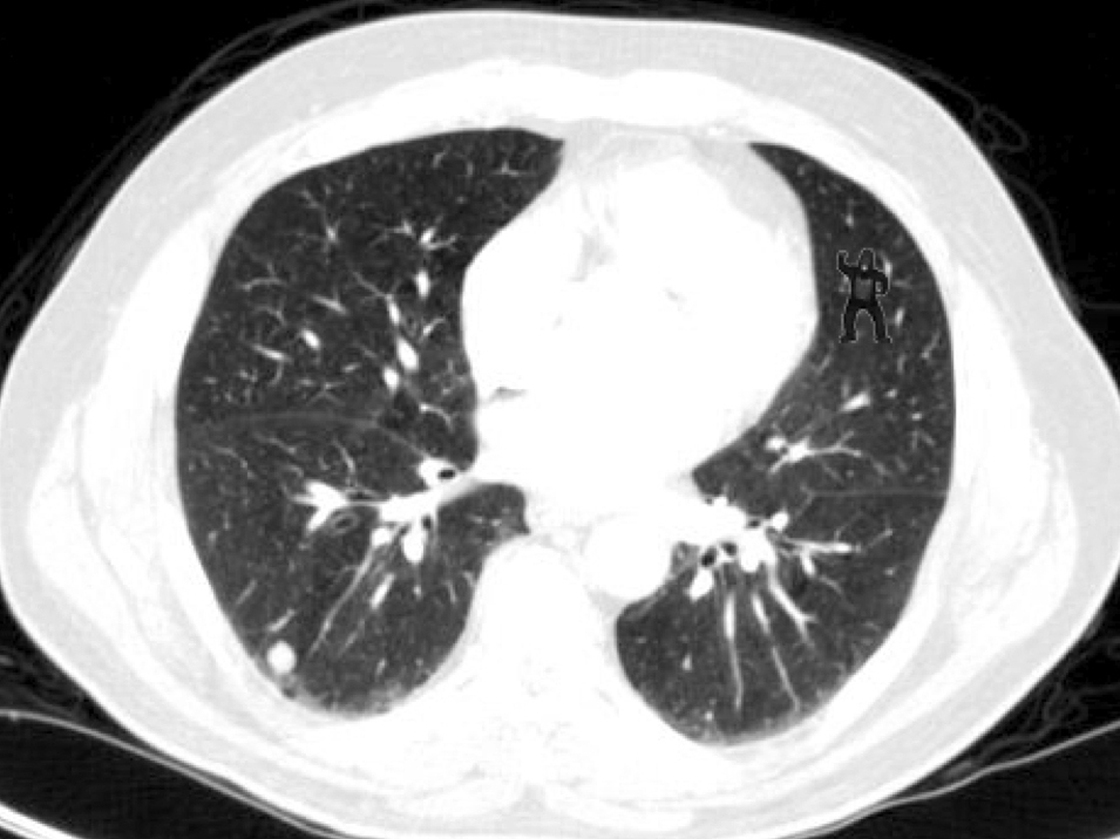
In an attempt to explain why radiologists sometimes miss important aspects of the images they review, Trafton Drew and Jeremy Wolfe recreated a famous attention study using the above image. Alix Spiegel summarizes:
Drew wondered if somehow being so well-trained in searching would make [the radiologists] immune to missing large, hairy gorillas. “You might expect that because they’re experts, they would notice if something unusual was there,” he says.
He took a picture of a man in a gorilla suit shaking his fist, and he superimposed that image on a series of slides that radiologists typically look at when they’re searching for cancer. He then asked a bunch of radiologists to review the slides of lungs for cancerous nodules. He wanted to see if they would notice a gorilla the size of a matchbook glaring angrily at them from inside the slide. But they didn’t: 83 percent of the radiologists missed it, Drew says.
This is explained by a phenomenon called “inattentional blindness” in which “you ask someone to perform a challenging task, [and] without realizing it, their attention narrows and blocks out other things.”
Responding to Joe Nocera’s NYT op-ed on violent video games, Scott Shackford rejects the argument for government intervention:
According to Pew Research study from 2008, 97 percent of American teens play video games. That’s somewhere around 40 million (depending on how you define a teen). Even if the Sandy Hook Elementary shootings could be tied back to violent video games, or Nehemiah Griego in New Mexico allegedly murdering his family in January, these guys are statistically insignificant when compared to the entire population of those who play video games.
Game designer Daniel Greenberg believes the industry hasn’t done a great job defending itself:
Even before the recent mass shootings, Congressmen Joe Baca and Frank Wolf wanted to place advisory labels on all games, even games with no violent content: “WARNING: Exposure to violent video games has been linked to aggressive behavior.” It’s as if no one told them that the Supreme Court already threw out every one of those “links,” finding that “These studies have been rejected by every court to consider them, and with good reason.”
That “good reason” includes the fact that the tests that some researchers use to measure aggression have never actually been validated for aggression, just for competiveness. At best, all the anti-game researchers can show is that imaginary violence leads only to imaginary violence. At no time can they show that imaginary violence ever crosses over to cause actual violence. Or even real aggression. Just competiveness.
David Banks and Nathan Jurgenson analyze the rise of “dashcams” in Russia, the source of yesterday’s wild footage of a meteor:
Their numbers have swelled over the past year or so due to the rampant corruption of traffic police and insurance company officials. The videos provide evidence for traffic disputes both common and not-so-common, from everyday fender-bender quarrels to pedestrians throwing themselves in front of cars for settlement money. After one particularly horrendous accident that killed twenty people, President Dmitry Medvedev made a statement calling on the State Traffic Safety Inspectorate to “take all the necessary measures to impose order on the roads.” That was in 2009 and little seems to have changed.
Last summer, Marina Galperina speculated that censorship makes dashcams so popular in Russia:
Russian websites go for the uncut, the horrible accidents–trucks flipping over, people being smashed into pieces and sedans flying up in the air and exploding. Given that television programing is mostly vacuous and heavily censored, dash-cam videos are very popular in Russia. It’s uncensored–drama, comedy, tragedy, horror, thriller and educational genres fused into one super-genre of “dash-cam.”
Kottke’s jaw recently dropped after watching a 13 minute compilation video of Russian traffic accident dashcam videos. An incredible example of such a video is seen above.
I know you aren’t big into sports, but I thought you’d be interested in something that’s making a few waves in the soccer world. Robbie Rogers is an American player who has played for the Columbus Crew and Leeds United. Early this morning, he announced on his blog that is gay and that he is retiring from soccer. He had some injury issues at Leeds, so I’m hoping that is the reason he’s hanging up his cleats. His blog post is here.
Another tempers the enthusiasm:
It’s too bad that he felt the need to wait until he quit the game to come out. I’d be very surprised if he’s the only gay man playing professional soccer. On the US women’s team there is at least one active player who came out of the closet.
Another:
Sure, soccer is not one of the Big 3 (not really close), but still, MLS averages about 18,000 fans per game, they’re on TV, top players are at least somewhat well known (David Beckham played here, after all!), etc. It ain’t nothin’.
Robbie Rogers made some appearances with the US National Team and recently played in England, and he’s only 25. He has been a top US player and he’s not old enough for his career to be over. He’s stepping away from the game, but if, as I hope, he comes back to MLS, he could be the first openly gay male athlete to compete in an American professional team sport.
Most interesting/encouraging were the reactions from other American soccer players, suggesting that he would be more than accepted. These are current and former top players, and their reactions were immediate and unequivocally supportive. My favorite was Eddie Pope’s: “@robbierogers Brave men like you will make it so that one day there’s no need for an announcement.That day can’t arrive soon enough.#Support”
Another:
The outpouring of support from fellow players and fans has been big. Top players from around the league and the national team all showing him public support and love. Marc Burch was one of the first players to reach out and support him. Marc plays here in Seattle and while an otherwise nice guy, he let loose a vile slur at an opposing goalkeeper who was time-wasting in a playoff match at the end of last season. The reaction here was immediate and furious (obviously Seattle isn’t the kind of city where that would go well and soccer fans are an especially liberal crowd). He’s done a lot to show his remorse and reach out to the gay community, but it was good to see him immediately accepting and supporting Rogers.
Other signs of progress in the pro-sports world here.
Friday on the Dish, Andrew took McCain to task for betraying his own presidential slogans to place country first, before calling out Rand Paul’s blatant opportunism in the Hagel filibuster. He delved deeper into Benedict XVI’s abandonment of renewal for sheer reaction, sparred with a reader on why he prefers “Burma” to “Myanmar,” and answered more emails on the reality and strength of the Dish community. Later, Andrew spent the afternoon chatting with Mediatwits about the SOTU, new media and new Dish.
On the political beat, we asked whether a defeat for Hagel would qualify as historical, Pareene ridiculed the right’s strategy of character assassination by innuendo, and Norm Ornstein proved that even AEI is getting worried over the GOP’s general intransigence. Elsewhere, we looked at Scott Walker’s plans to move the poor onto the ACA’s markets, Noah Millman demurred on raising the EITC instead of the minimum wage, and Seth Masket considered the heavy-handed investments of supposedly robust campaigns.
Peter Maass paged through the Iraq War diaries, David Axe foresaw long days ahead for war-torn Mali, and Syrian rebels emerged from the darkness for the Face of the Day. Waldman accounted for Obama’s drone surge while Kelsey Atherton reminded us that there’s more than one way to target a killing. We also kept up the research on stoned driving and met some athletes who unabashedly advocate marriage equality as Neil Freeman mapped out a more representative union.
In assorted coverage, we explored the space between truth and beauty, readers offered more insights on the definition of love, and Dreher confronted the fact that community is paramount amid terminal illness. Alyssa Rosenberg worried about the growing conflation of entertainment with advertisement, while Jen Graves learned that sometimes a sculpture of Hitler is really just a sculpture of Hitler.
Meanwhile, Phil Plait explained the asteroid that passed over our heads today, while Max Fisher stayed on top of the inevitable meteorite conspiracy theories. Readers defended the spirit of slightly puffy academic prose, Nicholson Baker cooked up a midnight poseur alert, and Ackerman and company broke down the military strategy of Lord Vader. James Serpell decided to bring purebreds back as we caught a lovely sight of Mbabane, Swaziland for the VFYW and dared you not to gape during the MHB.
Thursday on the Dish, Andrew stood in awe of the ongoing radicalization of Gingrich-ified GOP and evoked Henry Fairlie’s words on the “America of fear” to put a name to the madness. He returned to the case of Marcial Maciel as a critical indictment of the Vatican’s degradation and echoed Jay Rockefeller’s condemnation of America’s black sites-torture program. Later, Andrew checked in on the struggling case against marriage equality, looked up the history of the ❤, and delivered a list of thank yous to the people who made the new Dish transition possible.
In political coverage, Weigel sized up the Republicans’ Hagel hysteria, Larison scratched his head, Kaplan chided the Senate Armed Services Committee, and readers offered thoughts on the whole mess here. We continued to analyze the president’s pre-K proposition, Josh Barro proposed a better but unlikely substitute for boosting the minimum wage, and Tried to parse new signs of easing health care costs. Readers sounded off on Andrew’s aversion to ribbons-for-a-cause, Rabbi David Novak recalled the time the Pope came across ACT-UP, and the Tax Policy Center let us tally up the benefits of marriage. Later we debated whether Rubio is a rising star or mere placeholder as Wickman wondered if it’s possible to keep nuke tests on the DL.
In Valentine’s Day coverage, Liza Hix served up a host of spiteful V-day cards, Natasha Vargas-Cooper discovered the “demonic power of sex,” and we casually attempted to nail the meaning of love. Freddie asked for a subtler rom-com formula while Josh Freedman dumped his girl by the numbers. Elswhere, Daniel Estrin followed an Israeli matrimonial detective around Eastern Europe, as Natasha Lennard revealed the pain of proving it to the feds.
After we paged through the poetry of Robert Graves and James Merrill for the occasion, readers recoiled at the ranking of poets in general. After Katie Boo divulged her pleasure reading, readers offered more thoughts on the show COPS, a genre of its own. Cass Sunstein introduced some social mores to combat obesity, Brodie Smith breezed through the MHB, and we glanced out at West Hollywood for the VFYW.
(Photo by Win McNamee/Getty Images)
Wednesday on the Dish, Andrew took apart Rubio’s dogmatic and hypocritical rejoinder to the SOTU and responded to readers’ thoughts on the president’s remarks. He revisited the Gitmo question and spared a moment to reckon our mortality on Ash Wednesday. Later, Andrew poured another drink with Hitch as they discussed the ever-present specter of fanaticism, and pointed Canadian readers to a new pub named after his old friend.
In political coverage, we rounded up more reax to the SOTU as well as Rubio’s lamefollow-up, before digging deep into Obama’s proposal for universal pre-K. After Bouie brought up the GOP’s real immigration problem, readers took on conventional wisdom on boosting minimum wage, which Mark Perry pushed back on here. Bernstein called the Hagel nomination the latest in a mondo-filibuster, readers were boggled by James Inhofe’s latest sermon on U.S. foreign policy, and Armin Rosen toured a new site for real development in Palestine.
Meanwhile, we debated the death sentence in democracies, Nassim Taleb cautioned us not to overestimate the new era of Big Data, and George Packer insisted that we shouldn’t confuse our own bodily decay with the world’s at large. Benjamin Dueholm explored the Pope’s remarks on economic justice as Gregory Clark described the best methodology to study social mobility.
In assorted news and views, John Gruber traced the history of the printed-*cough* and Peter Elbow suggested academia hurts our writing more than its helps. We once again got a message to burn after texting and toyed with a new program that can rebuild languages lost. Elsewhere, we looked at the Lama bubble as Shafer asked for another plate of mustang. We rose early at St. John the Divine in New York City for the VFYW, stood before the Pope for the Face of the Day, and grooved point-by-point through the MHB.
(Photo by Charles Dharapak-Pool/Getty Images)
People have been talking about Obama’s new swagger. I can see that in this speech, but I don’t see an aggressive partisan attack.
Tuesday on the Dish, Andrew spent the night live-blogging the State of the Union. Blog reax here, tweet reax here and meme of the night here. Earlier, he sighed at what might have been of Benedict XVI’s reign, and pressed further on the implications of a Pope stepping down. He also compared the outgoing pontiff with St. Gregory the Great, and took on readers’ criticism of his take on what lies next for Ratzinger. Later, Andrew unmasked the Dish’s cartoonist, Terry Colon, and our special teams, Chas Danner, and updated everyone on the first few days of the new indie Dish experiment.
In political news, James Inhofe wonderfully articulated the stance of the American Christianists looking to divinize our foreign policy, Sam Tanenhaus linked the far right with the doctrines of John C. Calhoun, and the Consumer Protection Bureau went to bat for college students. Enten raised his eyebrow at Rubio’s 2016 chances, while Larison claimed it’s still too early to call. Meanwhile, we charted the theft of human life caused by gun violence, Kate Sheppard revealed the climate-benefits of fewer work hours and The Economist took social mobility down a peg.
Then we took a tour of the high seas with actual pirates as William Prochnau, Osnos reported the cost of anti-corruption to China’s economy, and Laura Parker found little evidence for the mythical “secure border.” Finally, we bummed out that the correction of the day wasn’t genuine news for the Alaskan Esther as Megan McCloskey corrected Phil Bronstein’s veteran-insurance blunder in Esquire.
In assorted news and views, we sampled deep-friend deep-space scallops, Alex Knapp unearthed more evidence at the scene of dinosaurs’ demise and Nicola Twilley made the case for cheap, fence-free animal herding. Paula Marantz Cohen praised literature-as-textbooks and Kelley Vlahos shook her head at thee persistence of must-cringe TV. Oriana Aragón and Rebecca Dyer explained the urge to squeeze that kitten to death, and posted more views from your blizzard here.
For another tricky VFYW contest, we breathed the open air of Castillo San Cristobal in San Juan, Puerto Rico and reconsidered the benefits of joining the Super Adventure Club for the MHB before we looked over Ojai, California in the VFYW.
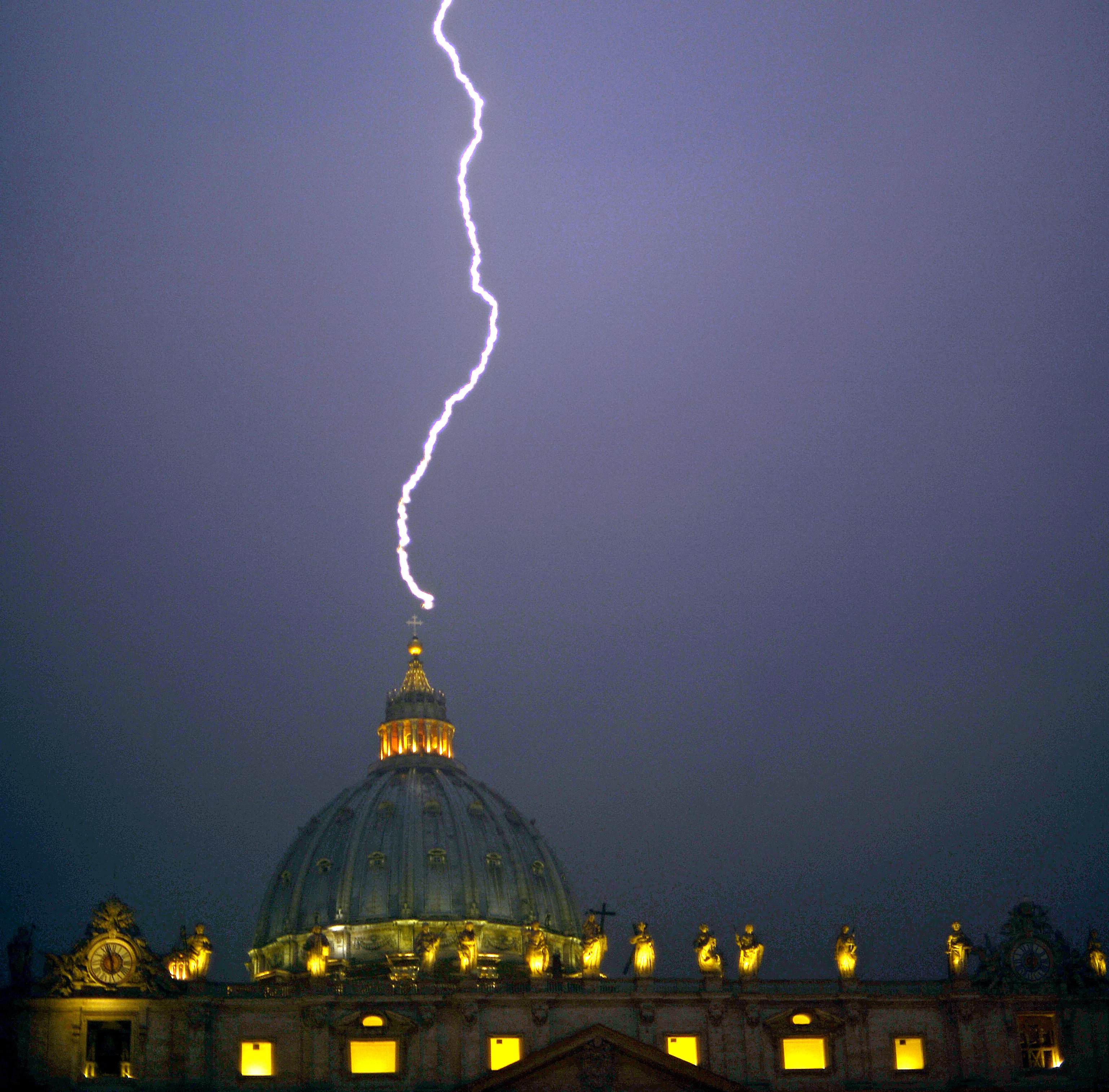
(Photo by Filippo Monteforte/AFP/Getty Images)
Monday on the Dish, in the wake of the Pope’s resignation, Andrew articulated the tragedy of Benedict XVI and his failure to restore faith through reason, before asking where the man will end up next. He dug up clips from Hitch’s dogged pursuit of justice against this Herr Ratzinger and his underlings, as well as his own appraisal of Benedict’s “Deus Caritas Est.” Later Andrew noted the outgoing Pope’s disquieting (and suspicious) obsession with homosexuality, wondered why the Pope would duck out at this precise moment, and doubted if we’ll ever know the extent of his involvement with the Church’s cover up of child rape.
Elsewhere, Joseph Komonchak raised the significance of Ratzinger’s leaving rather than dying a Pope and Russell D. Moore applauded his common cause with evangelicals, while George Weigel also found it a strange time to exit stage left. We gathered reax to Benedict’s resignation, from commentators and readers alike, then rounded up thoughts on who might come next, where he might be found, and how he’ll be chosen.
In non-papal news, Bill Becker asked the president to treat global warming as his Great Depression as we tried to pinpoint when Obama’s healthcare law will take a bite of his base. Phil Bronstein traced bin Laden’s demise back to his shooter’s teenage heartache, and marijuana farming devastated the environment in California.
In assorted coverage, Chris Moody filed a must-read on Florida’s rugged hunters and headless pythons, Mathew Ingram called Andrew and Amanda Palmer birds of a feather while Nicholas Carr didn’t grade Google Scholar very generously. Alyssa Rosenberg and Kirby Dick shed light on sexual abuse in the armed forces, David Foster Wallace said a good word for puppy love and Eric Jaffe projected a future without traffic lights.
After VFYW in Clintondale, New York, we quenched our thirst for a MHB, broke out more reader emails on the Dish as a business venture, and spent a moment with a recipient of the Medal of Honor.
Last weekend on the Dish, we provided our usual eclectic mix of cultural, religious, and books coverage.
In matters of faith, doubt, and philosophy, Daniel Siedell praised Cézanne’s affirmation of creation, Brett McCracken contemplated joy, and Justin E.H. Smith turned to Emerson to explain his faith. Reinhold Niebuhr explained why real saints have a sense of humor, Mark Rowland meditated on how play is what makes life meaningful, Will Willimon argued that fiction lets us see God in the mundane, and Alain de Botton outlined our changing view of virtue. Adam Gopnik described how Galileo saw a heavenless sky, Ben Myers applauded Origen’s approach to deciphering the Bible, Suzanne Klingenstein connected scientific discovery to the Biblical myth of creation, and Scott Aikin and Robert Talisse critiqued the Stoic approach to life.
In literary coverage, Elizabeth Gilbert appreciated the writing life, William Faulkner named the best day job for a writer, and Preeti Chhibber taught us how to handle crying over a book in public. The poet Allen Ginsberg tried his hand at photography, Rowan Hisayo Buchanan found herself transfixed by Anne Sexton’s tale of a modern Rapunzel, and Peter Popham claimed Geoffrey Hill as a great, under-read poet. Amazon moved toward selling used e-books, Stephen Greenblatt and Joseph Leo Koerner defended a dead language, and Kenneth Goldsmith stood up for “Uncreative Writing,” a course he teaches at the University of Pennsylvania. Read Saturday’s poem here and Sunday’s here.
In assorted news and views, readers provided their views of this weekend’s blizzard, an Alberta-based reader responded with some local perspective on the continuing Keystone fight, Stephen Lacey saw how much money is wasted on the weekends in office buildings, and Jordana Rothman surveyed the current market for “flairtending.” A new study found that mixing diet soda with alcohol gets you drunker, Greg Beato profiled a Las Vegas anesthesiologist turned hangover specialist, Paul Miller discovered dating is difficult without the Internet, and Amanda Hess reacted to the new Facebook app, “Bang With Friends.” MHBs here and here, FOTDs here and here, VFYWs here and here, and the latest window contest here.
Christopher Shea investigates the contrarian scientists questioning the connection between beauty and truth:
From Euclid and Pythagoras down to 20th-century physicists, many who explore the underlying laws of the natural world have seen truth and beauty as inextricably intertwined. “Beauty is a successful criterion for selecting the right theory,” the Nobel Prize-winning physicist Murray Gell-Mann said in a much-quoted TED talk, in 2007. In their popular-philosophizing mode, physicists like to quote the poets Keats (“beauty is truth, truth beauty”) or Blake on the subject of nature’s “fearful symmetry.” Indeed, the theme of this year’s meeting of the American Association for the Advancement of Science, next month in Boston, is “The Beauty and Benefits of Science.”
Unfortunately, [mathematician David] Orrell writes in his new book, Truth or Beauty: Science and the Quest for Order (Yale University Press), “It is easier to claim a theory is beautiful than to show that it actually works, or makes sense.” … Orrell also thinks it is more useful to study the behavior of complex systems rather than their constituent elements, a preference that’s perhaps not surprising given his academic and professional experience. At Oxford, his Ph.D. involved predictions involving “nonlinear” systems, including the weather.
Relatedly, Tim Hawkins, musing on Kant, sees the political and social value to our aesthetic instincts, especially as they relate to art:
Kant defines beauty as being judged through an aesthetic experience of taste. This experience must be devoid of any concept, emotion or any interest in the object we are describing as beautiful. Most of all, the experience of beauty is something that we feel. Whether you think this definition is too narrow, too wide or completely bat-shit crazy, you now have at least something to think about and come up with your own ideas. The most redeeming feature, I think, in Kant’s definition is that beauty is universal: It is the only experience on this earth that can be felt by all of us, without a need for communication. In this way it gives humanity a ‘sensus communis’ or a sense of harmony, because of common feelings that transcend race, religion or politics when we see something purely beautiful.
Dreher reflects on his sister’s fight with cancer and his return to his hometown:
Cancer makes a mockery of the idea that we can stand on our own two feet. When we are rendered helpless by disease and mortality, we have nothing but our faith, our friends, and, above all, our family to carry us. What if I woke up one morning, as Ruthie had done, to learn from my doctor that I had incurable cancer? Who would care for me and my family? Yes, we had friends in Philadelphia, but we had not lived there long enough—had not lived anywhere long enough—to develop the kinds of relationships that Ruthie had back home. …
We expected our Philadelphia friends, neighbors, and colleagues to be sorry that we were leaving, and they were. What we didn’t expect was folks telling us how much they wished they had a place like St. Francisville to go to. One friend confessed that his parents had raised him to put professional success ahead of everything else in life and to always move for better jobs. And he had. Now that he and his wife were older and their children were gone, they had no real community in which to grow old. They were rich, successful—and alone.
David Blankenhorn, in a conversation with Jonathan Rauch, worries about the marriage class divide:
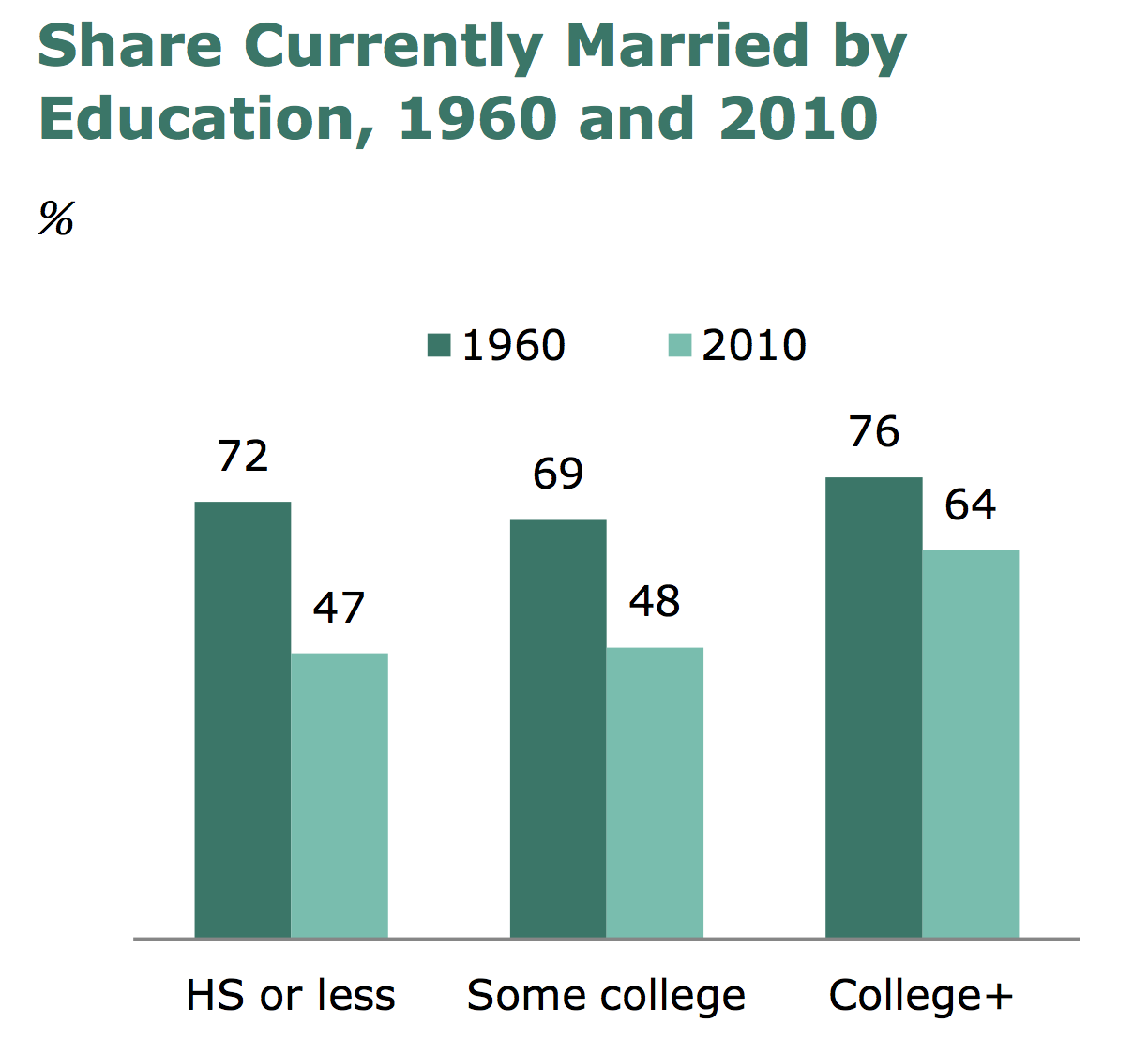
[W]hile marriage equality is winning victories and gaining converts (like me), marriage overall in the United States is fracturing along class lines. Among the 30 percent or so of upscale Americans with four-year college degrees, marriage trends are looking pretty good! (If this group were the entire nation, I’d be as encouraged as I was in the late 1990s.) But among the 60 percent or so of Americans who have high school degrees but not four-year college degrees — the nation’s broad lower middle class and working class — marriage is disappearing, right before our eyes. More and more unwed child bearing, one-parent homes, serial love relationships, chaotic home lives for children, frustrated hopes, bruised lives — the whole sad shebang. And very few people in high places seem to give a damn about it, or even to have noticed.
Rauch adds:
Yes, class bifurcation is the marriage problem of our time. Family instability among the less-educated and rising inequality are two sides of the same coin, each perniciously feeding the other. Yes, it’s tough to do anything about. But yes, I have hope, because we’ve arrived at a moment when, as a society, we can finally take off the culture-war blinders and see the real problem, which is the sine qua non for doing anything about it.
For many years, liberals were loath to talk about marriage and family values because both were code for “beat up on homosexuals.” At the same time, conservatives were loath to talk about inequality and class because both were code for “beat up on free markets.” But the era of gay marriage raises the prospect of a pro-marriage agenda which liberals can embrace as not even slightly anti-gay. And the country’s rapid division into marital and educational haves and have-nots makes inequality a problem that family-values conservatives can’t ignore.
Late last year, during a particularly bad day of fighting between the Free Syrian Army and the Assad regime, a band of rebels took refuge in the basement of an abandoned factory building in Aleppo. They had just lost two men and were in desperate need of more supplies and more fighters. As we all waited for the shelling to stop, I discovered a small hole in one of the factory walls. With that opening providing our only light, I photographed many of the rebels, each with the single item they claimed was the most crucial in their struggle against the government.
The caption for the above photo:
Kachadur Manukian, 25: “They killed my mother and father. I will kill them with my knife. I will kill them like I would kill a goat.”
Piccolomini recently won 2nd prize in the World Press Photo Award for a deeply unsettling photo of an injured baby in Aleppo.