Dish Awards: The Face Of 2014

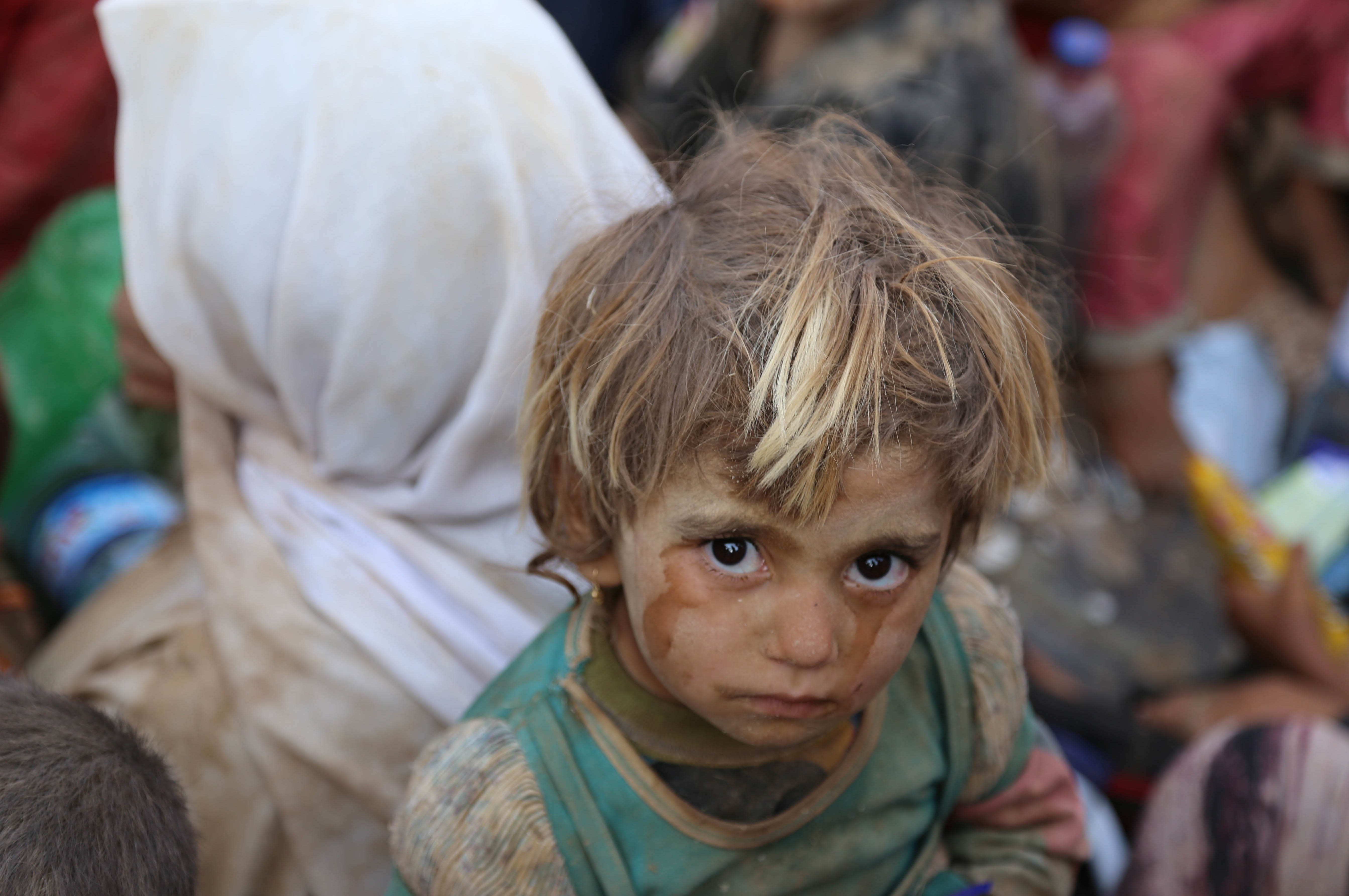
According to the polls, nearly 20% of Dish readers think this Yezidi child, who narrowly escaped ISIS in August, should be our Face Of The Year:

Yezidis trapped in the Sinjar mountains arrive in Syria's Haseki

And almost 14% of readers have chosen this young Ferguson protester instead:

Outrage In Missouri Town After Police Shooting Of 18-Yr-Old Man

But veering away from this year’s big news stories, more than 25% of you seem to agree that the year’s best face is this scene-stealing camel:

Disagree? Cast your vote for any of the above or the other seven candidates here. Then, continue on to our other polls for the 2014 Malkin Award, Hathos Alert, Poseur Alert, and Yglesias Award. Voting also remains open for the year’s best Chart, Mental Health Break and View From Your Window, as well as the 2014’s Coolest Ad, and for the first time ever, Map Of The Year and Beard Of The Year! Our polls will close Wednesday at midnight, so have at it:

Please note: due to there not being enough nominees this year, we will not be issuing a 2014 Hewitt Award, Moore Award, or Dick Morris Award. Learn more about all our awards here. The top two photos in this post are from Getty.

Scalise Should Learn To Google

Louisiana Congressman Steve Scalise, the House whip, has admitted that “he spoke at a gathering hosted by white-supremacist leaders while serving as a state representative in 2002.” Dreher is unimpressed by the excuses:

I think it is possible that Scalise didn’t know what he was getting into when he agreed to appear at this thing, but once you get there and realize that you are at a David Duke event, you leave. Period. There is no excuse for staying there — and it’s impossible to believe that Scalise remained ignorant of Duke’s sponsorship of the event until after he left. Did he send out a press release repudiating the group and saying he had been hoodwinked into speaking there? Doesn’t seem like it.

Do I think Scalise is a white supremacist? No, not at all. But he was insufficiently disgusted by associating with the most notorious racist and anti-Semite in the country. I don’t see how he stays in GOP leadership with this on his record.

Erick Erickson moved out of Louisiana because he was disgusted by David Duke:

By 2002, everybody knew Duke was still the man he had claimed not to be. EVERYBODY. How the hell does somebody show up at a David Duke organized event in 2002 and claim ignorance?

Weigel digs into the story:

Scalise was on the record attacking Duke for that 1999 race. “The novelty of David Duke has worn off,” Scalise told Roll Call‘s John Mercurio. “The voters in this district are smart enough to realize that they need to get behind someone who not only believes in the issues they care about, but also can get elected.”

That phrase—”who not only believes in the issues they care about”—seemed innocuous enough at the time. In 2014, after Scalise has won five easy elections to the House (he took Governor Bobby Jindal’s vacant seat in a 2008 special), it’s being read as evidence that Scalise did not condemn Duke nearly enough.

Ezra weighs in:

Scalise might well have ended up at the David Duke-backed European-American Unity and Rights Organization without knowing who they were or really bothering to find out. He might well have been trying to destroy Duke by questioning his electability rather than his views. But that’s only because he was practiced at appealing to the kind of people who really did support David Duke and really were sympathetic to the European-American Unity and Rights Organization. And, now that Scalise has risen through Louisiana politics to become a nationally influential figure, that’s the problem.

The biggest question for Scalise’s future is whether there’s anything else. Now that Scalise’s speech to EURO has been found, and his comments about David Duke unearthed, political reporters are going to go looking for more. If this is the end of it, Scalise might be fine. If it isn’t, then his career is in jeopardy.

PM Carpenter is enjoying the circus:

One can believe whatever one wants to believe about Scalise’s defense of know-nothingness, but one cannot deny the hilarity of the Washington Post’s magnificent understatement: “The news [of Scalise having addressed a white-supremacist, Neo-Nazi, KKK-associated, David Duke-founded group] could complicate Republican efforts to project the sense of a fresh start for a resurgent, diversifying party.”

Nearly as funny and equally unhelpful to Scalise’s defense is the amicus brief uttered by Iowa’s Rep. Steve King, who blathered to the Post that “Jesus dined with tax collectors and sinners. It’s not the healthy who need a doctor, it’s the sick.” A lofty comparison indeed, however the point of King’s parable is that Jesus knew he was dining with sinners (unless, of course, he was inadequately staffed).

Libya Remains A Bloody Mess

kyhcrE0.0

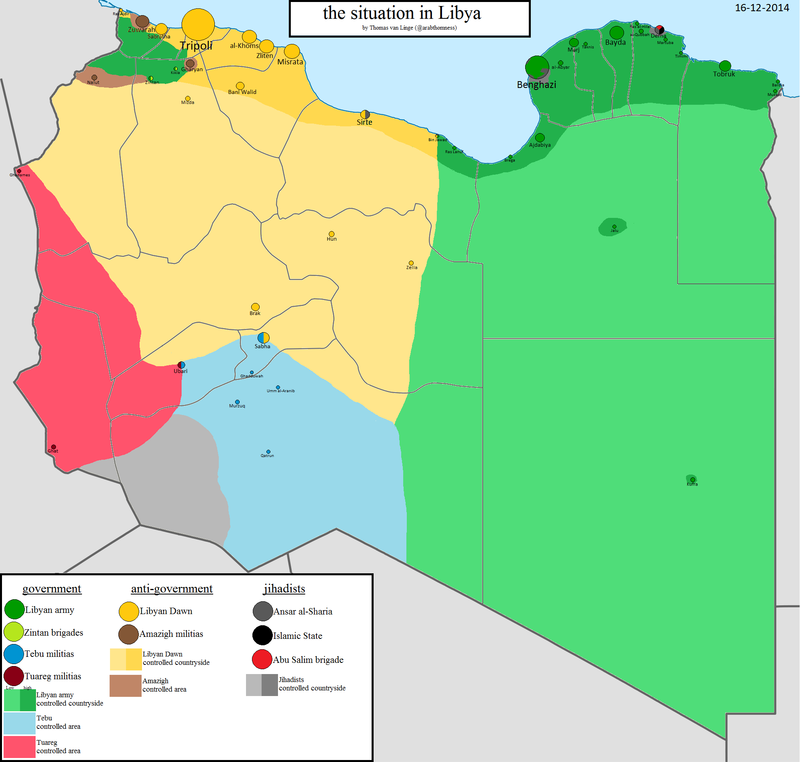
Zack Beauchamp passes along this map from Thomas van Linge, which illustrates the chaotic state of the country as of mid-December:

Libya is divided into two main chunks, but there are many smaller tribal, Islamist, and militia players that complicate the war even further. And it’s been bloody: a December UN report said hundreds of civilians have died since Libya Dawn swept the west in August. The UN claims that it has gotten the warring factions to agree to a peace conference “in principle.” Hopefully, that principle will translate to reality — and fast.

Sunday witnessed the first airstrikes on Misrata—Libya’s third-largest city—in the civil war that has raged since Moammar Qaddafi was deposed three years ago:

Jets under the control of General Khalifa Heftar, a militia commander who was a central figure in Libya’s revolution, fired missiles on Sunday morning at the city’s international airport, just half an hour before a Turkish Airlines flight was due to leave for Istanbul. There were no reports of casualties. The Libyan Air Force jets went on to attack the country’s largest steel plant and an air force academy near the airport, which are under the control of Islamist forces. …

Sunday’s air strikes were in apparent revenge for Christmas Day attacks on Libya’s largest oil terminal at Sidra and on the city of Sirte, in which Islamist militiamen firing rocket-propelled grenades from speedboats killed 22 government soldiers. There were further skirmishes in Sidra on Sunday, in which two Libya Dawn foot soldiers were killed, according to a security official in the port.

Fighting between pro-government and Islamist rebel forces is also ongoing in other parts of the country:

At the same time, recent fighting in the neighbouring Nafusa mountains has left 170 people dead. In addition to the casualties, the fighting has also caused a humanitarian crisis with at least 120,000 people forced to flee their homes, resulting in consequent shortages in both food and medical supplies. Meanwhile, in the eastern city of Benghazi, an uptick in violence has seen 450 people killed since October as residents continue to face shortages in medical care. Moreover, upwards of 15,000 families – some 90,000 people – have been displaced.

A Dish Best Served In The Cold

James Hamblin examines research connecting warmth and human metabolism:

[Former NASA materials scientist Ray] Cronise believes that our thinking about the modern plagues of obesity and metabolic disease (like diabetes) has not addressed the fact that most people are rarely cold today. Many of us live almost constantly, year-round, in 70-something-degree environments. And when we are caught somewhere colder than that, most of us quickly put on a sweater or turn up the thermostat. …

Cronise, [Andrew] Bremer, and [Harvard geneticist David] Sinclair propose what they call the “Metabolic Winter” hypothesis: that obesity is only in small part due to lack of exercise, and mostly due to a combination of chronic overnutrition and chronic warmth. Seven million years of human evolution were dominated by two challenges: food scarcity and cold. “In the last 0.9 inches of our evolutionary mile,” they write, pointing to the fundamental lifestyle changes brought about by refrigeration and modern transportation, “we solved them both.” Other species don’t exhibit nearly as much obesity and chronic disease as we warm, overfed humans and our pets do. “Maybe our problem,” they continue, “is that winter never comes.”

Budget Flights Deliver Big Bucks

Operating Profit

Alison Griswold finds that, over “the past five years, ultra-low-cost carriers like Spirit and Allegiant have consistently outperformed their peers in terms of operating profit”:

That airlines like Virgin America and JetBlue can’t turn a strong profit while maintaining a better level of service speaks to the odd tastes of the American air traveler. As Matt Yglesias put it in Slate two years ago, “the basic moral of the story is that airline service is bad because customers want bad airline service. Or, rather, they don’t want to pay a premium for better service.” As far as consumer preferences go, this attitude is an outlier. The restaurant industry, for example, is well aware that diners are willing to spend more for what fast-casual Chipotle and Shake Shack serve up than for the stuff at Taco Bell and McDonald’s. “There’s a lot of customers who believe that every airline is the same,” says Paul Berry, a spokesman for Spirit Airlines. “They don’t think that way when it comes to restaurants … but they think the airline industry is different. And really, it isn’t.”

Also commenting on airfare economics, Tim Wu ponders the airlines’ increasing reliance on extra fees:

If fees are great for airlines, what about for us? Does it make any difference if an airline collects its cash in fees as opposed to through ticket sales? The airlines, and some economists, argue that the rise of the fee model is good for travellers. You only pay for what you want, and you can therefore save money if you, for instance, don’t mind sitting in middle seats in the back, waiting in line to board, or bringing your own food. That’s why American Airlines calls its fees program “Your Choice” and suggests that it makes the “travel experience even more convenient, cost-effective, flexible and personalized.”

But the fee model comes with systematic costs that are not immediately obvious. Here’s the thing: in order for fees to work, there needs be something worth paying to avoid. That necessitates, at some level, a strategy that can be described as “calculated misery.” Basic service, without fees, must be sufficiently degraded in order to make people want to pay to escape it. And that’s where the suffering begins.


Following Jesus In An Age Of War

In an interview about his new book, Christ Actually: The Son of God for the Secular Age, James Carroll points to the most essential element of what he believes it means to live like Jesus in today’s world:

The biggest single thing I can think of is nonviolence. The thing that I most value about Jesus was his clear commitment to nonviolence in a very violent world. That message has never had more importance, especially for me as an American. The United States of America threatens the world with violence in ways that no other country does, and that boils down to our refusal to disarm after the end of the Cold War. This unchecked, monumental national security establishment that is defining our nation in terrible ways—the nonviolence of Jesus speaks directly to the American condition.

Obviously, this is defining for me because of my life history. I’m the son of a military man; I see everything through his eyes in some way.

More about that “life history”:

I was part of the anti-war movement. I was a Catholic priest and chaplain at Boston University, which was a center of the anti-war movement, and those were defining years for me. My father was an Air Force general, very much involved in the administration of the Vietnam War. He was the Director of the Defense Intelligence Agency, charged, among other things, with picking targets for our bombers in Vietnam. The war was the occasion of my break with my father. But my dad gave me my love of this country and he gave me my love of the Church, and those two things remain defining for me.

I’ve been working all these years to rescue, to protect my faith as a Catholic, and “Christ Actually” is the latest effort to do that. I’ve been working all these years to rescue my love of America, despite my dread of its unchecked militarism.

Has The Tide Turned Against ISIS?

Clashes between ISIL and Peshmerga forces in Sinjar

Taking stock of the conflagration in Iraq and Syria at year’s end, Wayne White sees the jihadist group on the defensive:

Despite the jitters many have concerning the sweep of Islamic State forces, the view from the IS capital of Raqqa is hardly rosy. Still stalled in front of embattled Kobani, IS could not stop a sweeping Iraqi Kurdish, Yazidi, and Iraqi Army drive across northern Iraq to take Sinjar Mountain (again rescuing Yazidi refugees) and wrest from IS much of the town of Sinjar by December 21. Back in mid-December, the Pentagon also confirmed that an air strike killed Haji Mutazz, a deputy to IS leader Abu Bakr al-Baghdadi, as well as the IS military operations chief for Iraq, and the IS “governor” of Mosul. Meanwhile, daily coalition air strikes grind away at various targets within IS’s “caliphate” (now increasingly wracked by shortages).

The implications of ISIS’s retreat from Sinjar are significant; Khales Joumah reports that the group’s grip on Mosul may be weakening as a result:

In the city of Mosul itself it seems as though ISIS is at a loss. Members of ISIS are still on the city’s streets but most of the foreign fighters appear to have gone.

The ones left on the streets tend to be younger, local fighters some of whom don’t even seem to be 25 yet. Some of the fighters on the streets admit that they’ve been forced to withdraw from Sinjar but only very quietly.

“For the first time you can sense the feelings of fear and frustration in ISIS’s fighters,” one Mosul doctor, who had been seeing ISIS casualties come in, told NIQASH; he had to remain anonymous for security reasons. “As the number of dead and wounded from among their ranks increases, they look more and more like they’ve lost confidence in their leadership.”

Juan Cole also stresses the importance of Sinjar’s liberation:

Historians refer to polities that exist on both sides of a mountain range, united by passes, as a “saddlebag empire.” These were common in South Asia, where southern Afghanistan and Punjab were often part of the same kingdom despite the barrier of the Hindu Kush mountains. What I have called the ‘neo-Zangid’ state of the Daesh unites the area from Aleppo to Damascus, across Mt. Shinjar , just as had the medieval ruler `Imad al-Din Zangi. It is a sort of contemporary saddlebag empire.

But now not only have the Peshmerga taken the Mt. Shinjar area away from Daesh, helping rescue the besieged Yezidis but they have at the same time cut the supply routes between the terrorist group’s Syrian capital, Raqqa, and its Iraqi power base, Mosul. If you take shears to a saddlebag, it can’t straddle the horse’s back any more and will fall down.

Still, hold off on the celebrations for now. As Loveday Morris reports, the humanitarian situation in Iraq remains grim:

U.N. officials acknowledge that the assistance is insufficient. The U.N. response plan for displaced Iraqis remains only 31 percent funded, while the World Food Program has stopped procuring supplies for the displaced because of a lack of money. That means the distribution of boxes of food to families, the only assistance many get, will end by February unless emergency funding is found.

“It’s not that we can do more with less; it’s that we don’t have anything and the needs on the ground are immense,” said Barbara Manzi, the outgoing Iraq representative for the U.N. Office for the Coordination of Humanitarian Affairs, which is overseeing the organization’s response to the displacement crisis.

(Photo: Smoke rises as Islamic State of Iraq and Levant (ISIL) fighters burn tires to obstruct the sight of warcraft during clashes with Peshmerga forces in Sinjar district of Mosul, Iraq on December 22, 2014. Peshmerga forces stage attacks against ISIL to liberate ISIL occupied Sinjar. By Emrah Yorulmaz/Anadolu Agency/Getty Images)
Inside The Russian Media Bubble

Walter Laqueur asserts that for a “considerable time the element of fantasy in Russian political discourse has been strong (and growing stronger), not only at the popular level but in official statements.” Not surprising, exactly, but the details he marshals are remarkable:

A Russian citizen watching television in the evening will be exposed to the historical programme of Nikolai Starikov (to mention but one representative of this genre) which “prove” in convincing detail that the Russian revolutions of 1917 were engineered by the British secret service (the question of whether Somerset Maugham played the decisive role in this context is left open), and that Hitler too was an agent of MI5 or MI6 but did not really want to attack the Soviet Union. He was egged on, however, by Churchill and Roosevelt.

This will be followed by a documentary demonstrating that Trotsky was the father of German Nazism (this also happens to be the title of the series).

If the viewer still has an appetite for sensational revelations, he can switch to yet another series dealing with the connection of the “German patriot Martin Heidegger” and the Balfour Declaration. Retiring to bed with a good book he may well chose the immensely popular Maxim Kalashnikov (no relation of the weapon designer) maintaining that while the present Russian generation is pretty hopeless, a new generation of heroes could be produced in record time, following the pioneering work done by the SS Ahnenerbe in the study of the Aryan race which will put right everything that is wrong or imperfect in contemporary Russia.

The Stalinist system came to Russia 90 years ago and with it the frequent belief in manifestly untrue assertions. This practice has been more pronounced in some periods than in others. It has been denounced on various occasions by experts, but it has by no means been rejected. If in recent years there has been increased sympathy, even a certain longing, for the Stalin period in Russian history, it should not be surprising that this includes the readiness to believe manifestly untrue assertions. President Putin himself argued not long ago that Stalin was no worse than Oliver Cromwell.

Rethinking Autism Research

John Elder Robison believes it’s about time:

Research into the genetic and biological foundations of autism is surely worthwhile, but it’s a long-term game. The time from discovery to deployment of an approved therapy is measured in decades, while the autism community needs help right away. If we accept that autistic people are neurologically different rather than sick, the research goal changes from finding a cure to helping us achieve our best quality of life.

One way to do so, he suggests, is to “put autistic people in charge”:

The fact is, researchers have treated autism as a childhood disability, when in fact it’s a lifelong difference. If childhood is a quarter of the life span, then three-quarters of the autistic population are adults. Doesn’t it make sense that some of us would want to take a role in shaping the course of research that affects us? If you’re a researcher with an interest in autism—and you want to really make a difference—open a dialogue with autistic people. Ask what they want and need, and listen.

Meanwhile, Stephen S. Hall examines how genetic mutations appear to contribute to autism spectrum disorders. He consults researcher Evan Eichler, who suggests “it’s like autism is the price we pay for having an evolved human species”:

Copy number variations in one specific [genetic] hot spot on the short arm of chromosome 16, for example, have been associated with autism. By comparing the DNA of chimpanzees, orangutans, a Neanderthal, and a Denisovan (another archaic human) with the genomes of more than 2,500 contemporary humans, including many with autism, Xander Nuttle, a member of Eichler’s group, has been able to watch this area on the chromosome undergo dramatic changes through evolutionary history known as BOLA2 that seems to promote instability. Nonhuman primates have at most two copies of the gene; Neanderthals have two; contemporary humans have anywhere from three to 14, and the multiple copies of the gene appear in virtually every sample the researchers have looked at. This suggests that the extra copies of the BOLA2 gene, which predispose people to neurodevelopmental disorders like autism, must also confer some genetic benefit to the human species. …

In other words, the same duplications that can lead to autism may also create what Eichler calls genetic “nurseries” in which new gene variants arise that enhance cognition or some other human trait.