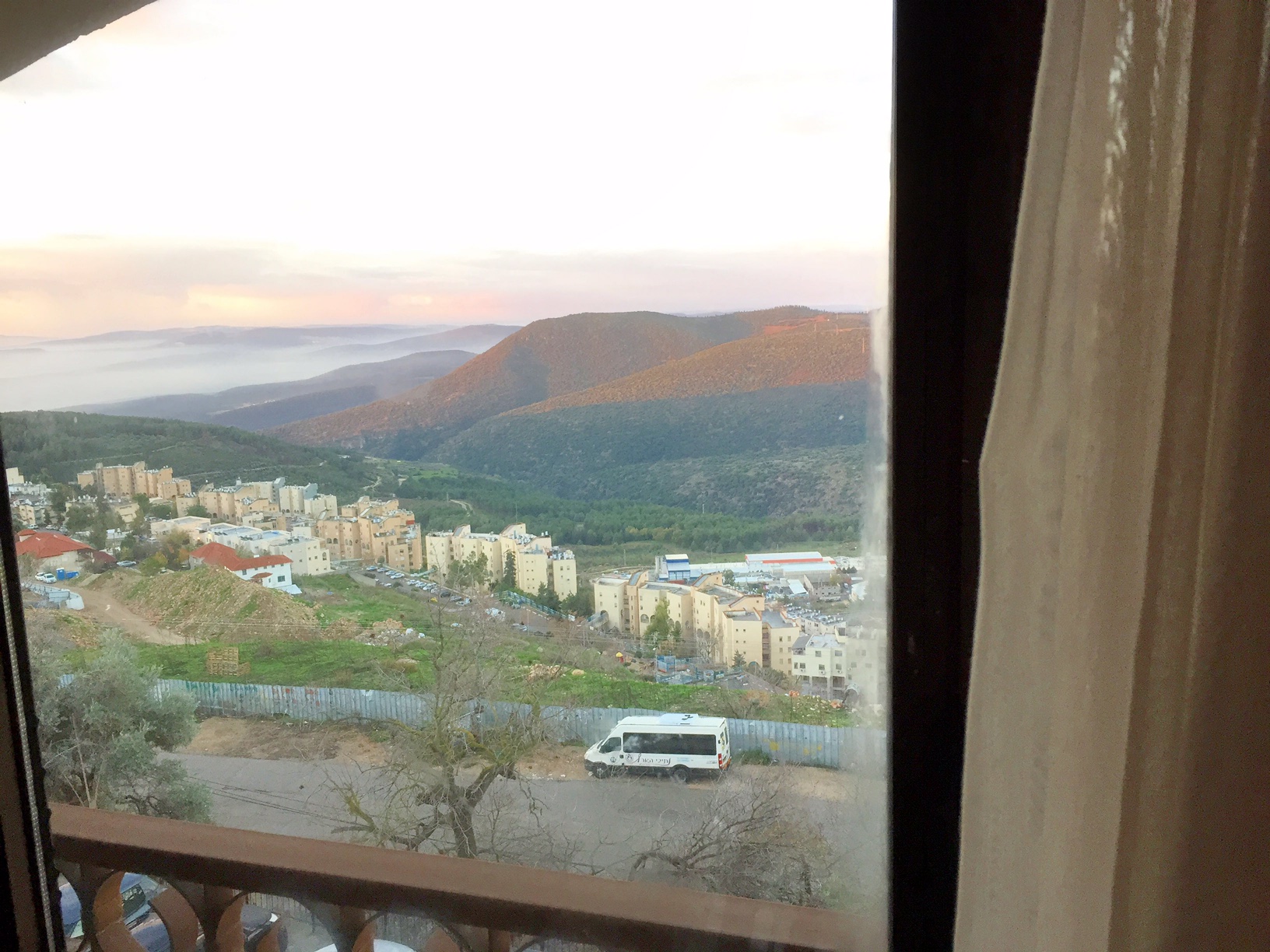
Safed, Israel, 6.45 am
Safed, Israel, 6.45 am
In an interview, John Caputo – a philosopher whose work explores the connections between postmodernism and Christian theology – distinguishes it from mere “belief”:
Faith is a form of life and so it also has a specific form. I wouldn’t say that faith is more general; I would say it is deeper. It gets expressed in a specific form like liturgy. It is an exercise of the whole person: affective, bodily, performative. It is making the truth.
If we didn’t have the specific historical religious traditions, we would be much the poorer for it. Without Christianity, we wouldn’t have the memory of Jesus. We wouldn’t have the books of the New Testament. You need these concrete, historical traditions that are the bearers of ancient stories and are cut to fit to various cultures. But I don’t want to absolutize them or freeze-frame them. I don’t think of one religion being true at the expense of another in a zero-sum game. I am not saying that if you burrow deeply enough under each religious tradition, you will find they are all the same. They are quite different. They are as different as the cultures and the languages out of which they come. There is an irreducible multiplicity.
This is one of the hallmarks of postmodernity: you can’t boil everything down to one common thing. There are many ways of doing the truth. There can’t be one true religion any more than there can be one true language. The truth of religion is not the truth of a certain body of assertions. It is not about a core set of agreements. That’s not relativism, and it is not saying that there is nothing true in religion. It is saying that religious truth is not like the truth of mathematics. It is a different sort that is deeply woven together with a form of life.
A short film from writer Randall Hayes and animator Anton Bogaty explains just what happens when we die:
(Hat tip: Maria Popova)
This weekend’s short story, James Joyce’s “The Dead,” is the last story in his imperishable collection, Dubliners. It takes place around this time of year, making it one of the truly great stories to read during the holidays. Here’s how it begins:
Lily, the caretaker’s daughter, was literally run off her feet. Hardly had she brought one gentleman into the little pantry behind the office on the ground floor and helped him off with his overcoat than the wheezy hall-door bell clanged again and she had to scamper along the bare hallway to let in another guest. It was well for her she had not to attend to the ladies also. But Miss Kate and Miss Julia had thought of that and had converted the bathroom upstairs into a ladies’ dressing-room. Miss Kate and Miss Julia were there, gossiping and laughing and fussing, walking after each other to the head of the stairs, peering down over the banisters and calling down to Lily to ask her who had come.
It was always a great affair, the Misses Morkan’s annual dance. Everybody who knew them came to it, members of the family, old friends of the family, the members of Julia’s choir, any of Kate’s pupils that were grown up enough and even some of Mary Jane’s pupils too. Never once had it fallen flat.

Woodbury, Minnesota, 7.44 am
A Poseur Alert is awarded for passages of prose that stand out for pretension, vanity and really bad writing designed to look like profundity. Thus far, this year’s top vote-getter is from Susan Elizabeth Shepard and Charlotte Shane on one of the age-old sex positions:
69 confronts us with an unfortunate truth: it is a distinctly capitalistic, efficiency-emphasizing endeavor that erases the unique personhood of each participant by relying on a crude approximation of how human bodies fit together if human bodies are conceived of as identical, two-dimensional figures like the numbers of its name. … The position also echoes the service economy in its demand (mainly on women) of a convincing performance of pleasure. It’s not enough to simply be present and to competently do the job that’s asked of you by your lover, you must also appear to simultaneously enjoy said lover’s ministrations, regardless of the delicate balancing requiring to keep from suffocating him or breaking his nose. This is a form of emotional labor like that demanded from baristas, servers, and sex workers; not only do you have to do a good job, you have to like it.
The current runner up was written by Mark Bauerlein about tattoos:
As a friend put it to me: A tattoo isn’t the Word made flesh, but the flesh made word. It may strike old-fashioned types as pedestrian narcissism and adolescent conformity, and sometimes it surely is. But in a deeper and more troubling way, it is canny and subversive artifice, spiced with a moralistic claim to personal liberation. A tattoo is a personal statement but also an anthropological position that accords with the prevailing transvaluations of our time. It’s a wholly successful one, too, judging from the entertainment and sports worlds, and youth culture. With the mainstreaming of tattoos, another factor in the natural order falls away, yet one more inversion of nature and culture, natural law and human desire. That’s not an outcome the rationalizer’s regret. It’s precisely the point.
Vote for one of the above, or any of the other three finalists, here. After that, cast your votes for the 2014 Malkin Award, Hathos Alert, Yglesias Award, Cool Ad, Face Of The Year, and the year’s best Chart, Mental Health Break and View From Your Window. This is also the first time you can help choose the Map Of The Year and Beard Of The Year as well! Polls will close on New Year’s Eve, so be sure to register your choices before then:
Please note: due to there not being enough nominees this year, we will not be issuing a 2014 Hewitt Award, Moore Award, or Dick Morris Award. You can learn more about those and all our awards here.

“Hunger for Something” by Chase Twichell:
Sometimes I long to be the woodpile,
cut-apart trees soon to be smoke,
or even the smoke itself,sinewy ghost of ash and air, going
wherever I want to, at least for a while.Neither inside nor out,
neither lost nor home, no longer
a shape or a name, I’d pass throughall the broken windows of the world.
It’s not a wish for consciousness to end.It’s not the appetite an army has
for its own emptying heart,
but a hunger to stand now and thenalone on the death-grounds,
where the dogs of the self are feeding.
Please consider supporting the work of The Poetry Society of America here.
(From Horses Where the Answers Should Have Been © 1998, 2010 by Chase Twichell. Used by permission of Copper Canyon Press. Photo by Nick Harris)
Gracie Lofthouse investigates depersonalization disorder, which is “characterized by a pervasive and disturbing sense of unreality in both the experience of self (called ‘depersonalization’) and one’s surroundings (known as ‘derealization’)”:
Dr. Elena Bezzubova, a Russian psychoanalyst who treats people with depersonalization in California, calls it a painful absence of feeling. “A mother comes to me and says, ‘My son is in prison, I received a letter from him. I do not care, but it bothers me. Please prescribe me something to cry.’”
It might be the implications of the numbing, as opposed to the actual numbing itself, that cause the most distress. Have you ever played that game when you repeat a word over and over again until it loses all meaning? It’s called semantic satiation. Like words, can a sense of self be broken down into arbitrary, socially-constructed components?
That question may be why the phenomenon has attracted a lot of interest from philosophers.
In a sense, the experience presupposes certain notions of how the self is meant to feel. We think of a self as an essential thing—a soul or an ego that everyone has and is aware of—but scientists and philosophers have been telling us for a while now that the self isn’t quite as it seems. Psychologist Dr. Bruce Hood writes in The Self Illusion that there is no center in the brain where the self is generated. “What we experience is a powerful depiction generated by our brains for our benefit,” he writes. Brains make sense of data that would otherwise be overwhelming. “Experiences are fragmented episodes unless they are woven together in a meaningful narrative,” he writes, with the self being the story that “pulls it all together.” InThe Ego Trick, Julian Baggini writes that people are, as the 18th century philosopher David Hume wrote in A Treatise of Human Nature, “bundles of different perceptions.” “The unity [of self that] we experience, which allows us legitimately to talk of ‘I,’ is a result of the Ego Trick—the remarkable way in which a complicated bundle of mental events, made possible by the brain, creates a singular self, without there being a singular thing underlying it,” Baggini writes.
Deadly but beautiful:
Charles Baxter explores the persistent appeal – as well as persistent racism and misogyny – of H.P. Lovecraft. He considers how his fiction represents faith, writing that “what accompanies Lovecraft’s depictions of living death is a fundamental conviction that there is something wrong with the whole idea of resurrection, mostly because there is something wrong with life itself. The greatest hope of Christianity is, in these stories, a terrible outcome fervently to be avoided”:
His three best stories, “The Colour Out of Space,” “At the Mountains of Madness,” and “The Dunwich Horror,” can all be read as inversions of Christian themes, as Houellebecq first noted. “The Colour Out of Space” contains a travesty of the Pentecost, “The Dunwich Horror” a travesty of the Incarnation, and “At the Mountains of Madness” a travesty of resurrection, which also appears elsewhere in graveyard-kitsch form in “Herbert West: Reanimator.” Whenever anybody or anything is brought back to life in a Lovecraft story, the resurrection is always botched, and the return to life is catastrophic. Since life itself is a form of sleepwalking anyway, the descent of the “foul” Pentecostal flame in “The Colour Out of Space” can only bring more destruction and misery, the God of these stories being a malicious trickster.
As for the afterlife, or the life to come, the unlucky resurrected ones dwell in various subbasements and oubliettes where they give off “a deep, low moaning” that is “hideous with the pent-up viciousness of desolate eternities.”
In Lovecraft, all the eternities are desolate. When not made out of spare parts and jolted to life by electrical means, the resurrected are hidden away, “leaping clumsily and frantically up and down at the bottom of [a] narrow shaft.” This is not just the depiction of horror but of genuine suffering, the suffering of those perpetually imprisoned and unable to die.
Haunted by the failure of death that can result in zombiism, the stories repeatedly quote “the mad Arab Abdul Alhazred”: “That is not dead which can eternal lie,/And with strange aeons even death may die,” an utterance not of hope but of inconsolable despair. Like “The Rime of the Ancient Mariner,” the stories are haunted by death-in-life and by the prospect of a life after this one that may be even worse than the one you have now.
 The Dish