Don’t Get Caught In The Middle

Nassim Nicholas Taleb and Gregory F. Treverton argue that a super-centralized infrastructure is a marker of instability:

The first marker of a fragile state is a concentrated decision-making system. On its face, centralization seems to make governments more efficient and thus more stable. But that stability is an illusion. Apart from in the military—the only sector that needs to be unified into a single structure—centralization contributes to fragility. Although centralization reduces deviations from the norm, making things appear to run more smoothly, it magnifies the consequences of those deviations that do occur. It concentrates turmoil in fewer but more severe episodes, which are disproportionately more harmful than cumulative small variations. In other words, centralization decreases local risks, such as provincial barons pocketing public funds, at the price of increasing systemic risks, such as disastrous national-level reforms. Accordingly, highly centralized states, such as the Soviet Union, are more fragile than decentralized ones, such as Switzerland, which is effectively composed of village-states.

States that centralize power often do so to suppress sectarian tension. That inability to handle diversity, whether political or ethnoreligious, further adds to their fragility.

Although countries that allow their sectarian splits to remain out in the open may seem to experience political turmoil, they are considerably more stable than those that artificially repress those splits, which creates a discontented minority group that brews silently. Iraq, for example, had a Sunni-minority-led regime under Saddam Hussein that repressed the Shiites and the Kurds; the country overshot in the opposite direction after Prime Minister Nouri al-Maliki, a Shiite, took office in 2006 and began excluding the Sunnis. Indeed, research by the scholar Yaneer Bar-Yam has shown that states that have well-defined boundaries separating various ethnic groups experience less violence than those that attempt to integrate them. In other words, people are better next-door neighbors than roommates. Thus, in countries riven by sectarian divides, it makes more sense to give various groups their own fiefdoms than to force them to live under one roof, since the latter arrangement only serves to radicalize the repressed minority.

MFAs Aren’t Worth It, Ctd

dish_mfabfagrads

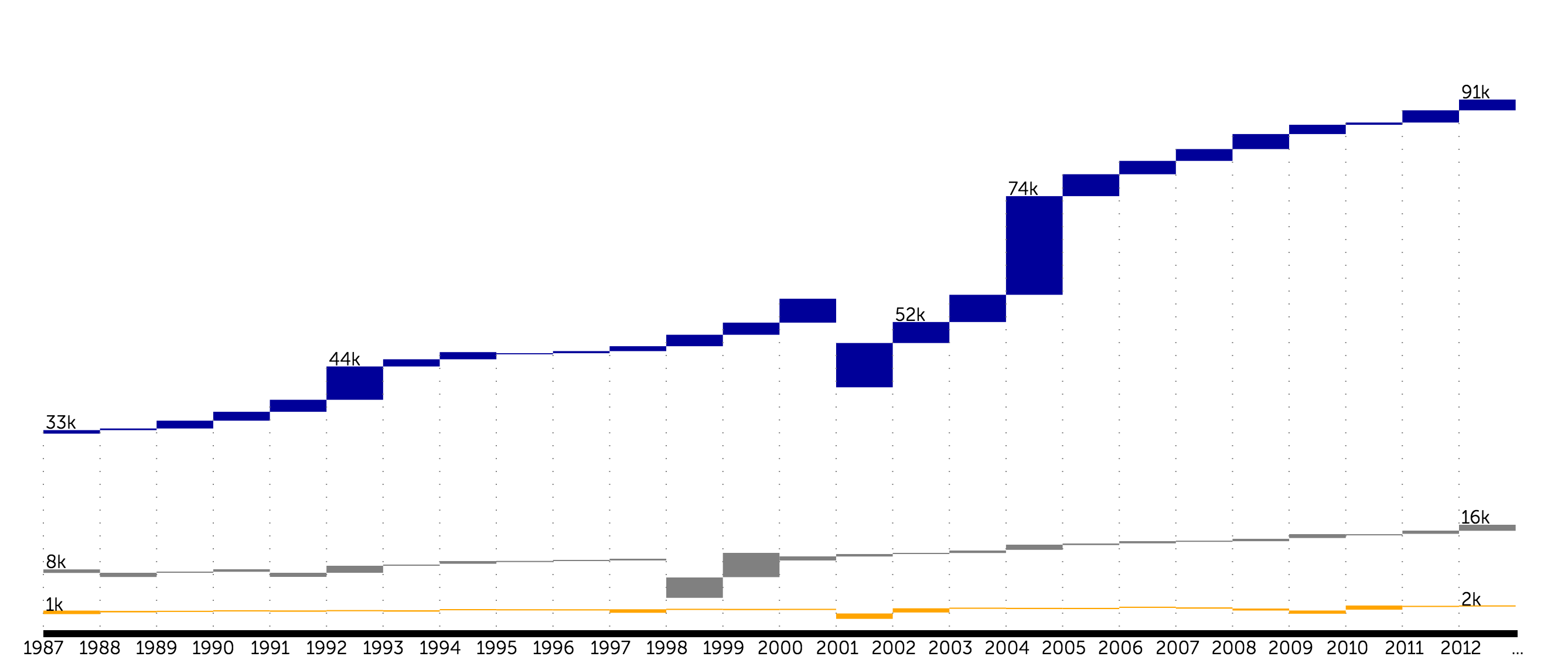
In a follow-up to Jerry Saltz’s dismissal of advanced art degrees, Bourree Lam points out the above chart that shows a continued rise in both BFA and MFA degrees:

It’s clear that the cost is not (yet) driving young artists away from getting educated at M.F.A. programs. It might be that no one studies art for the financial returns: Even as auction houses break records—Peter Lik’s photograph “Phantom” just went for $6.5 millionresale royalties for artists in America have yet to be legislated. Then there’s another common saying: that artists don’t need to get rich because they already are rich. Looking at Bureau of Labor Statistics data, Planet Money reported that artists do tend to have wealthier parents.

One piece of the puzzle might be that for those who choose this career path, the act of becoming an artist is an achievement itself that’s worth a lot. A group of sociologists took a look at what it means to be an artist, and wrote this in the conclusion of their study: “Seeing oneself as a professional artist is an achievement that compares to entering other elite status groups.” With artists being only 1.35 percent of the U.S. workforce, it’s a small group indeed.

(Chart via BFAMFAPhD, which captions: “Y-axis shows the number of graduates each year. Height of bar indicates increase or decrease in graduates each year.”)

Seated For Sociability

Christian Jarrett mulls over a finding that students who are assigned to sit in the center of the classroom are more popular than those assigned to sit on the margins:

Why should seating position have these associations with children’s perceptions of their peers? The researchers think two psychological mechanisms are pertinent. Social psychology research on race relations and prejudice finds that the more we interact with other people, the more positive our views of them tend to be. School pupils naturally interact and socialise more with the children located near to them, and so this interaction could encourage more positive perceptions. There is also a psychological phenomenon known as the “mere exposure effect”, which describes how familiarity with something or someone breeds more positive feelings towards them.sdgsdg

[Researchers Yvonne] Van den Berg and [Antonius] Cillessen also conducted a second study with 158 more school children, in which they asked them to rate each others’ popularity, and also to say where they would position themselves and their classmates if they could choose. Perhaps unsurprisingly, children said they’d like to sit nearer to their peers who were more liked and more popular. The researchers said this provided an insight into what’s known as the “cycle of popularity” – well-liked and popular children typically attract more social interactions with others, this then reinforces the popular perception that others have of them via the mechanisms mentioned earlier.

The Best Threads Of 2014: “When Does Spanking Become Child Abuse?”

Over the next several days, we’re going to highlight a handful of the best discussion threads that were sparked f739cac8_adrian-peterson-child-abuse-4or driven by your emails this year. Reader threads provide some of the most riveting and valuable content we post on the Dish, and they remind us every day how our readership is unmatched on the web for its wisdom, eloquence, and candor – qualities that are rare to find in any comments section.

Our first thread in the retrospective series – “When Does Spanking Become Child Abuse?” – stemmed from the story of Vikings running back Adrian Peterson, who was indicted for beating his four-year-old son with a tree branch (seen here and to the right). The first reader email to emerge was by far the most powerful – “Psychological Suspense That No Child Is Equipped To Manage” – and it opened the floodgates of the in-tray to dozens of other stories of spanking and outright abuse, falling all along the continuum of corporal punishment. Read the whole thread here. Below are many more emails on the topic, aired for the first time:

I wonder how many of your readers who oppose spanking are parents – and what proportion of them have dealt with strong-willed children determined to do what they want, time-outs and rescinded deserts notwithstanding. Beyond this, the number of readers who think a quick jolt to the butt is the equivalent of child abuse astonishes me.

But I suppose it shouldn’t. In a society where sex with an uneasy partner who never actually says no is “rape” – that is, is the very same thing as violent assault and physically coerced sex – we have also broadened the definition of “child abuse” to mean both what Adrian Peterson did, and what the dad who whacked his kid on the butt to keep the boy from running into traffic did. Is grabbing a child’s arm and telling him to stop making a scene in public also child abuse? And who gets to decide these things – a dispassionate system of law, or parents who consider themselves oh-so-enlightened who deign to tell tell the great unwashed that a quick whack on a misbehaving child’s behind is essentially the same thing as burning him with a cigarette or scarring him with a switch?

Another reader puts it well:

I have been following this thread with fascination.  A few years ago my wife broke off all contact with her parents, because she had been spanked perhaps 5-10 times by her father until the age of 12.  Her mother and father are extremely kind and loving parents otherwise.  But my wife feels that those 5-10 spankings constitute abuse, and she will not speak to her parents, or let them see their only grandchild, until they accept that what they did was abuse. They steadfastly refuse.

Now many of your readers may consider this an over-reaction, and that is precisely how her parents feel. But I have been with my wife many years now, and I no longer doubt how deeply wounded she was by what she experienced as an abject humiliation and betrayal of trust.  And I see this more clearly as a result of reading the letters you have received on this topic.  So I would submit that the answer to the question “When does spanking become abuse” is easily answered: when the child being spanked experiences it that way.  And to those who would scoff at that definition, you should consider whether you are willing to bet any future relationship with your child or your child’s family on whether you are right.

Another reader’s story:

I grew up in the South and spanking was “normal” in our household; but my mother and father were never brutish or brutal with us; and never hit us in anger. However, my dad taught me the best lesson on one “spanking” occasion.

I had been told not to drain any oil from our oil tank (I used it to clean paint brushes). Well, I did. My dad noticed the paint brushes in a jar of oil beside the tank. It was clear I had done it. He asked me if I did, and I lied, saying “no.” He knelt down beside me and held my shoulders so he could look into my face; and he asked me several times if I had used the oil, and I always denied doing it. The proof was right there! I was about 10 years old, and even I knew my lie was bald faced and stupid. He finally said to me, “If you tell me the truth, I will not spank you. If you lie to me, I will. Now, did you use the oil from the tank.” Again, I denied that I had. I saw his face go very blank and his stare lengthened. He was thinking. Then he said, “I know you would not lie to me, so I believe you.” I was crushed and shamed beyond belief.

I have never forgotten this. A spanking would have been forgotten immediately. And I never lied to him again.

Treating a child like an adult, once they are able to reason, is a good bet. It’s also good when parents know when this point is. Spanking should never become the fall back mode of communication.

Another:

I was glad to see a reader bring up school-based corporal punishment, as my memories of Bein’ Whooped are almost entirely paddle-based and at the hands of an overly-aggressive junior high P.E. coach.

In my Tampa junior high, the Troubled Teen had two disciplinary choices affectionately known as “Three or Three”: You could take three days of suspension, which went on your permanent record and (worse) alerted your parents, or you could take three licks with the paddle, which did neither of those things. Writing this now, I find a queasy sort of sadism in the nod-and-wink transaction between school and student in this hush-hushed ass-whopping option: “We won’t tell if you won’t, son. So bend over and let me spank that ass,” seems tawdry and a bit sick from a 30-year remove. At the time, facing three days of parental scorn and no TV for a month, it seemed a bargain at twice the price.

That is, unless you get busted for selling black market Jolly Ranchers the week your principal is out of town and his replacement is the world’s most stereotypical gym teacher, with oak tree arms and a Maker’s Mark cask of a chest who had no sense of his own colossal strength.

I should have known something was amiss when my paddling that day required a fucking witness. No joke, the outer lobby secretary had to stand in the coach’s office and watch as I received my paddling, I guess to make sure I wasn’t accidentally beaten to death or crippled from the ass down when Gigantor tucked in. I found this odd and unsettling until the first lick, which did two things simultaneously: Made me forget about everything and everyone in the world save the searing pain across my upper thighs, and dropped me to my knees in a bleating heap of penitence I have never forgotten. I would have done anything, anything, at that moment to save myself the final two-thirds of that beating. And though the coach helped me back to my feet kindly and without bravado, he took his last two licks, each worse than the one before, each a healthy splash of gasoline on a blazing ass-fire.

I had to stand in the outer office for half an hour, clutching the secretary’s desk and blubbering quietly to myself as my knees quivered and my thighs burned, before I could master the art of walking back to class. I wish I could say that was the Spanking That Turned Me Around, the last of my checkered high school career, but alas, I was a recidivist to the end.

My 12-year-old daughter, whose Perfect Precious Snowflakeness I defended to loud shouts of derision in a previous post, has been spanked exactly twice in her life: Once for playing with matches and again for nearly sticking a knife in an electrical outlet. Both were the mistakes you get with a curious mind attached to nimble fingers, so the spanking was meant to shock more than hurt. The house remains standing and she hasn’t yet electrocuted herself, so Bravo, Parent says I!

Another notes regarding the school angle:

Nineteen states still have some form of corporal punishment in schools on the books:

cp map

About 200,000 students are disciplined in this way in schools every year, and these students are disproportionately male, black, and often disabled.  It seems obvious to me that if we don’t want parents using corporal punishment, we should at minimum be banning it in our public schools.

Another offers some advice:

To the reader who resorted to spanking to prevent his/her son from running in front of cars: while I understand the frustration and worry that must have occurred, I wonder why you never thought of putting your son in reins? It can be effective for little ones. I think there are creative ways to keep your children safe or modify behavior without resorting to spanking.

Another relays some wisdom from Montaigne:

Thought you might be interested in ​including​ this passage from Montaigne’s essay, “Of the affection of fathers for their children”​: ​

​​I condemn all violence in the education of a tender soul which is being trained for honor and liberty. There is a sort of servility about rigor and constraint; and I hold that what cannot be done by reason, and by wisdom and tact, is never done by force[…]. Leonor […] is over six years old now, and has never been guided or punished for her childish faults […] by anything but words, and very gentle ones. […] I have seen no other effect of whips except to make souls more cowardly or more maliciously obstinate.​”

And a final reader story touches on the theme of sexual humiliation addressed here:

Thank you for the thread on spanking. The ongoing discussion comes at a critical time for me, as my wife and I are wrangling over how to discipline our daughter, who recently turned three.

I was raised by a single mother after my parents divorced when I was five. Mom went from being the stay-at-home mother of two boys (less than a year apart) to a single parent with an M.D. ex-husband who chafed against the divorce settlement and made our lives very difficult financially.

I know, now, that my mother was depressed when I was a child. She had married my dad right out of college, less out of love than out of the desire not to return to her parents’ dysfunctional home. And now she found herself alone, raising two boys, with little money and no help. It’s a recipe for disaster, but to her credit, my mother managed to get us through it. But did she spank us? Yes, she did.

I’m not writing this to either condemn or excuse my mother’s use of corporal punishment (she had a wooden ruler, or maybe it was a piece of wooden moulding, which came to be known as “the slat”). She didn’t hit us often; “the slat” was more than anything else an omnipresent threat, there to keep us in line. My brother and I would find and hide it whenever mom left it, and us, unattended.

Perhaps ironically, Mom’s wooden enforcer was not involved when things reached critical mass, when I was probably 7-8 years old. I had done something wrong – serious, I’m sure – because Mom announced that she was going to pull down my pants and spank my bare ass. I went into panic-overdrive mode, not at the idea of being spanked, but at the humiliation of Mom attempting to pull down my pants to do it. I struggled, and I lost it, and I hauled off and punched my mother right in the mouth. It was one of those moments you can never forget or take back. We both burst into tears. I didn’t get spanked, ultimately, and I think at that moment we both realized that hitting doesn’t solve anything – it makes everyone feel worse.

I’m 50 now, and my first/only child is a beautiful, intelligent, feisty toddler of three years. It’s difficult to hold back from reacting physically when a toddler is kicking, slapping, and elbowing, typically over mundane issues like bedtime, wanting to watch more TV, or not wanting to go pee pee. I don’t believe that hitting a child is sending the right message, that a three year-old has sufficient self-control to be fully accountable for her actions, or that violence is an acceptable solution or response. My wife disagrees, but has never hit our daughter in front of me.

Last week I picked up my daughter from her preschool, and as I strapped her into her car seat she said to me “Mommy hit me, like this” and slapped herself, hard across the face. My heart broke.

It’s 2014. My wife and I are equal partners in life and in parenting. I can’t tell her how to discipline our daughter. She knows how I feel about it, and I know she feels like I’m too easy on our daughter. She’s only three, for christ’s sake. Wish us luck.

God And The Great Chain Of Being

Burning candle at Nagaon Church on the x-mas day.

Toward the beginning of her essay about her complicated religious faith, Ayana Mathis announces that all of her attempts to describe it “begin with theological assertions and devolve into some syrupy business about the cosmos and the presence of God in all things.” She doesn’t give herself enough credit – it’s an elegant attempt well worth reading. A sample of her prose:

A few years before I left the church as a teenager, my mother and I became estranged from my grandparents and aunts and uncles. She and I were a little battalion of two, fighting our way through the world without family or neighborhood or most of the things that bond people to places and to each other. I suppose it could be said that we were impoverished by this circumstance. It is truer to say that ours was simply one in the infinite variety of human experience, with its accompanying difficulties and mercies. For a long time I held onto my unbelonging like a jewel, as though it were the most precious thing I had. And I liked tumbling around the world and sending dispatches to my mother who was, for a very long time, most of what I knew about love.

But it is time, as the saying goes, to put away childish things.

I am not, as I would like to think, hatched from an egg. It has taken me all my life to understand that I am a link in a long chain of fearless and flawed people: my grandparents, now dead; my aunts and uncles; my great-grandparents who came to Philadelphia from the South under harrowing circumstances at the beginning of the twentieth century. Also mine are Bettie Mae Fikes, and the millions who fled the Jim Crow South with nothing but a crumpled address and a few dollars in their pockets, the little children in those old colored schools with handed-down textbooks and more pride and hope than I can conceive of, and the children in the present iterations of those schools in Philadelphia and New York and all across this country. Also mine: Bessie Smith and Blind Lemon Jefferson. Nina Simone and Stevie Wonder and Lauryn Hill. To think that for so many years I refused to turn my head to see these luminous chains of souls, stretching across time and geography, to which I belong. I still turn away frequently. It is difficult for me to cede any bit of my growling individuality. But I have a few family photos, and I have the music I love, to chastise me when I am arrogant and to brace me when I falter.

God is in all of this. I don’t mean the God I encountered at church when I was a girl, the bearded tyrant up in the firmament jerking us around like marionettes. Rather, I believe in the God of the links in the chain of being. This includes ancestry and culture and history, but it extends beyond those particularities into a vast constellation of belonging, which seems to me to be a form of grace, and a bulwark against despair and disconnection. Certainly, it is what I mean by love.

(Photo by Diganta Talukdar)

A Poem From The Year

2290120626_0c9d955dae_b

“To Be Seen” by Jericho Brown:

Forgive me for taking the tone of a preacher.
You understand, a dying man

Must have a point—not that I am
Dying exactly. My doctor tells me I’ll live

Longer than most since I see him
More than most. Of course, he cannot be trusted

Nor can any man
Who promises you life for looking his way. Promises

Come from the chosen: a lunatic,
The whitest dove—those who hear

The voice of God and other old music. I’m not
Chosen. I only have a point like anyone

Paid to bring bad news: a preacher, a soldier,
The doctor. We talk about God

Because we want to speak
In metaphors. My doctor clings to the metaphor

Of war. It’s always the virus
That attacks and the cells that fight or die

Fighting. Hell, I remember him saying the word
Siege when a rash returned. Here

I am dying while
He makes a battle of my body—anything to be seen

When all he really means is to grab me by the chin
And, like God the Father, say through clenched teeth,

Look at me when I’m talking to you.
Your healing is not in my hands, though

I touch as if to make you whole.

Please consider supporting the work of The Poetry Society of America here.

(From The New Testament © 2014 by Jericho Brown. Used by permission of Copper Canyon Press. Photo by Andrew Malone).

Dish Awards: The Ones You Love To Hate

Hathos is the attraction to something you really can’t stand; it’s the compulsion of revulsion. And according to the voting thus far, this creepy fusion of fat-shaming and evangelism is the second most hathetic moment of 2014:

But still in the lead is Maureen Dowd’s description of what it was like to overdose on edibles:

Then I felt a scary shudder go through my body and brain. I barely made it from the desk to the bed, where I lay curled up in a hallucinatory state for the next eight hours. I was thirsty but couldn’t move to get water. Or even turn off the lights. I was panting and paranoid, sure that when the room-service waiter knocked and I didn’t answer, he’d call the police and have me arrested for being unable to handle my candy. I strained to remember where I was or even what I was wearing, touching my green corduroy jeans and staring at the exposed-brick wall. As my paranoia deepened, I became convinced that I had died and no one was telling me. And then I wrote a column on Hillary.

Cast your vote for these or any of the other five Hathos Alert finalists here. Once you’ve done that, please consider also voting for the 2014 Malkin Award, Poseur Alert, Yglesias Award, Cool Ad, Face Of The Year, and the year’s best Chart, Mental Health Break and View From Your Window. We’ve now introduced voting for the Map Of The Year and Beard Of The Year as well! Polls will close on New Year’s Eve, so be sure to make your picks before then:

Please note: due to there not being enough nominees this year, we will not be issuing a 2014 Hewitt Award, Moore Award, or Dick Morris Award. You can learn more about those and all our awards here.

Marilynne Robinson’s God

Reviewing Robinson’s new novel Lila, Linda McCullough Moore wants to see a bit more judgement from the author’s deity, claiming Robinson portrays a “God who, as far as I can tell, just wants us all to be happy, if not in this life, then certainly in the next”:

I venture to suggest that Lila is a polemic, and a brilliant one. If we engage the novel at this level, surely it is at Robinson’s express instigation. No matter that the art is heavenly; no child could mistake the conclusions: The Conclusion, Eternal Glory for us all. No questions asked. But also, no questions answered. Are we to be faulted for scratching our heads about this sermon later on a Sunday afternoon? Puzzling out where any God of Holy Writ might recognize himself in the story that she is telling?

Lila’s favorite book in the Bible is Ezekiel, written by the same prophet who says God will separate the sheep from the sheep, a far finer distinction even than the sheep from the goats. But Robinson is having none of it. We’re all just doing the best we can with what we’ve got. Some readers ask what kind of preacher is John Ames. We can only surmise, but we do know what kind of preacher is Marilynne Robinson. Convincing, in a word. Her nonfiction makes a reader think. Her fiction converts the heart. In Robinson there is a balm in Gilead, and it is surely sweet. I’m just not sure where it comes from.

Robinson writes that much is mystery, even as she is spelling out without confusion the ways of eternity and holiness and judgment. She claims the unknowable, even as she specifies God’s ways to man and womankind.

Gracy Olmstead rises to Robinson’s defense:

First, many of the quotes pulled from [McCullough Moore’s] review are Lila’s internal thought processes, as she grapples with the fear that many of those she once knew and loved will not be saved. Thus, these thoughts are not declarative truth statements being made by Robinson. They are all in the voice of Lila, who, as she reads Scripture, wrestles mightily with these questions. They aren’t meant as Robinson’s Gospel: they’re Lila’s still-being-formed-and-sanctified conceptions of the Gospel.

Second: Robinson here is writing to people from Lila’s world, and that is one of the reasons I appreciate this novel so deeply. Gilead was a lofty, lovely book, full of the wizened thoughts of a preacher. In it, Ames struggles with conceptions of grace and redemption, but he does so from a position of wisdom and maturity. Lila presents something different: a soul-grappling that is very raw, intimate, and personal. Moore, in her review, quotes a particular passage by Ames, in which he says, “If the Lord is more gracious than any of us can begin to imagine … then your Doll … is safe, and warm, and happy.” It may sound heretical or evil to some, but really, I think it’s a deeply important statement. Ames is noting that we are fallible humans, and God is mysterious. We do not know the heart of man, nor do we know the plan of God in its entirety. Salvation and redemption are not ours to give, nor are they ours to judge. And so Ames offers this truth to Lila—that God is good, more gracious and loving than the human mind can ever conceive or imagine. And he invites her to rest in that truth, using words that she will understand.

Previous Dish on Robinson and Lila here and here.

If Only Mangers Were Mangier, Ctd

nativity

A reader “couldn’t agree more” that the nativity scene shouldn’t look so clean and pristine:

This is one reason the [above] image has always been a favorite of mine among nativity scenes. It’s from the early 1400s, by the early Northern Renaissance painter known as the Master of Flémalle. Just take a look at how scrawny, sickly, and unappealing that barn-born infant is, lying there in the dirt!

But another notes:

The virgin birth includes a lot of theology (which might be speculative) that it wasn’t as ugly or messy as women who aren’t virgin nor immaculately conceived.

That said, the Manger scenes are usually too clean (it wasn’t in a barn, it was a cave!).  The stoic and pure (carrying an easter lily) Joseph?  There was an umbilical cord and placenta – I haven’t read anything saying he was born without these.

We seem to confuse flashiness and gaudy scenes with celebration.  Christmas should be a humble holiday.  Joyful, but solemn.  Like the birth of Jesus. Mary had many sorrows, the birth of her son was not one of them, even in the process.

Another notes regarding the representative nativity scene we posted:

Perhaps they could start with a family that looks more fitting a Middle East setting than a white upper-class family from Stockholm.

Another adds:

The manger would also be full of animal shit as well.  It was a stable, not a hayride.

Speaking of shit:

For more realism in nativity scenes, go to Catalonia, where any self-respecting nativity scene features a “caganer,” which is traditionally a shepherd taking a dump behind the manger. These days, of course, pretty much any public figure of any renown has a caganer made in his honor:

francis

Previous Dish on caganers and the caga tió, or shitting log, here and here.