The Dark Side Of Christmas

dish_bridgetxmas

Lisa Miller analyzes why “Bridget’s” self-loathing Christmas cards are such a social media hit:

Bridget’s cards won their internet moment not just because they’re clever and funny, but because they articulate that thought and the way it can become so explosive during the holidays: All this jollity rings false to me. Everyone, no matter what their relationship status, feels a little like Bridget this time of year — outcast, exiled, discontent; her cards capture a sentiment heartfelt enough to catch the attention of millions of newsfeed browsers but also noncontroversial enough to bypass the conformity threshold. Hark! Bridget has tapped our inner misfit, which emerges in a guffaw like a genie from a bottle. Isn’t that a gas?

Meanwhile, Sarah Condon ponders yuletide misery from a theological point of view:

Whether or not we realize it, we pointedly deny the harsh realities of our lives this time of year. I know I do. The moment we remember Jesus coming into the world is the same moment we hold up our perfectly posed Christmas photos. To the one who came to save us we say, “See how good we look? We are totally pulling this off.”

Only, we are not pulling it off, not even remotely. We are disappointed in our children, our spouses, the world, and ourselves. We deny our feelings of loneliness and inadequacy. We scurry to hide them. And the season provides some pretty amazing crutches for our denial: Jim Beam, party mix, and online shopping. All of a sudden, it becomes easy to make failure look like success. To make heartache look like mildly hungover.

Isn’t it odd that, more than any other time of year, Christmastime is when we want everyone to know just how glorious our lives are? I’m already bracing myself for the post-Christmas newsfeed. We can all gather round the old iPhone and sing a hymn of Sanctification by Gift Giving. For the record #besthusbandever #fairtrade and #santarocks are my own self-righteous picks for the season.

But it doesn’t have to be this way. We are actually allowed to admit that we are screwed up, yes, even at Christmas. Let the record show, St. Paul already gave us the bones in Romans 7: I do not understand what I do. For what I want to do I do not do, but what I hate I do.

The 2014 Dish Awards!

Calling all Dishheads: it’s the end of the year and that means it’s Dish award time! As usual, our elite, highly-specialized blue-ribbon panel has pored over more than a thousand posts in order to select this year’s finalists, now it’s up to you to pick 2014’s best (and worst).

If you have some free time today, click the links below and vote for the 2014 Malkin AwardHathos AlertPoseur Alert, and Yglesias Award. Polls are also open for the year’s best Chart, Mental Health Break and View From Your Window, as well as the 2014’s Coolest Ad, Face Of The Year, and for the first time ever, Map Of The Year and Beard Of The Year!

Our polls will close on Wednesday, December 31, at midnight. Winners will be announced soon after. Have at it:

Please note: due to there not being enough nominees this year, we will not be issuing a 2014 Hewitt Award, Moore Award, or Dick Morris Award. Learn more about all our awards here.

A Poem For Christmas

5944632130_1ce8d26f26_b

“Christmas Card to Grace Hartigan” by Frank O’Hara (1926-1966):

There’s no holly, but there is
the glass and granite towers
and the white stone lions
and the pale violet clouds. And
the great tree of balls in
Rockefeller Plaza is public.

Christmas is green and general
like all great works of the
imagination, swelling from minute
private sentiments in the desert,
a wreath around our intimacy
like children’s voices in a park.

For red there is our blood
which, like your smile, must be
protected from spilling into
generality by secret meanings,
the lipstick of life hidden
in a handbag against violations.

Christmas is the time of cold air
and loud parties and big expense,
but in our hearts flames flicker
answeringly, as on old-fashioned
trees. I would rather the house
burn down than our flames go out.

Please consider supporting the work of the Poetry Society of America here.

(From the Collected Poems of Frank O’Hara © by the University of California Press. Reprinted by permission of the University of California Press. Also reprinted in Christmas Poems © New Directions Publishing Corp. Photo by Flickr user Dominick)

If Only Mangers Were Mangier

341887154_726332a318_z

Joe Kay wishes holiday crèches weren’t so idealized:

If our manger scenes were realistic, Mary would be recovering from a painful labor full of sweat and blood, with a look on her face that’s anything but serene. And Joseph — wouldn’t he be a nervous wreck, too? His hand too shaky to hold a lantern? And about that newborn. Shouldn’t he be red-faced and screaming? Eyes clenched closed and wisps of hair stuck to the top of a head that‘s still odd-shaped from all the squeezing? Instead, we’ve sanitized and romanticized it. We’ve removed all the blood and sweat and tears and pain and goo. It’s no longer something real. We’ve left out all the messy parts. The oh-my-God-what-now parts. The I’m-screaming-as-loud-as-I-can-because-it-really-hurts parts. The oh-no-I’ve-stepped-in-the-animal-droppings parts. The real parts. …

It’s not about a calm-faced mother and a lantern-toting dad with a perfect baby stretching out its arms to the world. It’s about us as we really are. Bleeding and screaming. Covered in goo and disgrace. Aware of our many failings and falling-short moments. Coming apart. Barely holding it together. Unable to explain why we make such bad choices so many times. So, here’s an idea. Let’s replace those plastic manger scene figurers with something more real.

(Photo by Oscar Llerena)

A Short Story For Christmas

This story from O. Henry, “The Gift of the Magi,” was first published in December 1905. How it begins:

One dollar and eighty-seven cents. That was all. And sixty cents of it was in pennies. Pennies saved one and two at a time by bulldozing the grocer and the vegetable man and the butcher until one’s cheeks burned with the silent imputation of parsimony that such close dealing implied. Three times Della counted it. One dollar and eighty-seven cents. And the next day would be Christmas.

There was clearly nothing left to do but flop down on the shabby little couch and howl. So Della did it. Which instigates the moral reflection that life is made up of sobs, sniffles, and smiles, with sniffles predominating.

While the mistress of the home is gradually subsiding from the first stage to the second, take a look at the home. A furnished flat at $8 per week. It did not exactly beggar description, but it certainly had that word on the look-out for the mendicancy squad.

Read the rest here. This story and others are collected in The Four Million. Read all of our previous SSFSs here.

Are You Being Persecuted This Christmas?

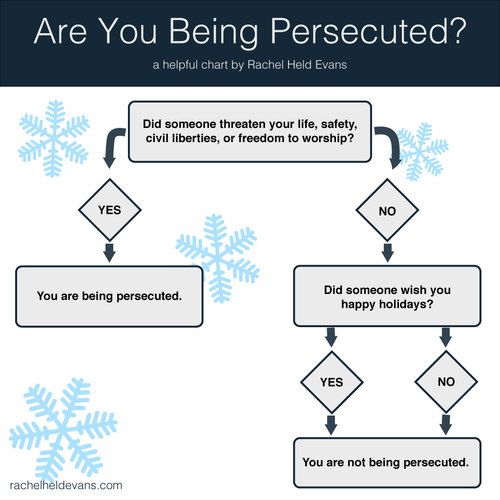
Christian blogger Rachel Held Evans provides a handy flow-chart:

christmas

She comments:

You may have heard it from Kirk Cameron or an anchor at Fox News or an army of culture warriors who have once again worked themselves into a frenzy over the “War on Christmas.” Galvanized by fear, they storm checkout counters to demand that clerks issue them a “Merry Christmas” instead of “Happy Holidays” and cry persecution when inflatable manger scenes are moved from public courthouses to private property. They pine after the good-old-days when Christians could force Jewish kids to sing Christmas carols at school and they demand that every gift purchased, every mall opened late, every credit card maxed out must be done so in Jesus’ name or else Christ will be “kept out” of Christmas. They do it because someone told them that God needs a nod from the Empire to show up, forgetting somehow that the story of Advent is the story of how God showed up as a Jew in the Roman Empire.

‘Tis The Season For Tackiness

3132412546_aed5bae800_b

And Joseph Bottum wants us to embrace it:

Tastefulness is just small-mindedness, pretending to be art. And Christmas isn’t tasteful, isn’t simple, isn’t clean, isn’t elegant. Give me the tacky and the exuberant and the wild, to represent the impossibly boisterous fact that God has intruded in this world. Give me churches thick with incense and green with pine-tree boughs, the approach to the altar that feels like running an obstacle course through the poinsettias, and a roar from the bell towers so ground-shaking that not even the deaf can sleep in. See these spires aspire to heaven, as I wrote in one of my new Christmas carols this year. Hear these bells rejoice to ring.

A follower once asked St. Francis—oh, so prissily—whether it was licit to eat meat on the Feast of Christmas, and he shouted in reply, “On a day like this, even the walls eat meat. And if they cannot, then let them be spread with meat.” Now there’s a picture that won’t make House Beautiful any time soon: the walls of the dining room dripping with smeared meat. Such an image will not be subsumed by any attempt to tidy up the holiday and make Christmas manageable. St. Francis points toward something about the wonder and the mess of the Incarnation: the shattering of ordinary life that the Nativity declares. …

In other words, embrace the madness of the season. Bellow out the off-key carols. Smile at the silly reindeer. Empty your pockets into the Salvation Army kettles as the Santas ring their bells. Slip on icy walks with your arms full of presents. Load the tree with lights. Pray not in despair or supplication but in wild thankfulness.

(Photo by Taber Andrew Bain)