Mental Health Break

Pushing the boundaries of a digital-analog mashup:

[vimeo https://vimeo.com/114767889 w=580]

Christopher Jobson captions:

Pixel is an innovative dance performance conceived by French performance artists Adrien Mondot and Claire Bardainne, known collectively as the Adrien M / Claire B Company, in collaboration with hip-hop choregrapher Cie Kafig. The hour-long performance incorporates a host of digital projection mapping techniques, 11 dancers, and bills itself as “a work on illusion combining energy and poetry, fiction and technical achievement, hip hop and circus.” Pixel premiered at Maison des Arts de Créteil on November 15th of last year, and above is a 3-minute exceprt of the shows most jaw-dropping moments.

The Known Unknowns Of Cyberwar

Noting that we still can’t say for sure whether the Sony hack was the work of North Korea, Schneier discusses the implications of a form of warfare in which the perpetrator can’t be immediately identified:

When it’s possible to identify the origins of cyberattacks—like forensic experts were able to do with many of the Chinese attacks against U.S. networks—it’s as a result of months of detailed analysis and investigation. That kind of time frame doesn’t help at the moment of attack, when you have to decide within milliseconds how your network is going to react and within days how your country is going to react. This, in part, explains the relative disarray within the Obama administration over what to do about North Korea. Officials in the U.S. government and international institutions simply don’t have the legal or even the conceptual framework to deal with these types of scenarios. …

It’s a strange future we live in when we can’t tell the difference between random hackers and major governments, or when those same random hackers can credibly threaten international military organizations. This is why people around the world should care about the Sony hack. In this future, we’re going to see an even greater blurring of traditional lines between police, military, and private actions as technology broadly distributes attack capabilities across a variety of actors. This attribution difficulty is here to stay, at least for the foreseeable future.

Neal Pollard compares the reality of cyberwar to what our military and intelligence brass had assumed it would look like:

Secretaries of Defense have been talking since the 1990s about a “cyber Pearl Harbor,” typically characterized as a massive attack on infrastructure such as the electric grid or transportation, usually envisioning massive economic damage and even great loss of life, as a strategic element accompanying a broader conflict among powers. This has been the dark future of various government and think-tank scenarios, predicting how nation-states would use cyberspace as a battlefield for national political or military advantage.

What we have seen over the past few years in the United States has been different: nation-states like (possibly) Iran and North Korea, using damaging but fairly limited attacks against specific companies such as banks, oil producers and media companies, to pursue rather tactical foreign policy goals, with no significant military context. … While it is true some states such as Georgia, Ukraine and Estonia have suffered wider-scale cyber-attacks, these have been within a broader context of threatened or actual military conflict. If the Sony and similar episodes are harbingers of future cyber conflict, then private-sector corporations might be dragged into state-driven geopolitical conflict as instruments of foreign policy and economic pressure, long before they become trenches under fire on a digital battlefield.

Meanwhile, Greenwald rails on on the media for swallowing the government’s line that North Korea did it, despite a lack of evidence to that effect:

It’s tempting to say that the U.S. media should have learned by now not to uncritically disseminate government claims, particularly when those claims can serve as a pretext for U.S. aggression. But to say that, at this point, almost gives them too little credit. It assumes that they want to improve, but just haven’t yet come to understand what they’re doing wrong. But that’s deeply implausible. …

U.S. journalists don’t engage in this behavior because they haven’t yet realized this. To the contrary, they engage in this behavior precisely because they do realize this: because that is what they aspire to be. If you know how journalistically corrupt it is for large media outlets to uncritically disseminate evidence-free official claims, they know it, too. Calling on them to stop doing that wrongly assumes that they seek to comport with their ostensible mission of serving as watchdogs over power. That’s their brand, not their aspiration or function.

A Socialist In The White House? Ctd

A reader isn’t jumping on the Bernie bandwagon any time soon:

I love me some Bernie, but the good Senator might ask himself whatever came of Occupy Wall Street, the Climate Change March in New York or the various metropolitan marches to protest aggressive police force against African Americans … NOTHING. The Koch Brothers still roll merrily along, thank you very much. So much for protests in the streets.

How another reader puts it: “I fear he would be a significantly quixotic, ineffective president, no matter how well meant his agenda was.” Another:

I’m from Vermont and probably fit the Vermont political stereotype – progressive in some sense.  However, Bernie Sanders is one of the reasons I’ve been less supportive of progressive causes.

Here in Vermont, he has been steadfast in his support of basing the F35 in the Burlington area despite the warnings and caveats of Air Force’s own Environmental Impact Report.  In other words, Bernie supports progressive causes AND military pork.  He gives progressive movement permission to be for military pork as long as their rhetoric is sounds good.

Media types like you give Bernie a pass in that you don’t question his progressive credentials when it comes to military pork. The F35 deserves to be questioned at a lot of levels.  For one thing, it’s a poorly-designed piece of military hardware that is ridiculously expensive (1.5 trillion dollars).  We could fight another Iraq war (with the same result) for that amount of money and not need the F35.  For another, it’s not really clear what its mission is in the 21st century.

The Dish recently featured Fallow’s latest cover-story, which contains a sizable takedown of the F-35, a project that “illustrates the broad and depressingly intractable tendencies of weapons development and spending.” Jim also takes aim at Bernie:

Whatever its technical challenges, the F-35 is a triumph of political engineering, and on a global scale. For a piquant illustration of the difference that political engineering can make, consider the case of Bernie Sanders—former Socialist mayor of Burlington, current Independent senator from Vermont, possible candidate from the left in the next presidential race. In principle, he thinks the F-35 is a bad choice. After one of the planes caught fire last summer on a runway in Florida, Sanders told a reporter that the program had been “incredibly wasteful.” Yet Sanders, with the rest of Vermont’s mainly left-leaning political establishment, has fought hard to get an F-35 unit assigned to the Vermont Air National Guard in Burlington, and to dissuade neighborhood groups there who think the planes will be too noisy and dangerous. “For better or worse, [the F-35] is the plane of record right now,” Sanders told a local reporter after the runway fire last year, “and it is not gonna be discarded. That’s the reality.” It’s going to be somewhere, so why not here? As Vermont goes, so goes the nation.

A followup from Fallows on the F-35 here. Shifting focus, another reader quotes from the Prokop piece we featured:

Beyond Clinton’s desire to raise campaign cash, there’s a long-held belief among many Democratic political consultants that messaging critical of the rich simply isn’t effective in US politics. Instead, they argue, much of the American public actually rather admires successful businessmen, and aspires to be like them. And lack of trust in government is a real and consistent force in American politics and public opinion.

Fucking Hell. This is why we can’t have nice things – or a nice country. What good is the damn Democratic Party if it doesn’t, you know, advocate policies that once upon a time the Democratic Party advocated – successfully for the country, I might add. In addition to literally possessing one, Hillary Clinton – and every “Democrat” – is a pussy. We live in stark times where the status quo just won’t help citizens. True leftists aren’t asking for the French Revolution, just some courage against the prevalent and powerful forces that have taken away economic human rights en masse. But apparently, even that is too much, and the income inequality gap, with all its attendant problems, will continue unchecked and unabated.

I have always though D.C. and Hollywood shared the worst qualities. The above quote proves it. Just like the studio heads at Hollywood, D.C marketing guys – the real power players of the country – are conservative and think Americans won’t cotton to new ideas and new ways of thinking. Just as movies now are generic sequel after generic sequel because Hollywood thinks Americans want to be comfortable and given entertainment they already know, so too the political class thinks Americans want to stay in the hard times, because, hey, it’s the new normal and rocking the boat isn’t going to fly with the public.

Trust me: a slight change like a little redistribution of wealth to the needy won’t result in Thermidor. We’re too placid as a people for that. What it will do is get millions excited about politics again – for we are all desperate for someone, anyone, even an identified socialist like Bernie Sanders, to lead us.

From The Annals Of CIA Incompetence

Dexter Filkins highlights an example – the gross mishandling of “Asset X”, the mysterious figure who eventually led the CIA to KSM:

Asset X was willing to help, for a price, the e-mail said. Then something went wrong. The C.I.A. agent who was meeting Asset X recommended that Asset X be paid a certain amount of money for his help, but the request was denied. Asset X disappeared. … Nine months later, the C.I.A. found Asset X, and he was still willing to help. Then something went wrong again: Asset X’s original C.I.A. handler had been transferred, and his replacement didn’t know Asset X’s real value. The replacement agent wrote several cables to C.I.A. headquarters seeking guidance and got no response. His cables were “disappearing into a ‘black hole’,’’ the agent later recalled.

With nothing to go on, the C.I.A. officer prepared to terminate his relationship with Asset X. While he was explaining his dilemma to a colleague, another C.I.A. officer—this one visiting from out of town—overheard him and explained that Asset X in fact was extremely valuable. Shortly thereafter, with no advance warning and no C.I.A. permission, Asset X travelled to Pakistan and unexpectedly met [Khalid Sheikh] Mohammed. Asset X went into a bathroom and sent a text message to his C.I.A. handler: “I M W KSM. Within hours, the C.I.A. and Pakistani intelligence agents stormed the Rawalpindi compound and captured Mohammed.

After which KSM, of course, was tortured over and over again, with “no information provided by [him leading] directly to the capture of a terrorist or the disruption of a terrorist plot.” However, as Judith Levine reminds us, it shouldn’t ultimately matter whether torture “worked” or not:

“No one shall be subjected to torture or to cruel, inhuman or degrading treatment or punishment,” pronounces Article 4 of the Universal Declaration of Human Rights.  No one. That’s the thing about human rights. Everybody has them—civilian, combatant, citizen, stateless migrant, innocent or criminal. Eichmann had human rights. Osama bin Laden had them. You can’t even waive your human rights. They are inalienable.

To torture is to strip a person not only of rights but of the humanity to which they attach. Dehumanization is torture’s definition, its prerequisite.

Is torture effective? The question is akin to asking if slavery is good economic policy or forced sterilization is an effective means of slowing population growth. Even if torture does work, it is still wrong. And the minute we start considering it as a tool to select to get the job done—like a wrench or a pliers to turn a bolt, a spade or pickax to dig a hole—then we do not only dehumanize those we torture, we cease to be human ourselves.

Will The FDA Ever Get Over Its Hemo-phobia? Ctd

A gay physician writes in:

Your reader estimates that under new FDA rules there might be two additional cases of HIV infection each year – and then concludes that this “unacceptable.” But where was the calculation of how many lives might be saved because of the new available blood? An entire side of the equation is missing.

Almost every decision in medicine involves judging risks versus benefits. Your reader appears to feel that for blood transfusions, our overriding principle must be that the “risk of giving a patient contaminated blood is as low as humanly possible.”  That would make sense if every hospital in the country was replete with usable donated blood.  However, last time I checked, the Red Cross was describing an “urgent need” for more donations.

A vivid recollection from my intern year: a middle-aged man with cirrhosis in the intensive care unit suddenly ex-sanguinating from his GI tract at two o’clock in the morning.  He likely would have died without massive blood transfusions. In that moment, the benefit of having available blood clearly outweighed any minuscule risk of contracting HIV.

Another expert weighs in:

I have written about biomedical research and policy for more than two decades. Even accepting that your writer’s assumptions and math are correct, what the comment lacks is a context.

Blood transfusion, like life, does carry risk. The FDA reports that 65 people died from blood transfusions in 2013. Often human error is a significant factor in those deaths. About 2-3 HIV infections occur each year in the US through blood transfusions, and that might increase by 1-2 if the policy is changed. But other serious and often fatal infections – sepsis, Hepatitis B, Hepatitis C, West Nile Virus – also are transmitted through transfusion, and at significantly higher rates. More about that issue here.

Additionally, a true risk/benefit calculation would have to factor in the impact of not having blood, particularly rare types, available for trauma victims and surgery. While the cost may be small, as with HIV transmission, it does exist. The discriminatory policy has negatively affected the ability to collect blood on college campuses. A growing body of research points to “young” blood as being more beneficial than that of an older person.

The experts who deal with transfusion medicine on a daily basis have studied these issues for many years and have concluded that lifting the gay blood ban is more cost-effective to society than keeping it in place. I trust their judgment more than I do that of some reader who cherry-picks issues and makes back-of-the-envelope calculations.

Another piles on:

Your reader argues that two additional deaths per year “simply for going to the hospital” is an unacceptably high risk.  He might be alarmed to know that, according to CDC estimates,  1 in 25 patients who simply walk into a hospital will contract an infection during the course of their stay, adding up to 722,000 infections in 2011.  About 75,000 patients with such health care associated infections die while in the hospital, although the presumably some of the patients might have died anyway.  Perhaps we should ban hospitals?  Or perhaps we should weigh benefits in addition to risks.

And another:

The math this reader laid out completely ignores the entire social context of this issue. The problem here is that the guidelines assume there is no way to make distinctions between gay men when it comes to risk of blood-bourne illnesses.  If you start from the presumption that there is no screening technique that could possibly give a more accurate picture than “any gay man who has had any sex in the last year is a potential disease vector,” then sure, that math makes sense.  By the same token, this map notes high incidence of HIV diagnosis (at least 428 per 100,000) among residents of NY, CT, NJ, DE, MD, DC, FL, SC, GA, and LA.  That’s almost a quarter of the US population.  In the absence of a ban on the residents of these states giving blood, we can assume (by the same very rough math used by that reader) that about 0.1% of donated blood is HIV positive.  The reason we don’t ban entire states from donating blood is that there are very simple questions we can ask that are only tangentially related to their place of residence which much more efficiently assess risk.

One more reader zooms out:

I think that one of the really wonderful things about the gay rights movement at this point in time is that the world is sort of opening up so quickly that everyone can be somewhat patient, and have faith in the progress to come.  It’s not necessary to dig in, and it’s easier not to get angry.  Your debate about the FDA guidelines is a great example.  If there is a bias in the blood donation policy, we can sort of unpack it and think about it clearly. I think it’s a pretty unusual place to be in a struggle for civil rights.

Rewriting The Story Of Selma

Selma, the new MLK film, has been criticized for its inaccurate depiction of LBJ. Last week, Yglesias defended the movie:

Both a Politico article by LBJ Library Director Mark Updegrove and a Washington Post article by former senior Johnson aide Joseph Califano charge the movie with serious historical inaccuracies. Like any biopic, Selma does condense and somewhat depart from the actual historical record. But Califano’s charge that the movie “should be ruled out this Christmas and during the ensuing awards season” goes well beyond standard-issue nitpicking.

But when you read these pieces closely, it seems that the big problem they have with the film is that it doesn’t cast LBJ as the hero of the Voting Rights Act. But the fact that Selma doesn’t do this is part of what makes it important. Hollywood too often gives us films about race in America where the real heroes are conveniently white. Selma doesn’t.

Bouie argues along the same lines:

[I]t’s wrong to treat nonfiction films—even biopics—as documentaries. Instead, it’s better to look at deviations from established history or known facts as creative choices—license in pursuit of art. As viewers, we should be less concerned with fact-checking and more interested in understanding the choices. …

Selma, simply put, is about the men and women who fought to put voting rights on the national agenda, and it engages history from their perspective. By hardening Johnson—and making him a larger roadblock than he was—DuVernay emphasizes the grass roots of the movement and the particular struggles of King and his allies. In the long argument of who matters most—activists or politicians—[filmmaker Ava] DuVernay falls on the side of the former, showing how citizens can expand the realm of the possible and give politicians the push—and the room—they need to act.

Ann Hornaday joins the debate:

The correct question isn’t what “Selma” “gets wrong” about Johnson or King or the civil rights movement, but whether we are sophisticated enough as viewers and thinkers to hold two ideas at once: that we’re not watching history, but a work of art that was inspired and animated by history. That we’re having an emotional and aesthetic experience, not a didactic one. That the literalistic critiques of historians and witnesses can co-exist — fractiously, but ultimately usefully — with the kind of inspiration, beauty and transformative power that the very best cinema such as “Selma” can provide.

But Josh Zeitz finds the film wanting:

[F]or a film about a pivotal moment in MLK’s life, it obscures too much of King’s political and personal genius. The events at Selma stood at the juncture of every theological and practical dilemma that King grappled with in his public career: The limits and utility of nonviolence. The balance between civil disobedience and civil society. How an activist stays politically relevant. Selma skims the surface of these questions, but it never gets to the core.

Gary May calls Selma “a flawed film”. However:

DuVernay has partly succeeded in presenting a more human King, warts and all. But ironically, this only increases King’s stature, making us admire him all the more for overcoming the political and personal problems that would have defeated a lesser man. Selma becomes a biopic in which the hero shines while those who worked beside him are overlooked or relegated to the sidelines. This is especially important because, as King often said, the essence of the civil rights movement was not one man’s actions but collective action, the work and sacrifice of many.

Prospero found it “hard to watch the film without thinking not just of the lead-up to the 1965 Voting Rights Act, but also of the unrest that followed recent fatal police actions in Ferguson, Missouri, and New York City.” National Review editor Rich Lowry rejects that comparison:

The protesters who faced off against the police in Selma didn’t shout abuse, although they would have been amply justified; they didn’t burn down local businesses; they didn’t randomly fire guns, or throw rocks or stones. The difference between demonstrators in Selma and Ferguson is the difference between dignity under enormous pressure in a righteous cause and heedless self-indulgence in the service of a smear (that Officer Darren Wilson shot Michael Brown as he surrendered).

Weigel puts Lowry’s criticisms in historical context:

This is a risky subject for National Review. William F. Buckley, the magazine’s founding editor, did not respond to the Selma marches by calling for universal voter rights. He wondered if immediately giving the vote to all black Alabamans would lead to racist vengeance, and cited Egypt, Ghana, and Algeria as despotisms “life for the dissenter is far worse than life for the Negro in Selma, if only because he has hope.” He also asked whether, if universal suffrage wasn’t possible, it made more sense to limit the franchise by education instead of race—to people with high school diplomas, possibly. …

From the vantage point of 2015, Selma looks like “as clear a conflict between right and wrong as we get” and a “righteous cause.” In the spring of 1965, it wasn’t so clear to everyone. Selma doesn’t do much with the doubters, though; it portrays the violence against the marchers as so heinous that it serves the Southern Christian Leadership Conference’s purpose in pushing the Voting Rights Act to the front of the national agenda. Critics of the march, such as Governor George Wallace, are shown to be obviously, humiliatingly defeated.

That’s the history everyone has come to prefer, even the people arguing that no current “civil rights” cause should be compared to Selma.

Palestine Ups The Pressure, Ctd

Israel has responded to the Palestinian Authority’s bid to join the International Criminal Court with predictable harshness:

In an initial response over the weekend, Israel said it had frozen 500 million shekels (more than $125 million) in tax funds collected for the Palestinians. The monthly transfers are a key source of revenue for the cash-strapped Palestinian government. Netanyahu’s government minister for strategic affairs, Yuval Steinitz, said Israel could take even tougher action. “If the Palestinian Authority continues to attack us, I assume we will consider other steps,” he said, without elaborating.

The Israeli government is also planning to petition Congress to cut off American aid to the PA. In an editorial, Ha’aretz slams these retaliatory measures as “perverse revenge”:

The Palestinian application to the ICC is uncomfortable for Israel. But those who fear it now should have considered the implications before they pushed Abbas into a corner.

In any case, despite the embarrassment Israel is liable to suffer in The Hague, the application is still a nonviolent, political move, whose impact Israel can mitigate greatly if it conducts its own investigation into suspected war crimes. But over all this hovers the question of where the punishments imposed by Israel will lead. Does Israel want to see the PA collapse? Has it taken into account the impact its action will have on the PA’s faltering economy? Revenge and punishment aren’t a policy. And they most certainly aren’t a smart policy.

Emily Schaeffer Omer-Man points out that Israel would have nothing to fear from the ICC if it were more vigilant in investigating and punishing crimes within its own security apparatus:

What is beyond ironic here, and in fact cause for concern, is that the Palestinian bid to the ICC would pose no threat to Israel if the latter were to meet the complementarity requirement under the court’s statute. According to the Rome Statute, state actors over which the court has jurisdiction by virtue of the said state being a party to the treaty, or the complaint having been launched by a state party, may only be prosecuted if it can be shown that the same state is “unwilling or unable” to carry out a genuine investigation and prosecution of the alleged war crime. …

Under the Israeli military justice system the Military Advocate General both counsels the military on the law during operations and decides whether to investigate and indict those accused of violating it after the fact. Moreover, relevant Israeli criminal law does not define offenses that constitute war crimes as such, and thus they are not prosecuted and penalized with the appropriate gravity.

J.J. Goldberg, meanwhile, thinks through what charges Israel might face if the Palestinians’ move succeeds:

Israel would be far more vulnerable to war crimes charges for its settlement policies. Many friends of Israel find it ludicrous that building apartment houses could be considered a war crime, but international law is pretty unambiguous on the question. The legal text is the Fourth Geneva Convention, the international treaty adopted in 1949 in response to the Nazi atrocities. According to Article 49 of the convention, a nation that occupies another nation’s territory in the course of war may not “deport or transfer part of its own civilian population into the territory it occupies.”

Note that there’s noting illegal about one nation occupying another nation’s territory in the course of war. That’s what happens in war. The Fourth Geneva Convention defines how the occupied territory and its population must be treated during the course of the occupation. It says nothing about the fact of occupation itself except that it happens in war. So all the talk you hear about Israel’s “illegal occupation” is simply ignorant. An argument can be made that Israel illegally violates certain of its obligations as the occupying power. That’s what the court case will be about, if it ever reaches the court.

Juan Cole fantasizes about the court indicting Netanyahu:

While it is unlikely that this could happen, Israel’s leadership might not be able to visit most of Europe, which would isolate them and much reduce their influence. The European institutions in Brussels would take an ICC conviction seriously. … Over a third of Israeli trade is with Europe, and technology transfers from Europe are crucial to Israel. It could be kicked out of European scientific and technological organizations, where it presently has courtesy memberships. And Israeli leaders could end up being afraid to visit European capitals lest they be arrested, Pinochet style (even if governments ran interference for them, they could not be sure to escape lawsuits by citizen groups and could not be insulated from activist judges).

The world wouldn’t end for Israeli leaders if they were convicted, as it hasn’t ended for [Sudanese President Omar] al-Bashir. But the consequences would be real and unpleasant, and over time could have a substantial impact.

But Aaron David Miller deflates expectations that Palestine will accomplish much of anything by joining the court:

There are numerous issues relating to whether the Palestinian Authority can be recognized as a state for purposes of presenting charges to the Court; jurisdictional questions; and Palestinian vulnerabilities too that stem from Hamas’s own transgressions and alleged war crimes. And even if these can be overcome, there’s the matter of whether the ICC wants to get drawn into the politics of the Israeli-Palestinian problem. Having publicly indicted roughly three dozen individuals in 12 years, and all of those in Africa for crimes that variously involve willful murder, torture and rape, it would strain the ICC’S credibility should the Court decide to open cases against Israeli military commanders or senior politicians. That the ICC can’t indict the Middle East’s No. 1 war criminal , Bashar Assad, because Syria isn’t an ICC member and Russia would block any UNSC referral of the matter doesn’t do much for the court’s credibility. And prosecutors want to take cases they can win; and it’s by no means clear that the ICC wants to get itself in the middle of the Israeli-Palestinian conflict or that it believes that’s going to enhance its political reputation and credibility by doing so.

The PA’s move, Matthew Waxman adds, “is also very bad for the ICC”:

That Court, which faces major resource and management challenges, is already reeling from the collapse of its case against the Kenyan President and from lack of support among states to enforce its arrest warrants against Sudanese leaders. Palestinian membership will make the United States more hesitant to support the ICC generally, and may push the United States back to actively undermining it. More significantly, it thrusts the ICC into the fiery politics of the world’s most intractable diplomatic problem. There is nothing the ICC can do that will not bring upon itself tremendous criticism, from one side or the other: pursuing cases against Israel will end any U.S. support for the Court and produce another tense situation in which the court’s authority is powerfully resisted, while declining cases will lead to charges that the court is feckless.

Beyond short-term factional politics on both the Palestinian and Israeli sides, the effect of which is to drive them farther apart in seeking long-term solutions, there are no winners in this move.

Yishai Schwartz argues that Palestine’s ICC accession will help Netanyahu, and what’s more, Abbas knows it:

So even though he might personally prefer Livni to Bibi, he must also recognize that politically, a right-wing Israeli government is a diplomatic triumph. International support for Palestinians plummets when Israel is led by leftist leaders who make concrete offers. Palestinian rejections of Barak’s and Olmert’s offershowever reasonable or unreasonablecontributed to a public image of the Palestinians as unserious and recalcitrant. By contrast, an Israeli government led by the confrontational Netanyahu and staffed by figures explicitly opposed to Palestinian statehood is a gift to Palestinians. In the years since Netanyahu assumed power, Europe has grown increasingly fed up with Israeland as demonstrated by France and Luxemburg’s Security Council votes in favor of Palestinehave completely embraced Palestinian positions on the major issues.

Obama’s Approval Bump

Not of the fist variety – though there are probably a lot of those going around:

Obama Polling

Sam Wang measures it:

Since mid-December, President Obama’s net approve/disapprove numbers have shot up. This graph shows the median of the last 21 days of polling. The current level, a net disapproval of only 2%, reflects six pollsters (Gallup, Rasmussen, CNN, ARG, YouGov/Economist, and ABC/Post). These are his highest numbers since early 2013. What is going on?

He connects this uptick to Obama’s “newfound liberation from the pressures of the election cycle”

I’ll get out on a limb with a speculation: If this “real Obama” uptick lasts, it might demonstrate a benefit to Democrats if they act, with vigor, like Democrats. With a newly invigorated President and a Congress in full opposition, the coming year will be worth watching.

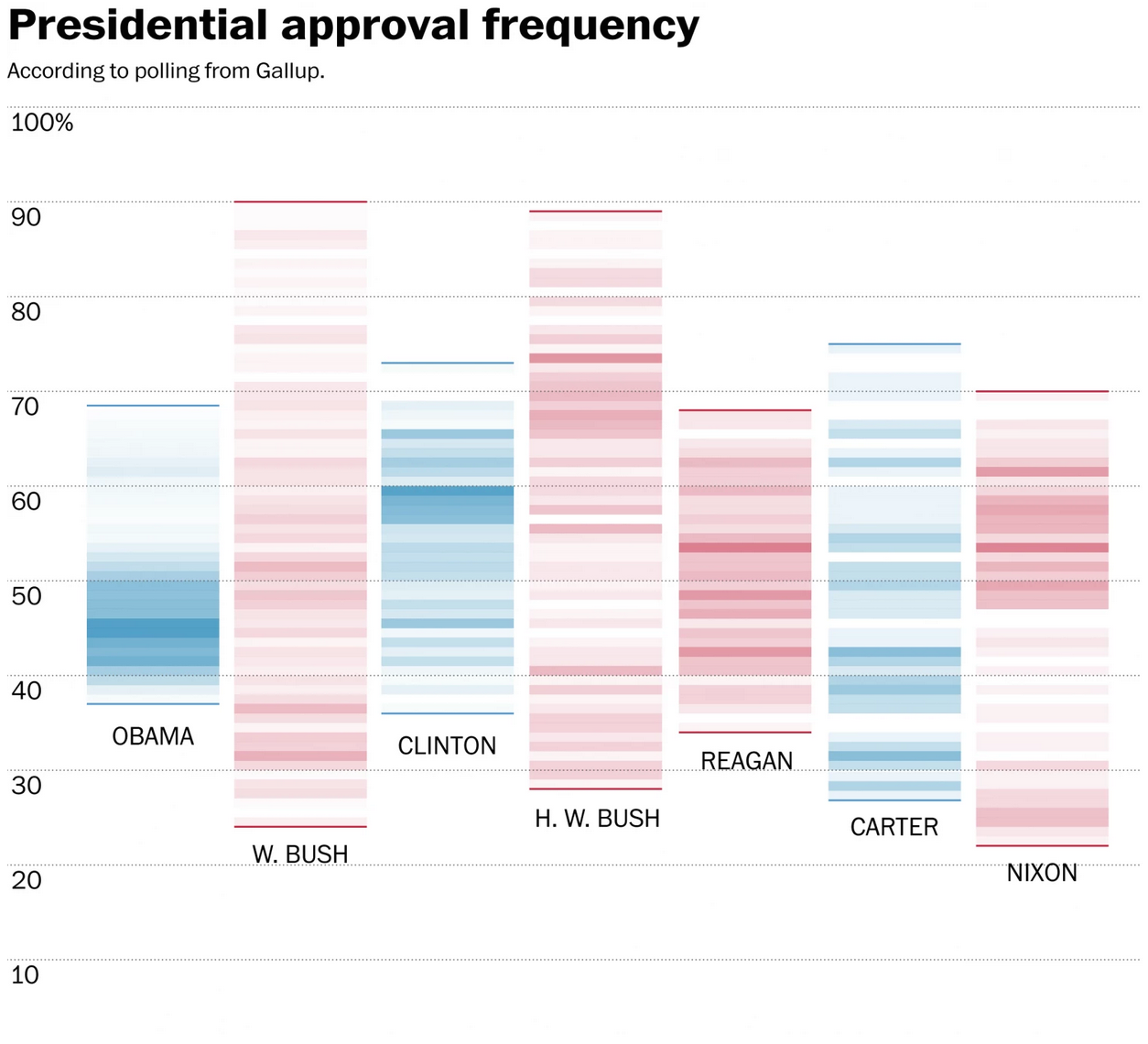
Meanwhile, Philip Bump notes that, “with the exception of a spike around the 2012 elections, President Obama’s approval rating has been unusually steady”:

If you look at the distribution of the most common approval ratings for presidents since Nixon (skipping Ford), you get a pattern that looks like this. The darker the bar, the more common that particular approval rating.

Approval

You’ll notice that the overall range of approvals for Obama has fallen in a fairly tight range — comparable to Presidents Reagan and Clinton. But that’s the total range. The most common approvals Obama has seen have been within a relatively narrow zone in the mid-40s.

He attributes this to consistent Republican disapproval:

By the end of his first year, Obama’s approval among Republicans had fallen to 16 percent; it’s rarely been above that since, settling into a general 7-15-point range. The fluctuations, then, have mostly been the result of Democrats embracing or ignoring the president — and independents getting more or less enthusiastic.

The 2014 Dish Award Winners!

More than five thousand readers have voted and the results are in. This year’s Malkin Award, given for noxious, divisive and hyperbolic commentary from the right, goes to Dinesh D’Souza offering his intemperate worst on the legacy of American slavery:

Did America owe something to the slaves whose labor had been stolen? I think so, but that debt is best discharged through memory, because the slaves are dead and their descendants are better off as a consequence of their ancestors being hauled from Africa to America.

And when it comes to the year’s best window views, this shot from Eilean Donan, Scotland took top honors:

2014’s Yglesias Award, given for criticizing one’s own side and thus risking something for the sake of saying what one believes, goes to Charles Krauthammer for his statement on the notorious rancher and conservative cause célèbre Cliven Bundy:

It isn’t enough to say I don’t agree with what he said. This is a despicable statement. It’s not the statement, you have to disassociate yourself entirely from the man. It’s not like the words exist here and the man exists here. And why conservatives, or some conservatives end up in bed with people who, you know, he makes an anti-government statement, he takes an anti-government stand, he wears a nice big hat and he rides a horse, and all of a sudden he is a champion of democracy …

Look, do I have the right to go in to graze sheep in Central Park? I think not. You have to have some respect for the federal government, some respect for our system. And to say you don’t and you don’t recognize it and that makes you a conservative hero, to me, is completely contradictory, and rather appalling. And he has now proved it.

Camels can graze wherever they want if they keep stealing selfies like 2014’s Face Of The Year:

For the first-ever Beard Of The Year competition, this magnificent piece of work won in a landslide:

IimgdL4

Meanwhile, Susan Elizabeth Shepard and Charlotte Shane have been crowned the year’s biggest poseurs for this pretentious mess:

69 confronts us with an unfortunate truth: it is a distinctly capitalistic, efficiency-emphasizing endeavor that erases the unique personhood of each participant by relying on a crude approximation of how human bodies fit together if human bodies are conceived of as identical, two-dimensional figures like the numbers of its name. … The position also echoes the service economy in its demand (mainly on women) of a convincing performance of pleasure. It’s not enough to simply be present and to competently do the job that’s asked of you by your lover, you must also appear to simultaneously enjoy said lover’s ministrations, regardless of the delicate balancing requiring to keep from suffocating him or breaking his nose. This is a form of emotional labor like that demanded from baristas, servers, and sex workers; not only do you have to do a good job, you have to like it.

Cattle weren’t the only ones to show up in support of 2014’s Mental Health Break Of The Year:

But a stoned Maureen Dowd might have considered that video a viral nightmare. She wins 2014’s top Hathos honors for her novel summary of what it was like to take too many edibles:

Then I felt a scary shudder go through my body and brain. I barely made it from the desk to the bed, where I lay curled up in a hallucinatory state for the next eight hours. I was thirsty but couldn’t move to get water. Or even turn off the lights. I was panting and paranoid, sure that when the room-service waiter knocked and I didn’t answer, he’d call the police and have me arrested for being unable to handle my candy. I strained to remember where I was or even what I was wearing, touching my green corduroy jeans and staring at the exposed-brick wall. As my paranoia deepened, I became convinced that I had died and no one was telling me. And then I wrote a column on Hillary.

According to the polls, more than 30% of you thought this powerful New Zealand PSA was the year’s Coolest Ad:

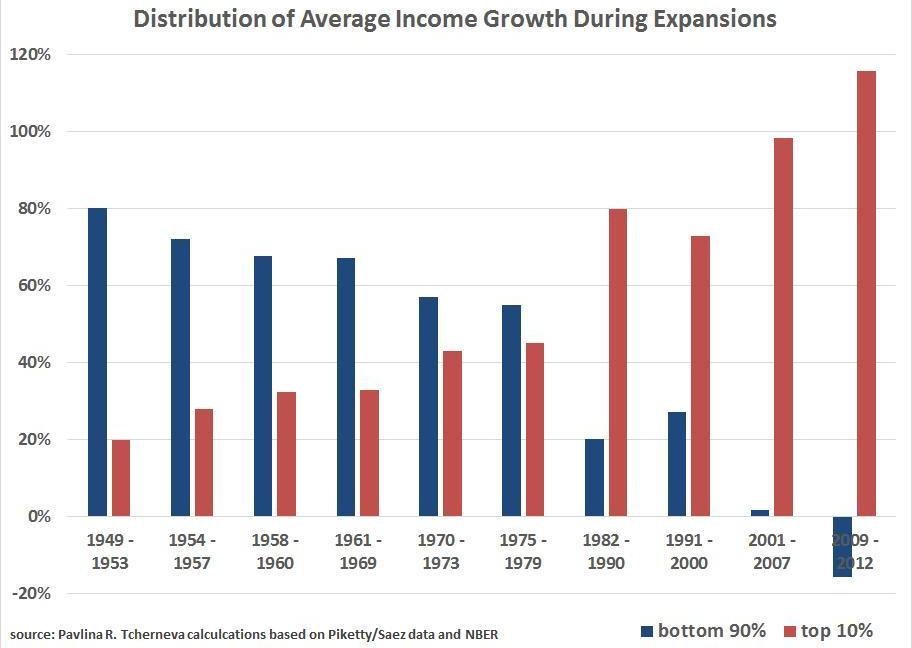
And Pavlina Tcherneva’s bar graph tracking America’s income growth disparity is the Chart Of The Year:

Finally, we also added maps to this year’s awards, and Dishheads chose Nik Freeman’s overview of where Americans don’t live as 2014’s best:

Thanks to everyone who took the time to channel their Dishness and vote. For our newer readers, you can find out more about how and why we nominate award candidates here. To recommend a new nominee, email us here.