Emails Of The Day

A handful of your photos especially warmed our hearts this Christmas:

unnamed (26)

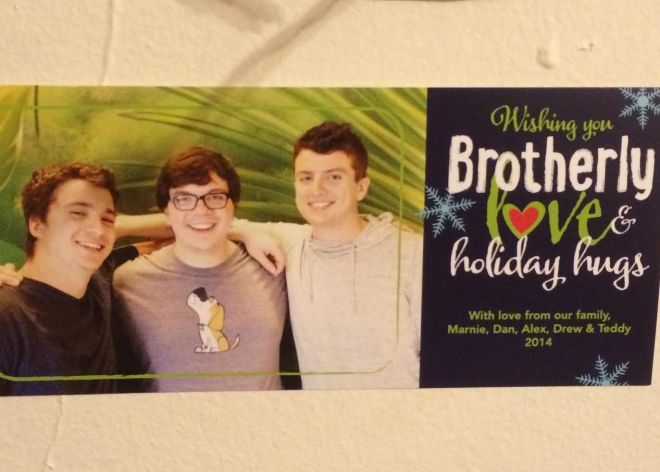
Hey Andrew and company! On a recent family vacation to Las Vegas, I brought along my Dish t-shirt. My mother, desperate for post-empty nest family photos, snapped pictures at every conceivable opportunity in the hopes of getting something for our family Christmas card. Lo and behold, the photo that made the cut featured yours truly donning the now-iconic howling beagle. Now dozens upon dozens of my parents’ friends will get some not-so-subtle Dish advertising beamed into their mailboxes this December; I hope I can help drive up the subscription numbers (I bought my dad a gift membership for starters)!
Another subscriber:

IMG_0684My soon-to-be-husband correctly picked up on my not-too-subtle hints, and gave me my very own Dish mug for an early Christmas present!  I am a thoroughly delighted Dish head, and enjoyed the inaugural cup o’ joe just this morning.

I’ve given Dish subscriptions as holiday gifts – selectively, to certain friends and family members – for several years now, often explaining that I certainly don’t agree with every opinion or perspective contained at the Dish, but that I always find it lively, engaging, and thought-provoking.

So I raise a cup of kindness and gratitude to you, Andrew and Team Dish. Here’s wishing you all health, happiness, and stamina for the year ahead.

P.S. Yes, that’s a fabulous, glittery rainbow flag ornament in the background on the tree!

And another:

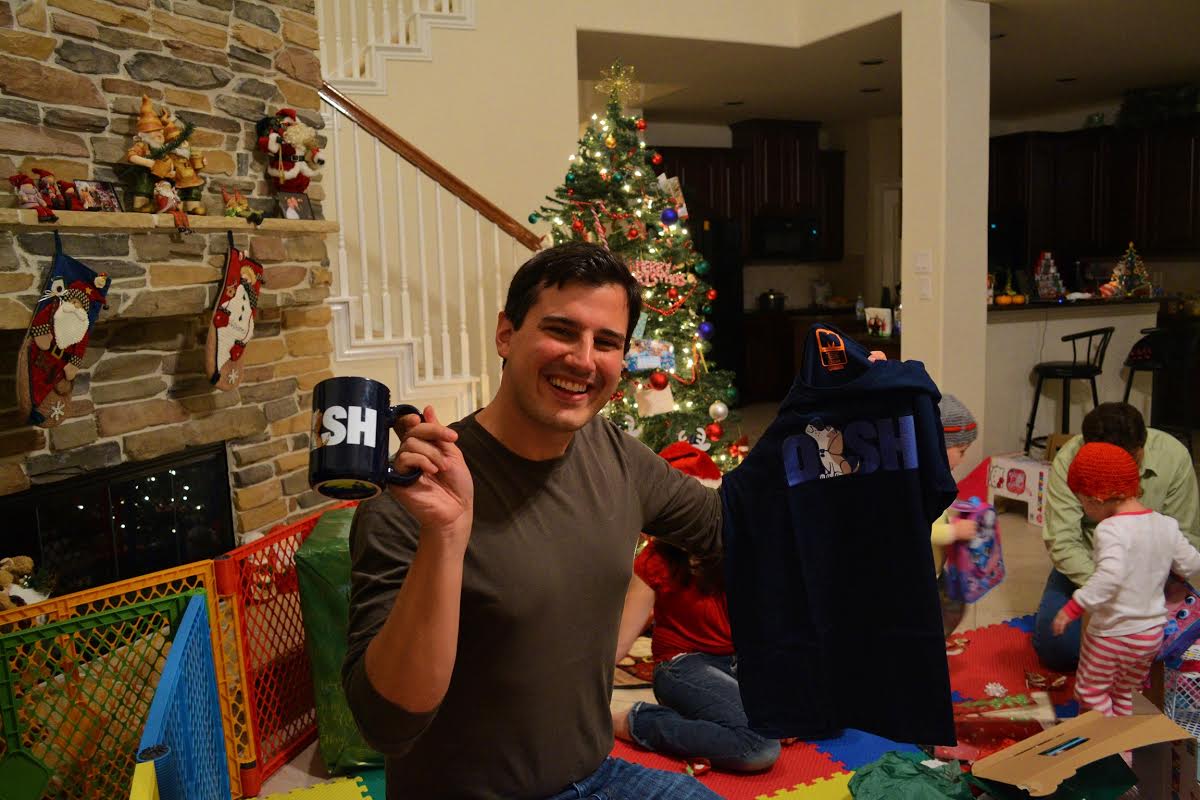
I’m sure you’ll be inundated with these on the 25th, but as a Hispanic celebrating Noche Buena, I have a one-day headstart to boast about my amazing wife’s gift-giving abilities. She knew just how to make this Dish-head happy this year, with a double whammy:

unnamed (27)

I love her. And I love you guys. Merry Christmas, and here’s to a very happy, Dish-filled New Year.
And speaking of 2015:

Has The Dish ever thought of doing some kind of gathering of Dishheads? It would be awesome to be able to chat with the whole team as well as with each other. Not sure exactly what the format would be, but it might a great way to further the Dish community, as well as provide some in-person recognition for you guys. Mainly, I suggest it for selfish reasons: I don’t know any other Dishheads, but would like to!

Events are very much on our agenda for the new year, so stay tuned. And thanks again for your support in 2014. We’ll have a year-end update soon.

A Story About Surviving The War On Christmas Decorations

Simon Doonan explains what happens when window dressing the White House turns into the country’s first découpage-centered political controversy:

[youtube https://www.youtube.com/watch?v=2ydctzEhDeI]

Doonan is the Creative Ambassador for Barney’s New York as well as a Slate columnist, fashion commentator and professional window dresser. His latest book is Asylum: A Collage of Couture Reminiscences…and Hysteria. Previously featured storytelling on the Dish here. Learn more about The Moth here.

The Menace Of Mistletoe

Helen Thompson characterizes the holiday plant as “basically a vampire,” calling it “a parasite that spends its days sucking the ‘lifeforce’ from trees round the globe”:

Mistletoe’s parasitism starts with poop and exploding berries. Mistletoe bushes clump on branches like something out of a Dr. Seuss book. Their parasitism is airborne. Birds eat their berries, which are coated in gluey material called viscin. The birds poop all over the forest, and thanks to the viscin, the mistletoe seeds in said poop stick to branches. Once firmly attached to the branch, mistletoe sprouts and drills down into the branch until it reaches the tree’s veins. It sticks a haustorium (basically a straw) in and sips the tree’s mineral and water cocktail.

Another group of mistletoes, dwarf mistletoes, does things a bit differently. In a dramatic twist on mistletoe reproduction, their seeds explode, literally. The blast zone can reach up to 15 feet. Seeds stick to saplings and wedge themselves into the tree’s innards, infecting the entire tree, and sprouting sometimes years later. These guys are full parasites, taking sugar, water, and minerals from the tree. “Dwarf mistletoe is freaky, freaky, freaky stuff,” says David Watson, an ecologist at Charles Sturt University in Australia. “Its [shoots] look like miniature asparagus.”

Eventually, the mistletoe bush grows, blooms, and forms berries, and the cycle begins anew.

For a more festive take on the plant, check out the below Broad City webisode, which follows Abbi’s pursuit of her first below-the-mistletoe kiss:

Why Christmas Songs Stir Us

Joseph Bottum, the critic and author, explains why he has taken to writing Christmas songs – they are “one of the last few enchantments left in our public world”:

Think of it this way: If meaning comes only from us — if meaning arrives only via the human outlook on the world — then there is nothing meaningful in itself. Oh, sure, we have great emotions and great hungers. That’s part of what we want art to express. But what outside ourselves is inherently worthy of having our great feelings attached to it? In a thin world, nothing is enchanted. Nothing is naturally weighty, meaningful, infused with power. Nothing is rich, thick, and alive with the kind of true beauty that art needs to survive beyond a few generations.

Throw in a few zombies, however, and you’ve got a world, for screenwriters and viewers, that thrums with all the deep meaning of the apocalypse and the end of days. Toss in some vampires, ghosts, and demons, and you have a world in which evil and good have palpable presence.

In other words, a hunger for a metaphysically rich, supernaturally thick, emotionally wrought world is written across our age. And Christmas still provides it to artist and audience.

(Video for the Bottom-penned “Some Come to See the Lord”)

Christmas Wishes From A Grinch

In his sci-fi series Black Mirror, the great Brit Charlie Brooker uses his mordant wit to send up technologically-dependent modern life. The series’ newest episode, White Christmas, is a holiday special critics are hailing as “about as festive as being bludgeoned to death by a stocking full of coal, but … also an unerringly brilliant piece of lo-fi sci-fi.” Louisa Mellor sums up the episode’s central conceit:

Taking Google Glass to its logical conclusion, the world of White Christmas is populated by augmented humans whose Z-Eye implants let them control and share what they see. It’s in this kind of technological advance – one that doesn’t seem far off in the realm of possibility but that has the potential to shatter human relationships – that Black Mirror specialises.

The episode features John Hamm as Matt, who makes a living off such advanced tech. Sam Wollaston thinks Brooker’s “dystopia isn’t outrageous, it’s plausible, and all the more terrifying for it. Less sci-fi, more like now after a couple of software updates”:

Matt’s day job … – working for Smartintelligence, a company that, accompanied by Rossini’s Thieving Magpie overture, extracts “code” from people under anaesthetic, stores it in a widget called a cookie before implanting it into a simulated body, which is what happens to Greta (Oona Chaplin) – well, that’s basically human cloning. There’s probably a company in South Korea that’s about five minutes away from doing that. There’s a company in South Korea that thinks it can clone a woolly mammoth from a piece of 40,000-year-old frozen mammoth meat; putting people’s code inside plastic eggs like this, before turning them into slaves, has got to be easier.

Yes slaves. Because this isn’t just about the technology, it’s about the issues – very real world ethical issues – surrounding the technology. It’s about slavery and morality and torture and separation and access to children as well as the technology, and what the technology does to us. It’s about people, which is its real beauty. Along with all the razor-sharp wit, the nods and the winks, it manages to be a very human story.

Willa Paskin also finds the episode eerily relevant:

In “White Christmas,” wearable tech has advanced beyond the rudimentary stages of Google glass and become Z-eyes, irremovable implants that let you take pictures and record things and, if you must, “block” other people. As used in “White Christmas,” blocking makes the person who is blocked and the person who has done the blocking look like grey, fuzzy outlines to one another. They can’t hear each other or communicate, and the blocked party has no recourse.

The terminology suggests a lineage with blocking someone on Facebook or Twitter.  But here in 2014 we tend to understand blocking as essentially protective: It insulates people from unwanted attention and (often misogynistic) threats—though of course it also keep ex-friends and other irritants out of your feed. While Black Mirror understands the protective quality of blocking—the episode expressly deals with some messy, vile misogyny—it is more concerned with the ways blocking can be abused. In “White Christmas,” blocking is largely something women do to men in lieu of communicating with them. It’s the technological equivalent of sticking one’s fingers in one’s ears, an all-powerful silent treatment that can, sometimes, take on draconian legal backing.

If that sounds a bit wrong-headed, “White Christmas,” like the most disturbing episode of Black Mirror that exists, the similarly titled “White Bear,” asks questions about what we are willing to do to the least worthy amongst us: the convicted, the guilty, the criminal. When technology makes it easy to ignore, ostracize, manipulate, and torture the worst of us, might not the rest of us comply?

Merry Christmas.

The Christmas special is currently only available outside the UK on Direct-TV, but other would-be viewers can stream the previous two seasons on Netflix. The show, as Emily Yoshida explained last year in a spoiler-free guide, is best watched without much foreknowledge.


The Dark Side Of Christmas

dish_bridgetxmas

Lisa Miller analyzes why “Bridget’s” self-loathing Christmas cards are such a social media hit:

Bridget’s cards won their internet moment not just because they’re clever and funny, but because they articulate that thought and the way it can become so explosive during the holidays: All this jollity rings false to me. Everyone, no matter what their relationship status, feels a little like Bridget this time of year — outcast, exiled, discontent; her cards capture a sentiment heartfelt enough to catch the attention of millions of newsfeed browsers but also noncontroversial enough to bypass the conformity threshold. Hark! Bridget has tapped our inner misfit, which emerges in a guffaw like a genie from a bottle. Isn’t that a gas?

Meanwhile, Sarah Condon ponders yuletide misery from a theological point of view:

Whether or not we realize it, we pointedly deny the harsh realities of our lives this time of year. I know I do. The moment we remember Jesus coming into the world is the same moment we hold up our perfectly posed Christmas photos. To the one who came to save us we say, “See how good we look? We are totally pulling this off.”

Only, we are not pulling it off, not even remotely. We are disappointed in our children, our spouses, the world, and ourselves. We deny our feelings of loneliness and inadequacy. We scurry to hide them. And the season provides some pretty amazing crutches for our denial: Jim Beam, party mix, and online shopping. All of a sudden, it becomes easy to make failure look like success. To make heartache look like mildly hungover.

Isn’t it odd that, more than any other time of year, Christmastime is when we want everyone to know just how glorious our lives are? I’m already bracing myself for the post-Christmas newsfeed. We can all gather round the old iPhone and sing a hymn of Sanctification by Gift Giving. For the record #besthusbandever #fairtrade and #santarocks are my own self-righteous picks for the season.

But it doesn’t have to be this way. We are actually allowed to admit that we are screwed up, yes, even at Christmas. Let the record show, St. Paul already gave us the bones in Romans 7: I do not understand what I do. For what I want to do I do not do, but what I hate I do.

The 2014 Dish Awards!

Calling all Dishheads: it’s the end of the year and that means it’s Dish award time! As usual, our elite, highly-specialized blue-ribbon panel has pored over more than a thousand posts in order to select this year’s finalists, now it’s up to you to pick 2014’s best (and worst).

If you have some free time today, click the links below and vote for the 2014 Malkin AwardHathos AlertPoseur Alert, and Yglesias Award. Polls are also open for the year’s best Chart, Mental Health Break and View From Your Window, as well as the 2014’s Coolest Ad, Face Of The Year, and for the first time ever, Map Of The Year and Beard Of The Year!

Our polls will close on Wednesday, December 31, at midnight. Winners will be announced soon after. Have at it:

Please note: due to there not being enough nominees this year, we will not be issuing a 2014 Hewitt Award, Moore Award, or Dick Morris Award. Learn more about all our awards here.

A Poem For Christmas

5944632130_1ce8d26f26_b

“Christmas Card to Grace Hartigan” by Frank O’Hara (1926-1966):

There’s no holly, but there is
the glass and granite towers
and the white stone lions
and the pale violet clouds. And
the great tree of balls in
Rockefeller Plaza is public.

Christmas is green and general
like all great works of the
imagination, swelling from minute
private sentiments in the desert,
a wreath around our intimacy
like children’s voices in a park.

For red there is our blood
which, like your smile, must be
protected from spilling into
generality by secret meanings,
the lipstick of life hidden
in a handbag against violations.

Christmas is the time of cold air
and loud parties and big expense,
but in our hearts flames flicker
answeringly, as on old-fashioned
trees. I would rather the house
burn down than our flames go out.

Please consider supporting the work of the Poetry Society of America here.

(From the Collected Poems of Frank O’Hara © by the University of California Press. Reprinted by permission of the University of California Press. Also reprinted in Christmas Poems © New Directions Publishing Corp. Photo by Flickr user Dominick)

If Only Mangers Were Mangier

341887154_726332a318_z

Joe Kay wishes holiday crèches weren’t so idealized:

If our manger scenes were realistic, Mary would be recovering from a painful labor full of sweat and blood, with a look on her face that’s anything but serene. And Joseph — wouldn’t he be a nervous wreck, too? His hand too shaky to hold a lantern? And about that newborn. Shouldn’t he be red-faced and screaming? Eyes clenched closed and wisps of hair stuck to the top of a head that‘s still odd-shaped from all the squeezing? Instead, we’ve sanitized and romanticized it. We’ve removed all the blood and sweat and tears and pain and goo. It’s no longer something real. We’ve left out all the messy parts. The oh-my-God-what-now parts. The I’m-screaming-as-loud-as-I-can-because-it-really-hurts parts. The oh-no-I’ve-stepped-in-the-animal-droppings parts. The real parts. …

It’s not about a calm-faced mother and a lantern-toting dad with a perfect baby stretching out its arms to the world. It’s about us as we really are. Bleeding and screaming. Covered in goo and disgrace. Aware of our many failings and falling-short moments. Coming apart. Barely holding it together. Unable to explain why we make such bad choices so many times. So, here’s an idea. Let’s replace those plastic manger scene figurers with something more real.

(Photo by Oscar Llerena)