Corrections Of The Year

Craig Silverman votes for this doozy from the NYT:

An earlier version of this column was published in error. That version included what purported to be an interview that Kanye West gave to a Chicago radio station in which he compared his own derrière to that of his wife, Kim Kardashian. Mr. West’s quotes were taken, without attribution, from the satirical website The Daily Currant. There is no radio station WGYN in Chicago; the interview was fictitious, and should not have been included in the column.

Another favorite of his, from Slate:

This post originally quoted photographer Tom Sanders as saying it takes him five years to get on the dance floor. It takes him five beers.

Read all of Silverman’s list here. The Dish’s own picks throughout the year here. One of them would make Santorum smile, if he had a sense of humor:

To the Editor:

I was grateful to see my book “This Is the Story of a Happy Marriage” mentioned in Paperback Row (Oct. 19). When highlighting a few of the essays in the collection, the review mentions topics ranging from “her stabilizing second marriage to her beloved dog” without benefit of comma, thus giving the impression that Sparky and I are hitched. While my love for my dog is deep, he married a dog named Maggie at Parnassus Books last summer as part of a successful fund-raiser for the Nashville Humane Association. I am married to Karl VanDevender. We are all very happy in our respective unions.

ANN PATCHETT
NASHVILLE

That one was from the NYT. Another from the Guardian:

Dish Awards: Last Chance To Vote!

Here on the final day of voting, the tightest race is for 2014’s best Mental Health Break. Currently in the top slot, with 18.26% of the vote, is this concert for cows:

But 15.35% of Dishheads think this montage deserves the prize:

Which improved your mental health the most and thus deserves this year’s crown? Let us know here. In addition, today is your last chance to cast votes for the 2014 Malkin Award, Hathos Alert, Poseur Alert, and Yglesias Award. You can also help pick the year’s best Chart and View From Your Window, as well as the 2014’s Coolest Ad, Face Of The YearMap Of The Year and Beard Of The Year! Our polls will close tonight at midnight, so have at it:

Please note: due to there not being enough nominees this year, we will not be issuing a 2014 Hewitt Award, Moore Award, or Dick Morris Award. Learn more about all our awards here.

Piketty’s Payoff

Jordan Weissmann argues that whether the famed economist is ultimately right or wrong, he’s had a fundamental influence on how his field thinks about inequality:

Predictably, economists are split on the merits of Capital’s big idea—though the breakdown doesn’t fall neatly along liberal and conservative lines. Heavyweights like Krugman and Robert Solow, both Nobel Prize winners, have been supportive while others, including right-leaning figures like Cowen and left-of-center thinkers like former Harvard president, Treasury secretary, and Obama adviser Larry Summers, have been critical. When I asked Justin Wolfers, a plugged-in senior fellow at the Peterson Institute for International Economics, for an assessment, he told me that while Capital had unquestionably forced economists to grapple with inequality in new ways, Piketty’s theoretical framework hadn’t made much of an impact in the field. …

Yet in December, highly respected Stanford University professor Chad Jones released an entire working paper exploring how r>g relates to concepts in macroeconomics.

The field may not be going wild for the theory, as Wolfers suggests, but at least some researchers are engaging it outside the world of econ blogs. And in the end, it doesn’t matter if the academy gives Capital a gold star. What matters is that even its detractors are now considering wealth in a way economists haven’t in years—as more than income that’s been stowed away in a bank or brokerage account, as something that may have the power to shape the economy itself.

Clive Crook is less thrilled by the Frenchman’s big splash:

Even critics of “Capital” … are generous in praising Piketty for his industry and especially his ambition. Attention, social scientists. Don’t worry about being wrong, just be wrong in a big way. Be wrong because you over-reach. Be wrong the way Marx was wrong (but maybe hope for less collateral damage). Above all, admirers and critics alike pay tribute to “Capital” for drawing attention to inequality. I hadn’t noticed that it was lacking attention to begin with. The American left pays attention to little else. It was really the reverse: The obsession with inequality demanded, so to speak, an academic testament, and that’s what “Capital” provided. Piketty’s economics leaves a lot to be desired, but his timing was fantastic.

The Economist is perplexing a lot of people by putting Piketty at only #13 in its list of the world’s 25 most influential economists – and not one woman. The most glaring omission on that front is Fed Chair Janet Yellen, says Ben Casselman:

Now, there are lots of ways to gauge influence. Yellen’s academic work, for example, is respected but not groundbreaking. But The Economist’s rankings explicitly aim to track “clout outside the ivory tower,” as measured by media attention. How, by that measure, could Yellen not come out near, if not at, the top?

The answer: The Economist excluded “serving central bank governors.” That leads to some strange results, since the list includes not only former governors but also the presidents of the various regional Fed banks. There aren’t many contexts in which Philadelphia Fed President Charles Plosser is more influential than Yellen.

Still, one could argue that Yellen isn’t so much influential as flat-out powerful. So fine, leave her off the list. The rankings are still deeply strange. The top scorer, for example, is health care economist Jonathan Gruber, whose prominence in the media in recent months has been due almost entirely to the emergence of a video in which he said President Obama’s signature health care law passed in part due to the “stupidity of the American voter.” That isn’t influence — that’s a gaffe. Or take No. 25, San Francisco Fed President John Williams, an undeniably important economist but one who apparently scored higher because The Economist’s algorithm mixed him up with a discredited conspiracy theorist who happens to share his name.

Tyler Cowen made his own list and put Piketty at the top, adding:

e. There is no right-wing or center-right economist on the list.  See the EJW symposium on why there is no Milton Friedman today.  Krugman is probably the most politically conservative figure among the top five.

f. Behavioral economics as a whole is quite influential, but with no single dominant figure of influence.  In actuality Cass Sunstein (not formally an economist) and Richard Thaler might globally be #1 in the behavioral area, followed by Daniel Kahneman.

If You Legalize It, They Will Toke

CO WA Pot Use

Pot use in Colorado and Washington has gone up:

The increase appeared to occur almost entirely among adults. Among adolescents aged 12 to 17, past-month marijuana use went from 10.5 percent to 11.2 percent in Colorado and 9.5 percent to 9.8 percent in Washington state — neither of which are statistically significant increases. But among adults 18 and older, use increased from 10.4 percent to 12.9 percent in Colorado and 10.3 percent to 12.5 percent in Washington state — both statistically significant.

Christopher Ingraham notes that, “since these numbers only go through 2013, they only reflect the period when Washington and Colorado had legalized the possession of weed, but had not yet set up their fully taxed and regulated marijuana markets”:

Overall, I’d expect to see a continued rise in adult use in states that legalize weed. A big part of this will probably be the novelty factor: people who were previously discouraged from using marijuana due to its legal status may be tempted to give it a whirl when they can simply walk down the street and buy some at the store.

But weed isn’t for everyone (see: Dowd, Maureen). It’s reasonable to expect that many, if not most, new users may simply try it once or twice and decide it’s not their thing. This seems to be what happened in Portugal, which decriminalized all drugs in 2000: use rates rose in the year or two after decriminalization, but have fallen since then. Marijuana legalization experiments in the U.S. may very well yield similar results.

Sullum also isn’t alarmed by the numbers:

By itself, rising cannabis consumption should count as a benefit of legalization, since it indicates an increase in consumer satisfaction. There may be costs as well, but at this point their nature and magnitude are not clear.

The impact of legalization on car accidents, for instance, will require years to assess. Since alcohol has a more dramatic effect on driving ability than marijuana does, legalization could reduce traffic fatalities if more pot smoking is accompanied by less drinking. So far that sort of substitution has not happened in Colorado, where past-month alcohol consumption rose slightly between 2011-12 and 2012-13, although the change was not statistically significant. Washington, by contrast, saw a statistically significant drop in past-month alcohol use.

Did North Koreans Even Hack Sony In The First Place?

Maybe not. At the very least, they probably didn’t do it alone:

According to an anonymous government source, Reuters report​s, the FBI is now considering the possibility that North Korea contracted the job out to foreign hackers. The source told Reuters that North Korea “lacks the ability” to pull off such an extensive cyber attack. Norse, Inc., a cybersecurity firm based in California, claims to have un​covered evidence that links the hack not to North Korea, but to an ex-employee laid off this year among thous​ands of other Sony workers.

Sam Biddle talks to Kurt Stammberger, the Norse exec whose team identified the “Guardians of Peace” hackers as including several ex-Sony employees:

Stammberger and his team shared their raw data with the FBI yesterday, and agreed to not show his evidence elsewhere, so the theory as he described it to me is still sketchy. But it hinges on an ex-Sony employee that Stammberger calls “Lena.”


“Lena” was an employee of ten years at Sony in Los Angeles, working in a “key technical” position at the company, and axed during the company’s brutal layoffs this past May. Even if she’d departed the company months before the attack, she would have remained “very well placed to know which servers to target,” and “where all the sensitive information in Sony was stored.” … What drew this group together, Stammberger says, is a mutual hatred of Sony: “These were individuals that were connected with torrenting Sony movies and content online, were targeted by legal and law enforcement arms, and were irritated that basically they were caught.”

The experts at Norse aren’t the first to question the FBI’s assertion that Pyongyang did the hacking:

Brian Martin of Risk Based Security, for example, told Motherboard that the malware used in the attack communicating with North Korean IP addresses likely indicates nothing more than the hackers cleverly routing their attack through North Korean proxies. Marc W. Rogers, principal security researcher for CloudFlare, told us that the malware used in the attack—which the FBI claims is similar to previous attacks that have been linked to North Korea—was likely shared among many hackers and built using code from previous malware.

And security expert Bruce Schneier has called the evidence “circumstantial at best”. But the FBI is sticking to its story for the time being. Meanwhile, the hackers are now threatening an unnamed American news organization:

Referring to Sony only as “USPER1”and the news organization as “USPER2,” the Joint Intelligence Bulletin, dated Dec. 24 and marked For Official Use Only, states that its purpose is “to provide information on the late-November 2014 cyber intrusion targeting USPER1 and related threats concerning the planned release of the movie, ‘The Interview.’ Additionally, these threats have extended to USPER2 —a news media organization—and may extend to other such organizations in the near future.”

The bulletin doesn’t identify “USPER2”, but Matthew Keys ventures a guess:

The Desk is identifying the news organization as CNN based on copies of messages posted to Pastebin on December 20. The messages have since been removed from Pastebin. In one message, the group mockingly praised CNN for its “investigation” into the attack on Sony’s computer network and offered a “gift” in the form of a YouTube video titled “You are an idiot.” The message closed with a demand that CNN “give us the Wolf,” a likely reference to CNN news anchor Wolf Blitzer.

Putin Takes A Hostage

Yesterday, a Russian judge pulled a stunt straight out of Game of Thrones, handing prominent Kremlin critic Alexei Navalny a suspended sentence on politically motivated charges of fraud but sentencing his younger brother Oleg – a politically inactive postal worker – to three and a half years in a penal colony in Alexei’s stead:

Both men were found guilty of stealing 30m roubles (about £334,000 under the current exchange rate) from the French cosmetics company Yves Rocher. Asked by the judge, Yelena Korobchenko, if the rulings against them were clear, Alexei replied: “Nothing is clear. Why are you imprisoning my brother? By this you punish me even harder.” … “Of all the possible types of sentence, this is the meanest,” said Alexei Navalny outside court after his brother was taken away. “The government isn’t just trying to jail its political opponents – we’re used to it, we’re aware that they’re doing it – but this time they’re destroying and torturing the families of the people who oppose them,” he said.

Max Fisher explains what Putin’s playing at here:

Putin’s calculus in holding Oleg Navalny hostage is as transparent as it is ruthless. He wants to crush Alexei Navalny, whom he sees as representing one of the last substantial, internal political threats to his rule. And he wants to do it with cruel, brute force. But he does not want to make Alexei Navalny into a martyr by giving him jail time or worse.

Putin’s solution is to release Alexei from prison — he was also convicted today, but his sentence suspended, freeing him on house arrest after a year and a half in prison awaiting trial — but then punish Alexei by locking up his innocent brother. Think about that for a moment: Alexei Navalny’s only real crimes are organizing anti-Putin protests and running for Moscow mayor on an anti-Putin platform. Putin punished him with a year and a half in jail and now by locking up his innocent brother to intimidate him into silence. The punishment is also designed to send a signal to the Russian opposition more broadly: this is what happens. You are putting your closest family members at risk by speaking out, so shut up.

And as Katie Zavadski observes, the elder Navalny’s suspended sentence serves a political purpose as well:

While the suspended sentence may seem like Navalny was getting off with a slap on the wrist for standing up to Putin, in reality, the felony conviction means he’s barred from running for public office for a decade after he’s done serving his term — thus, essentially eliminating one of the main viable opposition candidates. He won 27 percent of the vote in Moscow’s 2013 mayoral election, coming in second.

So who is this Navalny and why is he such a big deal? Well, says Keating, he sort of defies description:

Navalny describes himself as a nationalist democrat, and his ideology can be a bit difficult to place, beyond being anti-Putin. Though he has earned comparisons in the international media to figures ranging from Julian Assange to Nelson Mandela, there’s a bit of Pat Buchanan mixed in there as well. Navalny has called for Russia’s liberal opposition to unite with far-left and far-right groups who share an antipathy to Putin but have very different ideas about who or what should replace him. He has unapologetically appeared at rallies with ultranationalist, xenophobic groups. He was expelled from Russia’s largest liberal party, Yabloko, over his nationalist ties in 2007. Fellow members of the opposition have also accused him of intolerance to criticism and compared his occasionally hectoring, macho tone to that of Putin himself.

But the fact that Navalny is difficult to pigeonhole is probably a large part of his appeal: He’s a street activist and a savvy political campaigner at the same time and is just as comfortable talking to Russian nationalists as with readers of the New York Times.

And Amanda Taub voxplains why his activism makes Putin nervous:

Navalny has smartly focused his activism on the mechanics of politics and governance, which are unifying issues, rather than the specifics of issue-based politics, which are potentially divisive. (Especially so in his case, as Navalny’s actual politics appear to be disturbingly ethno-nationalist and on the rightward end of the economic spectrum.)

Da!, his youth movement, organized active political debates at a time when genuine opposition was missing from state-controlled media. His anti-corruption campaign is a savvy platform from which to undermine the legitimacy of Putin’s government, because its core demand is that politicians and their cronies should follow existing law, rather than a demand that the law should be changed or updated. And his broader political message is that inclusion is a defense against tyranny because “they cannot arrest us all.”

Several thousand Muscovites turned out to protest the verdict, and Navalny briefly violated his house arrest to join them before being arrested and sent home under guard. Bershidsky doubts Putin will lose any sleep over the demonstration but wonders how long he can keep behaving this way without paying a price:

Despite Navalny’s bravery, today’s protest was not big enough to make the Kremlin truly worried. Police were in full control, detaining 117 people. Putin will probably crack a smile when he hears his aides’ report of the tiny rally. He will see his chosen tactic as successful, and he seems intent on keeping Navalny out of jail despite his escapade today. Why make him a martyr if a few thousand active supporters are all he can muster? And, once emotions cool off, won’t he have to think about his brother?

Inside his feudal kingdom, Putin’s is waging the same kind of hybrid war as in Ukraine: a combination of psychological pressure, old-fashioned brute force and information trickery. So far, his enemies are much weaker, but continuing economic problems may mean someday — although likely not soon — Putin will meet his match, and the opposition, remembering all his dirty tricks, will take no pity on him.

Previous Dish on the Navalny saga here.

ISIS: Once You’re In, You’re In

ISIS has executed around 2,000 people since June, according to the Syrian Observatory for Human Rights, including “116 foreign fighters for trying to flee to their home countries” and four others for “violations of the extremist group’s code”. Adam Taylor finds it remarkable that ISIS has been killing its own and points to the group’s dwindling power:

SOHR’s report seems to be further evidence that although some foreign fighters are no doubt fearsome, others are quite clearly not. In fact, a few may be quite some way from fearsome:

In November, the French newspaper Le Figaro carried an account of French Islamic State fighters complaining to their family back home about their broken iPods and the cold winter. Even hardier fighters may have had second thoughts as the Islamic State, facing U.S. airstrikes, began to lose its momentum late in the year. …

The Islamic State, which has built much of its reputation on the fierce loyalty of its fighters, would no doubt be aware of how damaging returning fighters could be, both in terms of publicity and because they could be of value to international intelligence agencies. According to a report from the Financial Times, the Islamic State recently formed a military police unit to crack down on fighters not reporting for duty. Executing fighters attempting to flee also would send a powerful message to other fighters having second thoughts.

In an interesting parallel, the Assad regime is having trouble filling the ranks of its own army and has resorted to stringent – though not quite as stringent – measures to stop desertions:

In recent weeks, the regime … began upping threats to dismiss and fine state employees who fail to fulfill military obligations, according to Syrian news Web sites and activists. In addition, they say, new restrictions imposed this fall have made it all but impossible for men in their 20s to leave the country.

Since the start of the uprising in 2011, Syrian authorities have used arrests and intimidation to halt desertions, defections and evasion of military service — but not to the extent seen recently, Syrians and analysts say. Men who are dragooned into the army appear to be deserting in larger numbers, they say, and the government’s crackdown is driving many of these men as well as more of the large number of draft-evaders to go into hiding or flee abroad.

Furthermore, the shortfall in pro-regime troops may also be due to the departure of foreign militiamen from Iraq, Afghanistan, and the Lebanese Hezbollah, who moved on to Iraq this summer to fight ISIS. So all in all, it sounds like going off to war in Syria is a pretty dismal experience whichever side you’re on.

Would You Report Your Rape? Ctd

Another reader recounts a horrifying experience:

I’ve been following this thread closely.  Thank you, as always, for providing a forum for these kinds of conversations.  I’m grateful.

I’m an over-educated, professional, heterosexual male, single, no kids.  I’m also a recovering sex addict.  Several years ago I was to meet a woman whom I had met online at a party at a sex club, a club where she said she was a member.  I had never been to one of these kinds of parties before.  I was still very active in my addiction at the time, and I had not yet found my way to meetings or rehab or therapy or honesty.

She did not show up.  I stayed at the party anyway.  It was a pretty amazing environment at the time, given my current state of mind.  At some point during the evening (the details are still a bit sketchy), I was drugged.

It was a drink someone gave me, or mine was spiked – I don’t know. I woke up several hours later, alone in a room, bleeding, naked, battered, very high.  I had no active memory of what had happened to me, but I wasn’t stupid either.  I quickly gathered my things, put myself together as best I could and stumbled out.  My driver’s license, debit cards, credit cards and cash were gone.  I was barely coherent, barely conscious, barely able to move or walk. I did not know how I got out of there; I did not know how I got home. And I was in an incredible amount of pain.

On some level I knew what had happened to me, but my mind very quickly and very effectively buried and burned any memory away.  Three or four days later, I went on vacation with my girlfriend overseas for two weeks.  She did not know about my “other life.”  I told no one, and two days later I did not remember why I had bruises on my body and face – seriously.  I still didn’t know where my wallet had gone.  I had no conscious explanation, so I chalked it up to maybe I had been in a bar fight.

It took several years, two months of inpatient rehab, 30 months of Sex Addicts Anonymous meetings and 12-step work, and two years of incredibly intense therapy for the memories to begin to return.  I had been gang raped by at least three people that I can remember that night.  The memories came in bits and pieces for a day or two, and then everything, all at once, while I was driving across a bridge.  I almost wrecked my car, and then I almost parked it and jumped.

When “it” all came back, I cannot begin to express the level of shame I felt, the level to which I blamed myself.  I believed that because of how I had been living my life at the time I deserved what had happened to me – I believed that to my core.

And the next day I went to work.  I was in my office, socializing with my co-workers, again hiding my real daily experience from those around me, although this version was much different than what I had believed to be the exciting double-life I had been living before – as a sex addict, screwing everything in sight.

I have since told four people what happened to me, about my gang rape – my sponsor, my therapist, a sibling, and one close friend.  It is still almost impossible for me to even type those words and own them.  I have never spoken of it again until writing this email.  I did not “report” it … what would that have even meant for me?  Call the cops?  What would that phone call have sounded like?  HOW would I have even reported anything?  I could not even begin to wrap my head around that concept.

It was an experience that, on a very deep subconscious level, drove me deeper and deeper into my sex addition.  I was left suicidal for a very long time and kept heading full speed for rock bottom until I lost everything of any value in my life.  Only then did I somehow find my way to a residential, inpatient treatment center out of state.  I still don’t entirely understand exactly how that came to pass, but it is the only reason I am alive today.

Obviously the name on the email account is fake – the account is a burner account – but I would still like to remain as anonymous as possible.  Part of me fears that I have already given away too much detail in this email, that someone will find out its me.  No one (apart from those mentioned) in my life has any idea of what I’ve been through, what I experienced.  I still struggle with reconciling this experience in my life with being a heterosexual male, dealing with all of the fallout and aftermath, in the context of our society and culture, in the context of my “identity”.  It’s challenging everyday, but the ones I have shared this with have been (to me) surprisingly supportive and understanding, never failing in telling me that it was not something I deserved to have happen to me.

The Best Of The Best

Best Of 2014

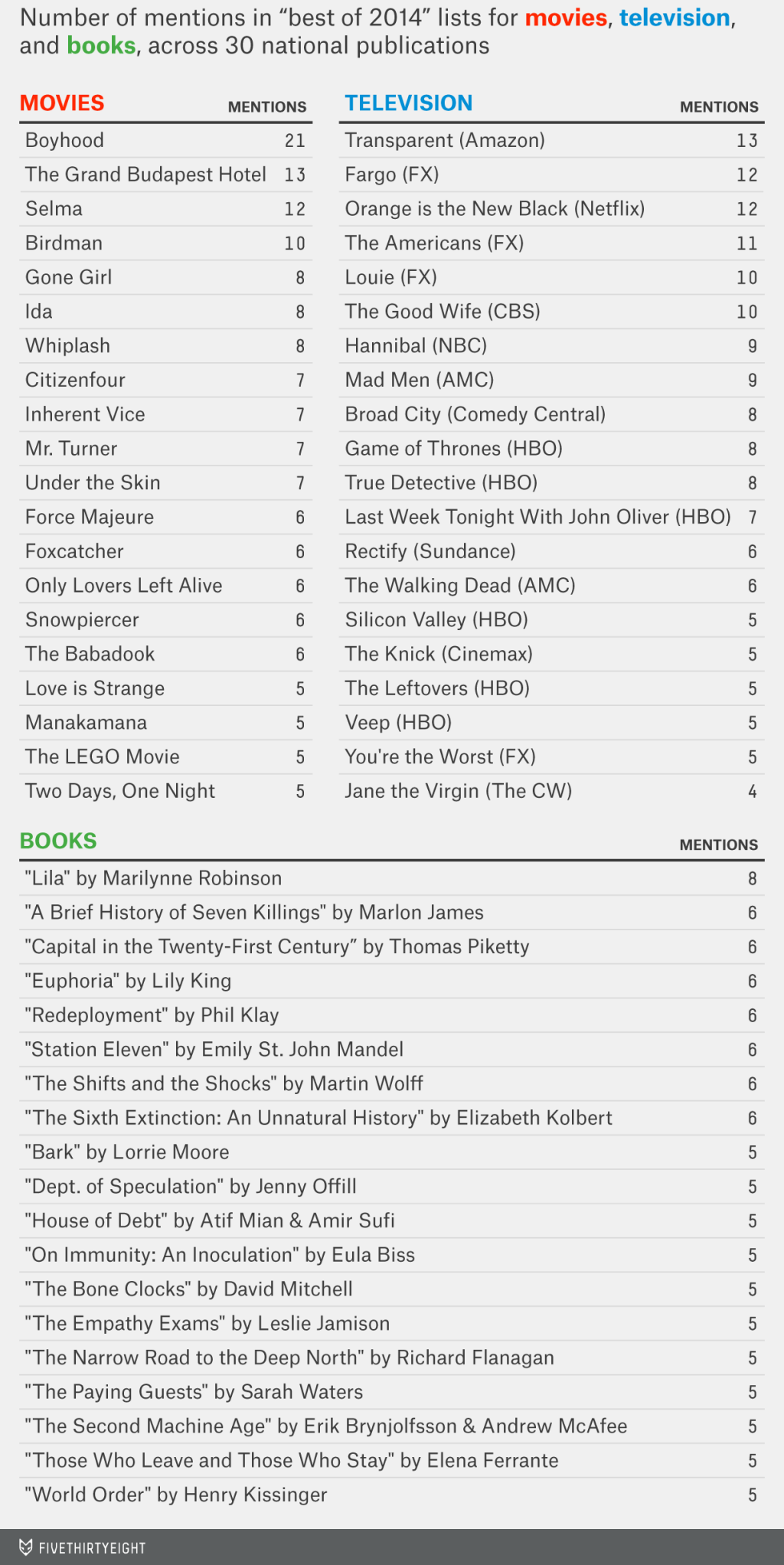
Hayley Munguia analyzes “best of 2014” lists:

As far as the most frequent selections are concerned, the lists of best books were the least uniform, whereas every movie critic in my sample agreed that “Boyhood” deserved to be listed among the year’s best films. TV shows had the lowest percentage of titles that appeared on only one list.

That’s largely because there are so many books:

According to the bibliographic information publisher Bowker, there were 1.4 million books published in the U.S. last year, whereas the Motion Picture Association of America‘s data shows that only 659 films were released. Numbers on TV shows in production are harder to come by, but Showtime’s president of entertainment, David Nevins, has estimated that there are currently about 350 scripted original shows in production. By those numbers, it seems like book critics are actually a lot more unified than they should be.

Beard Of The Week

beard-tug

The back-story:

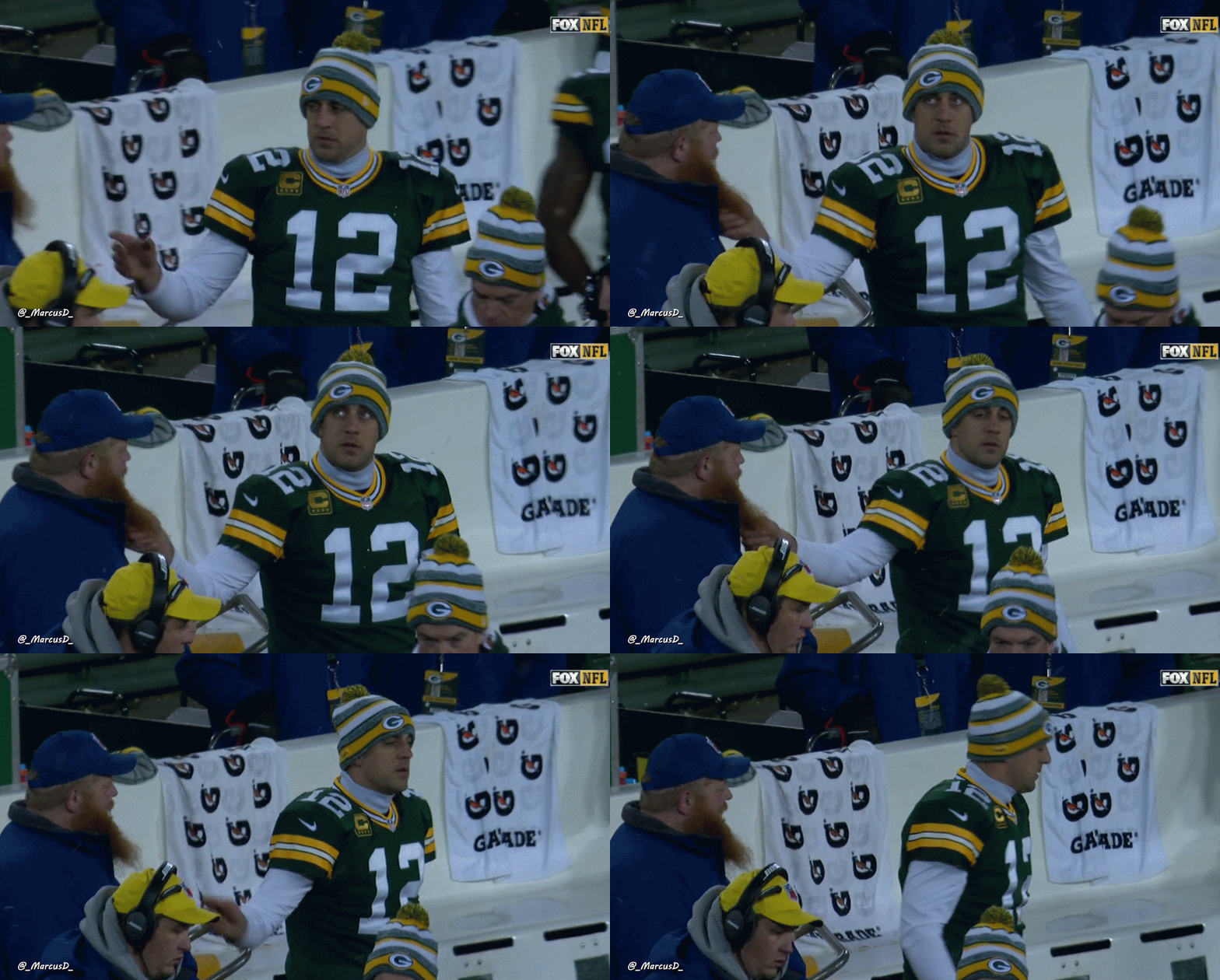
That bearded guy who’s apparently [Green Bay QB] Aaron Rodgers’ good-luck charm? He’s Wausau’s Jeremy Wilcox.

Wilcox, whose company is a Lambeau Field contractor for the Green Bay Packers, caused a social media stir when FOX Sports TV cameras caught Rodgers tugging the man’s beard right before he re-entered Sunday’s game against the Detroit Lions. Rodgers injured his left calf right before the half and sat out two series before returning in the third quarter to lead the Packers to a 30-20 victory that secured a first-round playoff bye and a home game. … [F]ans are joking that Wilcox’s beard was pivotal in the Packers big win.

No joke. James Dator counts the ways:

There are three good reasons pulling this beard is important to Aaron Rodgers.

– It’s a beard that brings him luck.

– He’s wistfully remembering his own beard.

– The beard’s essential oils soften his throwing hand in preparation for the Packers next drive.

Previous BOTWs here. Update from a reader:

You missed the best part of the beard story: “It’s red and 9 inches long, and #Packers quarterback Aaron Rodgers tugs it for good luck”.

Heh.