“Why Do People Feel So Rushed?”

The Economist explores the question:

Part of this is a perception problem. On average, people in rich countries have more leisure time than they used to. This is particularly true in Europe, but even in America leisure time has been inching up since 1965, when formal national time-use surveys began. American men toil for pay nearly 12 hours less per week, on average, than they did 40 years ago—a fall that includes all work-related activities, such as commuting and water-cooler breaks. Women’s paid work has risen a lot over this period, but their time in unpaid work, like cooking and cleaning, has fallen even more dramatically, thanks in part to dishwashers, washing machines, microwaves and other modern conveniences, and also to the fact that men shift themselves a little more around the house than they used to.

The problem, then, is less how much time people have than how they see it. Ever since a clock was first used to synchronise labour in the 18th century, time has been understood in relation to money. Once hours are financially quantified, people worry more about wasting, saving or using them profitably. When economies grow and incomes rise, everyone’s time becomes more valuable. And the more valuable something becomes, the scarcer it seems.

Talking Through Touch

Clive Thompson explains why we may soon be able to feel who’s texting us:

Haptic technologies have begun to flourish recently—tools that buzz, vibrate, or otherwise “communicate information through people’s skin,” as haptics pioneer Karon MacLean, of the University of British Columbia, puts it. Automakers like General Motors are producing drivers’ seats that vibrate in the direction of an impending collision. Apple’s new smartwatch can deliver taps of different intensity to your wrist to communicate everything from a new message to GPS directions. Haptics, it appears, is the next way we’ll interact with information—and each other. …

[T]o me, the most interesting use of haptics won’t be “hey, go check this out” alerts. It’ll be the potential to spawn a new mode of communication. People are extremely good at distinguishing among many different signals written on their skin. Google wearables designer Seungyon Claire Lee tested what she called BuzzWear, a wristband that vibrated three small buzzers in 24 different patterns. With 40 minutes of training, her subjects were able to distinguish among them with 99 percent accuracy. In another study, MacLean played patterns onto people’s fingertips via a smartphone game—and found they could remember them weeks later. “It was like learning new words, like learning verbal language,” MacLean says.

Thompson imagines that the “alphabet of haptics could become the next emoji, a way of supplementing our traditional language—email, text—with expressive flourishes.”

Was The Ebola Epidemic Preventable?

A NYT investigative report finds that “there was a moment in the spring when the longest and deadliest Ebola outbreak in history might have been stopped”, but failures of communication among health officials in West Africa enabled it to spiral out of control:

A two-month investigation by The New York Times into this largely unexamined period discovered that the W.H.O. and the Guinean health ministry documented in March that a handful of people had recently died or been sick with Ebola-like symptoms across the border in Sierra Leone. But information about two of those possible infections never reached senior health officials and the team investigating suspected cases in Sierra Leone. As a result, it was not until late May, after more than two months of unchecked contagion, that Sierra Leone recorded its first confirmed cases. The chain of illnesses and deaths links those cases directly to the two cases that were never followed up in March.

Since then, West African authorities and international organizations have followed a steep learning curve, Alexandra Ossola writes, but containing the outbreak (which the WHO reports has now infected over 20,000 people) remains a daunting task:

The WHO and others have disseminated info​rmation about proper burials to dissuade families from conducting funeral practices that may cause further infection, and they have been pretty effective. But there are still too many risky burials; Sierra Leone, which still has the highest number of cases, did no​t meet its December 1 goal of safe burials for 70 percent of victims.

… There are signs that these countries are fighting Ebola more effectively, [CDC spokesperson Kristen] Nordlund said, but challenges remain. Health care workers are still struggling to contain Ebola’s spread in cities like Freetown, Sierra Leone. When people move across borders between countries with high infection rates, tracking down the people who may have come into contact with a patient becomes extremely challenging. Some hospitals still don’t have enough beds to safely treat infected patients, Nordlund said, and not all regions have sufficient number of medical personnel to do the necessary follow-up with those who may have been exposed.

Meanwhile, a group of scientists has put forth a theory as to how the outbreak made the jump from animals to its first human victim, a two-year-old boy from the remote Guinean village of Meliandou:

Reporting in the journal EMBO Molecular Medicine, scientists led by Fabian Leendertz at Berlin’s Robert Koch Institute delved into the circumstances surrounding this first fatality. The finger of suspicion points at insectivorous free-tailed bats — Mops condylurus in Latin — that lived in a hollow tree 50 metres (yards) from the boy’s home, they said. “The close proximity of a large colony of free-tailed bats… provided opportunity for infection. Children regularly caught and played with bats in this tree,” the team said after an exhaustive four-week probe carried out in April.

In other Ebola news, another returning health worker has carried the disease home with her, this time in the UK. Scottish nurse Pauline Cafferkey was diagnosed yesterday after returning from Sierra Leone, where she had been volunteering along with other NHS health workers:

Ms Cafferkey, who had been working with Save the Children in Sierra Leone, arrived in Glasgow on a British Airways flight on Sunday but was placed in an isolation unit at Gartnavel Hospital on Monday morning after becoming feverish. [Scotland’s First Minister Nicola] Sturgeon told journalists that as a precaution, Health Protection Scotland has traced and contacted, or left messages with, 63 of the 70 other passengers who were on the same flight from London to Glasgow as the patient.

The New Greek Drama

-1x-1

Yesterday, Greece’s Prime Minister Antonis Samaras called snap elections after the parliament rejected his candidate for president a third time:

The trigger for the elections was the failure at the third and final attempt of Samaras’s bid to push through his nominee for president, Stavros Dimas. Dimas attracted the support of 168 lawmakers in the 300-seat chamber, short of the 180 votes required. Under the constitution, the legislature must now be dissolved and a date for elections set. Samaras said he’ll meet tomorrow with the incumbent president, Karolos Papoulias, and ask for the election to be held on Jan. 25. That’s just weeks before Greece’s 240 billion-euro ($293 billion) bailout expires.

Mark Gilbert explains why Greece’s political crisis could have ramifications for the entire Eurozone:

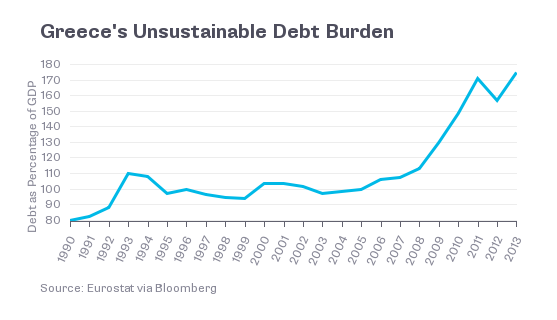
Polls suggest that the opposition Syriza party may win power in Greece; its leader, Alexis Tsipras, wants to unwind government spending cuts to halt what he calls a “humanitarian crisis” in his country. If he does win the prime minister’s job on Jan. 25, the EU will need to take his concerns seriously, recognize that fiscal backtracking is preferable to seeing Greece exit the euro, and concede that the unfortunate solution to the nation’s unsustainable debt is to forgive some of it. …

The EU’s apparatchiks will need to take seriously Syriza’s demands for an easing of Greece’s economic strictures — or risk turning the political drama into an economic crisis. If Greece were to abandon the common currency project, it would call into question the membership credentials of other euro nations. (Note that Portuguese bonds are also taking fright today.)

Danny Vinik also warns of a Eurozone crisis if Syriza wins:

[M]arkets are nervous. Germany has an outsized influence at both the ECB and European Commission, and is determined to use its financial leverage to force Greece to make structural changes to its economy. If Germany becomes determined to hold a hard-line negotiations with the Syriza-run Greek government, the odds of a “Grexit” could rise substantially. Already on Monday, yields on 10-year Greek bonds rose nearly 1 percentage point, to 9.7 percent. That could provoke similar fears in other periphery nations in the Eurozone.

That is all months off. Greek attitudes toward Syriza may shift if the party’s chance of gaining control of the government increases. There may be another political stalemate with parties unable to form a governing coalition. But the risks are realnot just for Europe’s economy, but the world’s.

Yglesias runs down some other possible outcomes:

One can also imagine a scenario in which parties of the far-left and far-right (including the fascist Golden Dawn) gain enough votes that no politically viable coalition is mathematically workable. In that case, well, it’s not really clear what would happen. Something along these lines occurred briefly in 2012 leading to a short-term “caretaker” government of Brussels- and Frankfurt-approved technocrats. That could happen again, or you could have the kind of more severe political crisis that sometimes occurs when a country endures a years-long spell of unemployment over 20 percent.

But Douglas Elliott downplays the potential for a Greek tragedy:

It is quite unlikely that Greece will end up falling out of the Euro system and no other outcome would have much of a contagion effect within Europe. Even if Greece did exit the Euro, there is now a strong possibility that the damage could be confined largely to Greece, since no other nation now appears likely to exit, even in a crisis.

Neither Syriza nor the Greek public (according to every poll) wants to pull out of the Euro system and they have massive economic incentives to avoid such an outcome, since the transition would almost certainly plunge Greece back into severe recession, if not outright depression. So, a withdrawal would have to be the result of a series of major miscalculations by Syriza and its European partners. This is not out of the question, but the probability is very low, since there would be multiple decision points at which the two sides could walk back from an impending exit.

Likewise, Neil Irwin sees no signs of a periphery-wide panic:

[W]hat we’re not seeing is the kind of contagion that was widespread from 2010 to 2012. At that time, any sign that the crisis was worsening in Greece immediately translated, through the financial markets, into greater panic about the much larger European economies of Spain and Italy. … But Greece’s latest troubles don’t seem to be adding much to economic and financial uncertainty beyond Greece. Spanish and Italian bond prices fell a bit Monday and their yields rose a bit, but Spain’s 10-year borrowing costs are now at 1.67 percent and Italy’s at 1.98 percent, much closer to Germany than to Greece.

“A Virtual Work Stoppage”

The New York Post reports that “NYPD traffic tickets and summonses for minor offenses have dropped off by a staggering 94 percent following the execution of two cops — as officers feel betrayed by the mayor and fear for their safety”:

[O]verall arrests [are] down 66 percent for the week starting Dec. 22 compared with the same period in 2013, stats show. Citations for traffic violations fell by 94 percent, from 10,069 to 587, during that time frame. Summonses for low-level offenses like public drinking and urination also plunged 94 percent — from 4,831 to 300. Even parking violations are way down, dropping by 92 percent, from 14,699 to 1,241.

The Post obtained the numbers hours after revealing that cops were turning a blind eye to some minor crimes and making arrests only “when they have to” since the execution-style shootings of Officers Rafael Ramos and Wenjian Liu.

Scott Shackford snarks:

Well, we can only hope the NYPD unions and de Blasio settle their differences soon so that the police can go back to arresting people for reasons other than “when they have to.”

The NYPD’s failure to arrest and cite people will also end up costing the city huge amounts of money that it won’t be able to seize from its citizens, which is likely the real point. That’s the “punishment” for the de Blasio administration for not supporting them. One has to wonder if they even understand, or care, that their “work stoppage” is giving police state critics exactly what they want—less harsh enforcement of the city’s laws.

No doubt police are hoping that citizens will be furious when police don’t do anything about the hobo pissing on the wall in the alley or won’t make the guy in apartment 3b turn down the racket at four in the morning. And they’re probably right to a certain degree. But if they think the city is going to turn into sheer anarchy over the failure to enforce petty regulations, they’re probably going to be disappointed.

Update from a reader:

Nice to see the NYPD are not responding like petty, petulant, spoiled children and have instead taken up a constructive debate over their grievances with the mayor. It would be sad to think that they were so thin skinned as to compromise the integrity of their positions because their soft, touchy-feely side was bruised when the mayor expressed how he cautioned his child in dealing with the police.

Another piles one:

It’s anecdotal, but we went away for Christmas and left the car on the street. At $45, one street-cleaning ticket is cheaper by far than putting it in a garage. Then I changed my return, putting us in line for two tickets. I got back yesterday anticipating a $90 bill—and found nothing on the windshield. Suspecting the wind might have blown the tickets away, I checked online. Zip.

I’m selfishly pleased by that. But if this horseshit “wartime footing” stance by the NYPD union extends even to traffic cops, then the life-and-limb ramifications of minimal law enforcement are appalling. The NYPD is using New York citizens – its bosses, its responsibility, and the folks who pays its salaries – as the ante in its poker match with the mayor. In the past, I’d have expected the citizenry to pretty quickly side with the cops, be it simply out of self-interest. But I think this time the NYPD may have made a bad bet. One of their men killed a man and walked. Then, when even gently criticized, they took the city hostage rather than eat a bite of crow, or even swallow a bite of pride. This time may be different, and I very much hope it will be.

Reality Check

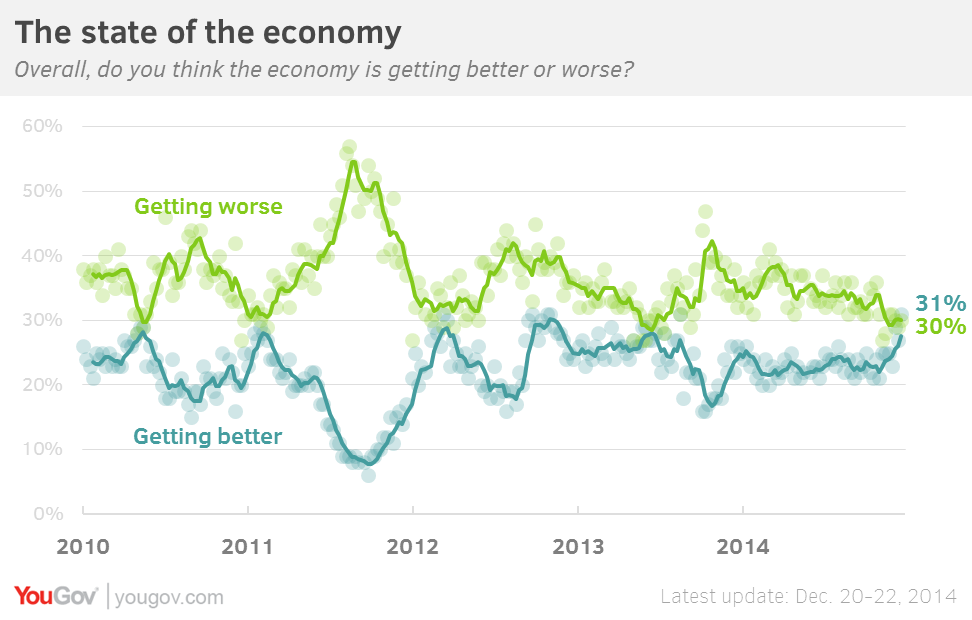
Americans are starting to feel better about the economy:

State Of Economy

Zachary Karabell wonders how the good economic news will affect politics next year:

With rising consumer confidence (not a good proxy for behavior but not a bad snapshot of attitudes) and all economic metrics reflecting stability and growth, it may be that the narrative of failure and coming implosion will weaken in 2015. That will change the landscape for the presidential election campaign. If that campaign pits Hillary Clinton versus Jeb Bush, it might mean a more nuanced (nuance in an election year?) debate about what government can or should do to accelerate and smooth the transition away from a manufacturing economy and towards a service and technology economy.  But it is still hard to see the Republican primaries revolving around anything other than a litany of Democratic economic and national security failures, along with alleged usurpations of power.

After last week’s strong GDP report, Nyhan predicted that Obama’s numbers will improve:

The lesson of history is that Mr. Obama will get credit if growth continues, but we should not be surprised if public opinion lags objective measures of the economy. The political scientists Peter Enns and Gregory McAvoy write, for instance: “For the most part, public opinion does not react instantaneously to changes in economic information. It takes time for economic news to make its way from government reports into news reports so that ordinary citizens can absorb and respond to this information.”

Reihan hopes Republicans will get their act together:

In 2010 and 2014, reminding voters that “we are not currently in charge and things are bad” basically worked for Republicans, particularly with older white voters favorably disposed toward conservative candidates. In the next two years, this strategy is unlikely to work quite so well. It will get harder to deny that the economy is picking up a head of steam, that unemployment levels have gone from high to halfway decent, and that the federal budget deficit is getting smaller. Should Republicans congratulate President Obama on a job well done and leave it at that? Well, no. They need to do what they’ve failed to do for the past half-decade and explain why they can do a better job than the Democrats of steering the American economy.

But Waldman thinks that Republicans are in a bind:

The most important fact of the American economy in the past few decades may be its failure to produce rising wages, but that’s not something Republicans are particularly concerned with. Their economic focus is usually on business owners — the taxes they pay, the regulations they have to abide by, and so on. Even if you believe that helping those owners is the best way to help the people who work for them, you’re going to have a hard time finding Republicans who want to talk about something like wage stagnation.


Lastly, Jordan Weissmann curbs some of the excitement:

What makes this moment of the recovery seem promising is that it looks sustainable. As Matt O’Brien puts it at the Washington Post, the last year of growth hasn’t been the fastest since the recession ended, “but it has been the best.” Namely, it’s being driven by domestic spending, instead of exports (which, given the weakness elsewhere in the world, you can’t always count on), and the housing market hasn’t even fully rebounded yet. I would add that, after years of paying down their debts and buying cars with better gas mileage to deal with fuel prices, consumers are on slightly stronger footing should something unexpected go wrong in the economy, such as another sudden rise in oil prices (you never know).

In short, the U.S. economy is getting hot enough to keep chipping away at the unemployment rate and eventually push up wages a bit—at least until the Federal Reserve feels compelled to raise interest rates. It’s a good place to be. You can call it a comeback. But I wouldn’t hold your breath for a boom.

Dish Awards: The Face Of 2014

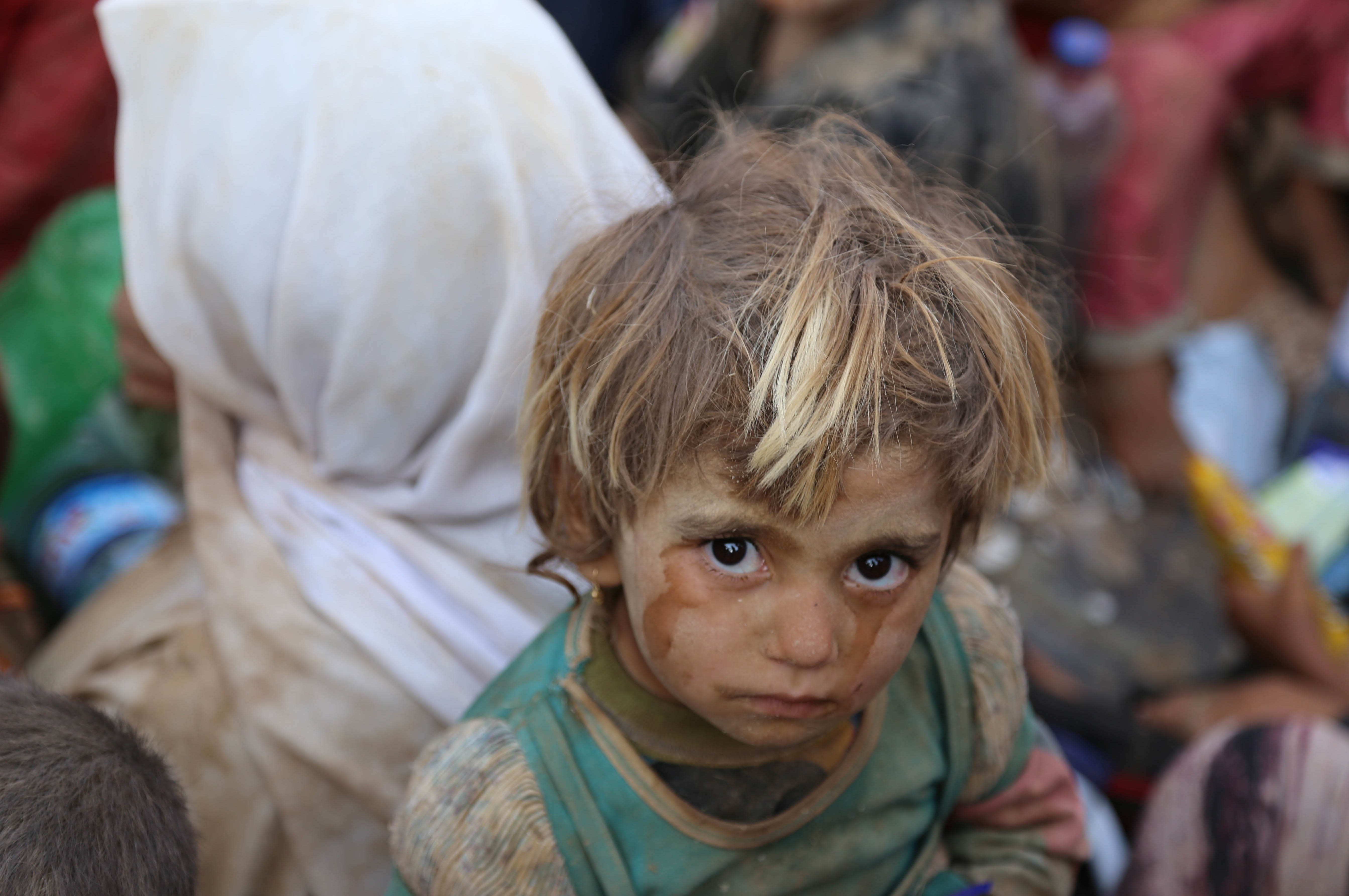
According to the polls, nearly 20% of Dish readers think this Yezidi child, who narrowly escaped ISIS in August, should be our Face Of The Year:

Yezidis trapped in the Sinjar mountains arrive in Syria's Haseki

And almost 14% of readers have chosen this young Ferguson protester instead:

Outrage In Missouri Town After Police Shooting Of 18-Yr-Old Man

But veering away from this year’s big news stories, more than 25% of you seem to agree that the year’s best face is this scene-stealing camel:

Disagree? Cast your vote for any of the above or the other seven candidates here. Then, continue on to our other polls for the 2014 Malkin Award, Hathos Alert, Poseur Alert, and Yglesias Award. Voting also remains open for the year’s best Chart, Mental Health Break and View From Your Window, as well as the 2014’s Coolest Ad, and for the first time ever, Map Of The Year and Beard Of The Year! Our polls will close Wednesday at midnight, so have at it:

Please note: due to there not being enough nominees this year, we will not be issuing a 2014 Hewitt Award, Moore Award, or Dick Morris Award. Learn more about all our awards here. The top two photos in this post are from Getty.

Scalise Should Learn To Google

Louisiana Congressman Steve Scalise, the House whip, has admitted that “he spoke at a gathering hosted by white-supremacist leaders while serving as a state representative in 2002.” Dreher is unimpressed by the excuses:

I think it is possible that Scalise didn’t know what he was getting into when he agreed to appear at this thing, but once you get there and realize that you are at a David Duke event, you leave. Period. There is no excuse for staying there — and it’s impossible to believe that Scalise remained ignorant of Duke’s sponsorship of the event until after he left. Did he send out a press release repudiating the group and saying he had been hoodwinked into speaking there? Doesn’t seem like it.

Do I think Scalise is a white supremacist? No, not at all. But he was insufficiently disgusted by associating with the most notorious racist and anti-Semite in the country. I don’t see how he stays in GOP leadership with this on his record.

Erick Erickson moved out of Louisiana because he was disgusted by David Duke:

By 2002, everybody knew Duke was still the man he had claimed not to be. EVERYBODY. How the hell does somebody show up at a David Duke organized event in 2002 and claim ignorance?

Weigel digs into the story:

Scalise was on the record attacking Duke for that 1999 race. “The novelty of David Duke has worn off,” Scalise told Roll Call‘s John Mercurio. “The voters in this district are smart enough to realize that they need to get behind someone who not only believes in the issues they care about, but also can get elected.”

That phrase—”who not only believes in the issues they care about”—seemed innocuous enough at the time. In 2014, after Scalise has won five easy elections to the House (he took Governor Bobby Jindal’s vacant seat in a 2008 special), it’s being read as evidence that Scalise did not condemn Duke nearly enough.

Ezra weighs in:

Scalise might well have ended up at the David Duke-backed European-American Unity and Rights Organization without knowing who they were or really bothering to find out. He might well have been trying to destroy Duke by questioning his electability rather than his views. But that’s only because he was practiced at appealing to the kind of people who really did support David Duke and really were sympathetic to the European-American Unity and Rights Organization. And, now that Scalise has risen through Louisiana politics to become a nationally influential figure, that’s the problem.

The biggest question for Scalise’s future is whether there’s anything else. Now that Scalise’s speech to EURO has been found, and his comments about David Duke unearthed, political reporters are going to go looking for more. If this is the end of it, Scalise might be fine. If it isn’t, then his career is in jeopardy.

PM Carpenter is enjoying the circus:

One can believe whatever one wants to believe about Scalise’s defense of know-nothingness, but one cannot deny the hilarity of the Washington Post’s magnificent understatement: “The news [of Scalise having addressed a white-supremacist, Neo-Nazi, KKK-associated, David Duke-founded group] could complicate Republican efforts to project the sense of a fresh start for a resurgent, diversifying party.”

Nearly as funny and equally unhelpful to Scalise’s defense is the amicus brief uttered by Iowa’s Rep. Steve King, who blathered to the Post that “Jesus dined with tax collectors and sinners. It’s not the healthy who need a doctor, it’s the sick.” A lofty comparison indeed, however the point of King’s parable is that Jesus knew he was dining with sinners (unless, of course, he was inadequately staffed).

Libya Remains A Bloody Mess

kyhcrE0.0

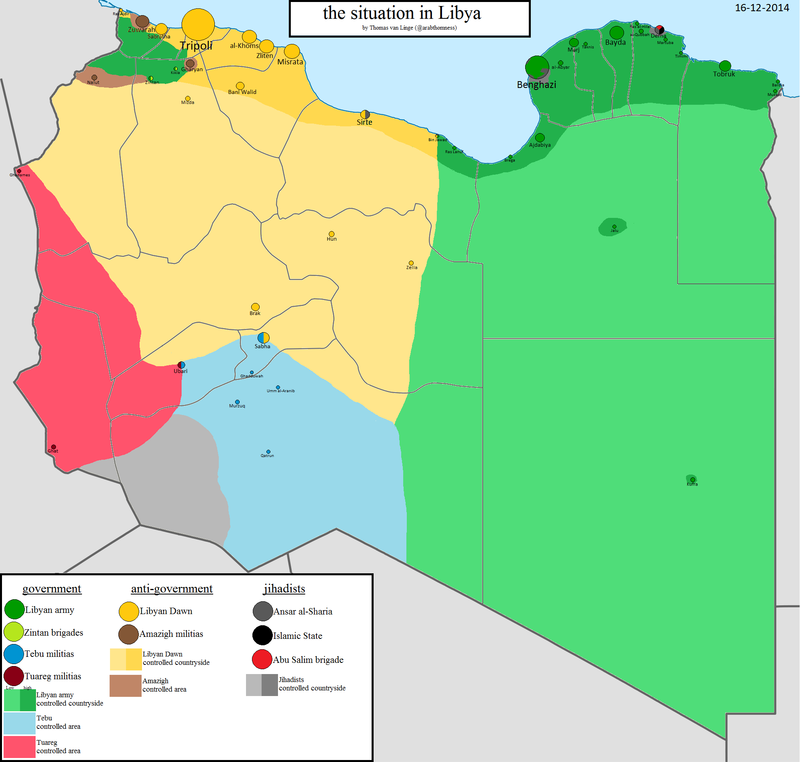
Zack Beauchamp passes along this map from Thomas van Linge, which illustrates the chaotic state of the country as of mid-December:

Libya is divided into two main chunks, but there are many smaller tribal, Islamist, and militia players that complicate the war even further. And it’s been bloody: a December UN report said hundreds of civilians have died since Libya Dawn swept the west in August. The UN claims that it has gotten the warring factions to agree to a peace conference “in principle.” Hopefully, that principle will translate to reality — and fast.

Sunday witnessed the first airstrikes on Misrata—Libya’s third-largest city—in the civil war that has raged since Moammar Qaddafi was deposed three years ago:

Jets under the control of General Khalifa Heftar, a militia commander who was a central figure in Libya’s revolution, fired missiles on Sunday morning at the city’s international airport, just half an hour before a Turkish Airlines flight was due to leave for Istanbul. There were no reports of casualties. The Libyan Air Force jets went on to attack the country’s largest steel plant and an air force academy near the airport, which are under the control of Islamist forces. …

Sunday’s air strikes were in apparent revenge for Christmas Day attacks on Libya’s largest oil terminal at Sidra and on the city of Sirte, in which Islamist militiamen firing rocket-propelled grenades from speedboats killed 22 government soldiers. There were further skirmishes in Sidra on Sunday, in which two Libya Dawn foot soldiers were killed, according to a security official in the port.

Fighting between pro-government and Islamist rebel forces is also ongoing in other parts of the country:

At the same time, recent fighting in the neighbouring Nafusa mountains has left 170 people dead. In addition to the casualties, the fighting has also caused a humanitarian crisis with at least 120,000 people forced to flee their homes, resulting in consequent shortages in both food and medical supplies. Meanwhile, in the eastern city of Benghazi, an uptick in violence has seen 450 people killed since October as residents continue to face shortages in medical care. Moreover, upwards of 15,000 families – some 90,000 people – have been displaced.